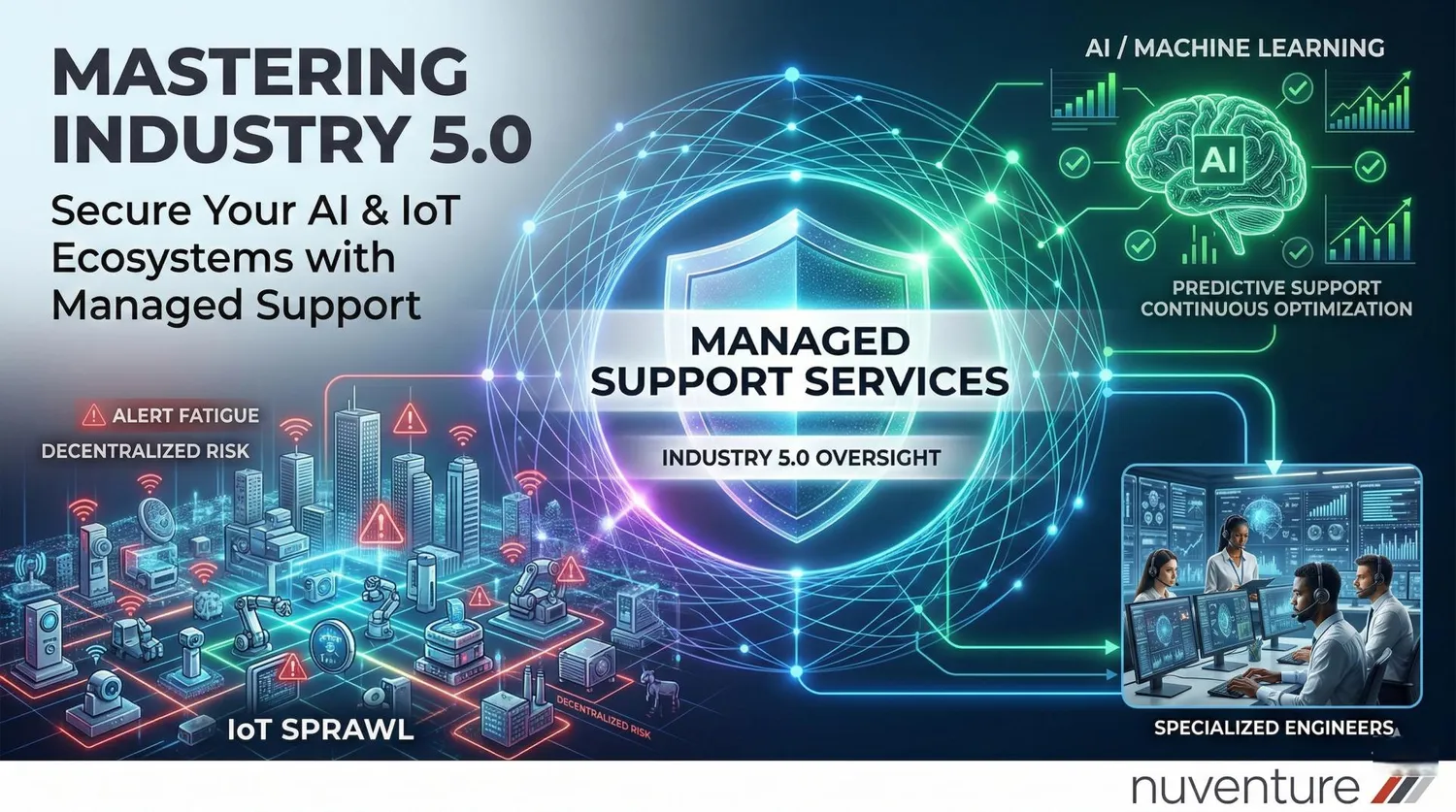
As organizations transition from the automation-focused era of Industry 4.0 to the human-centric, resilient, and sustainable frameworks of Industry 5.0, the definition of IT infrastructure is undergoing a radical transformation. Modern enterprises are no longer simply managing centralized servers and structured databases; they are orchestrating hyper-connected, decentralized ecosystems powered by Artificial Intelligence (AI) and the Internet of Things (IoT).
In this advanced technological landscape, traditional "break-fix" IT maintenance is entirely insufficient. To maintain operational stability across thousands of connected devices and complex intelligent algorithms, forward-thinking enterprises must leverage advanced managed support services specifically designed for the edge-to-cloud era.
The Challenge of "IoT Sprawl" and Alert Fatigue
Deploying an enterprise-grade IoT solution—whether it involves a network of predictive maintenance sensors on a manufacturing floor or biometric performance monitors in a healthcare facility—creates immediate operational complexities. Every new connected device introduces a new data stream, a potential point of hardware failure, and a new network vulnerability.
When an organization scales from a few hundred nodes to tens of thousands of edge devices, internal IT teams quickly become overwhelmed by what is known as "IoT sprawl." This leads to severe alert fatigue, where engineers are buried under a mountain of minor notifications, making it impossible to identify critical system warnings. Managing this sprawl requires a highly structured approach. Dedicated managed support services equipped with certified L2-L4 engineering pods provide the continuous, 24/7 monitoring necessary to track device health, deploy automated firmware updates across the network, and ensure seamless connectivity without straining internal staff.
Shifting from Reactive to AI-Driven Predictive Support
Historically, IT infrastructure support has been a purely reactive discipline: a server crashes, an alert is generated, and a technician works to restore it. However, in an AI-integrated business environment, this paradigm must shift entirely toward proactive resilience.
Modern managed support services utilize machine learning models to continuously analyze the massive volumes of telemetry data generated by IoT ecosystems. By establishing a deeply accurate baseline of normal operations, these monitoring systems can detect micro-anomalies—such as a slight increase in a server’s thermal output, a minor vibration in a smart factory motor, or an unusual latency spike in database queries—long before they cause a critical failure. This enables true predictive maintenance. Support teams can intervene, reroute traffic, or replace failing components in the background, effectively reducing machine downtime to near zero and protecting the user experience.
Securing the Decentralized Edge Network
The integration of AI and IoT fundamentally dissolves the traditional corporate network perimeter. Data is now gathered, processed, and analyzed at the "edge" (closer to where it is generated) before being routed back to hybrid or private cloud environments. While this decentralized architecture drastically reduces latency and bandwidth costs, it also presents a massive surface area for sophisticated cyber threats.
To protect these intelligent ecosystems, infrastructure oversight must include rigorous, uncompromising security protocols. Elite managed support services implement continuous threat hunting, automated access controls, and Zero Trust network architectures across both legacy infrastructure and emerging technologies. Operating under strict ISO-certified and SOC 2 compliance frameworks, these teams ensure that a compromised remote sensor or edge device cannot be exploited as a gateway to access core enterprise data or proprietary AI algorithms.
Sustaining AI Model Accuracy and Data Pipeline Integrity
Implementing an AI solution is not a static, one-time deployment. Machine learning models require continuous tuning, retraining, and an uninterrupted flow of clean data to remain accurate. If the underlying data pipeline experiences latency or corruption, the AI's predictive capabilities rapidly degrade—a phenomenon known as model drift.
Comprehensive managed support services extend beyond simple hardware maintenance; they ensure the health and integrity of the entire data pipeline. By maintaining the cloud architecture that feeds data into the AI, these services ensure that the algorithms continue to deliver actionable, high-fidelity insights. This operational continuity frees up internal data scientists and developers to focus on building new, innovative features rather than constantly troubleshooting pipeline bottlenecks.
Conclusion
As human intelligence and machine automation become increasingly intertwined in Industry 5.0, the underlying technical foundation of any business must be virtually flawless. Integrating specialized managed support services ensures that AI and IoT deployments actually deliver on their promise of amplified efficiency and operational insight. By trusting expert engineers to handle predictive monitoring, edge security, and complex cloud orchestrations, organizations can confidently scale their ecosystems and fully embrace the next industrial revolution.