Nexthermal has spent more than three decades solving one recurring problem on Indian factory floors: unexpected heating failure. In one plastics processing unit in Peenya, Bangalore, a single off-the-shelf heater burnout caused nearly eighteen hours of production downtime, scrapped material, and delayed dispatches. The root cause was not poor maintenance. It was incorrect watt density and an unsuitable sheath material for a high-humidity, voltage-fluctuating environment.
This is where the difference between a generic supplier and an Electric Heating Elements manufacturer with real engineering depth becomes evident.
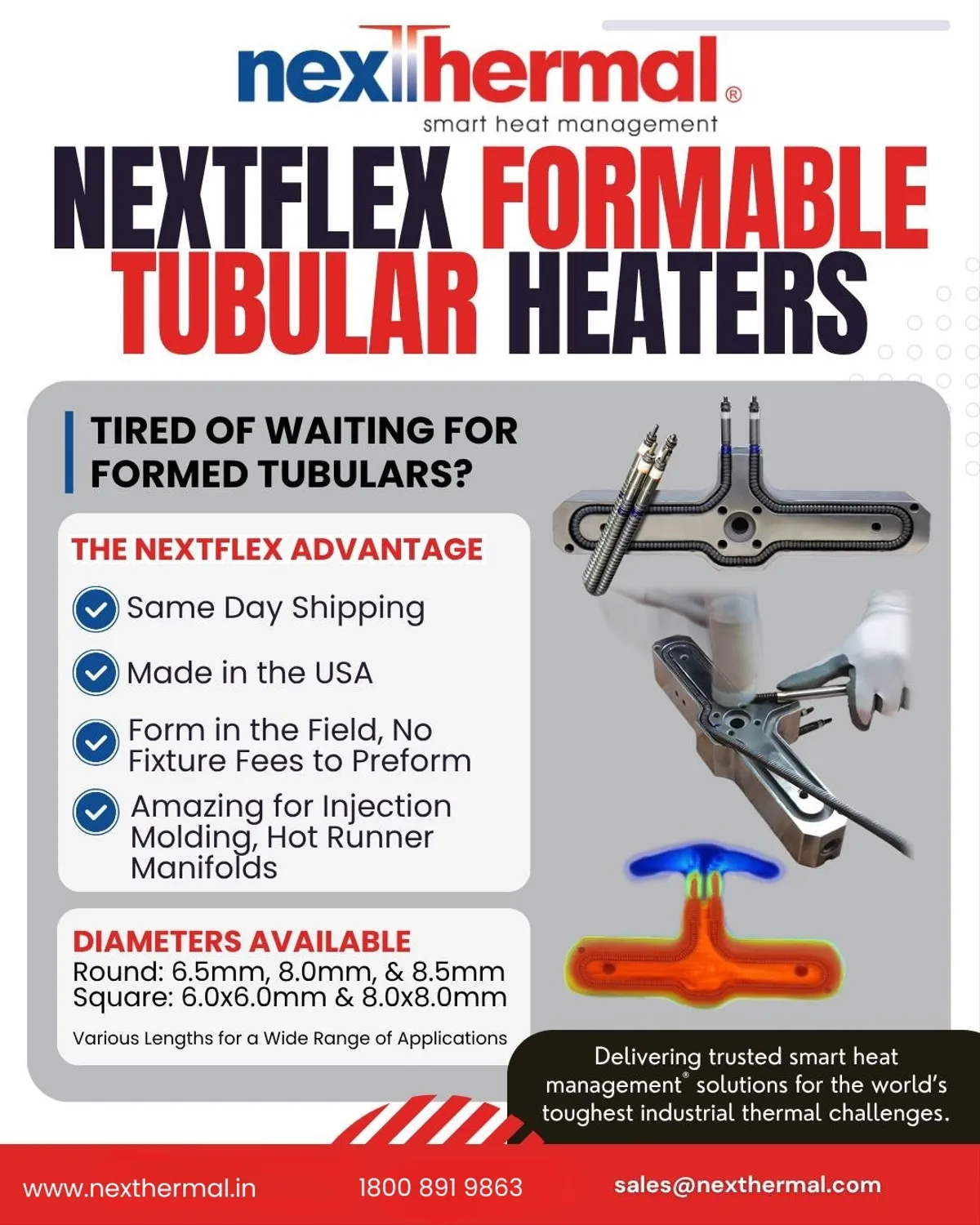
Why Electric Heating Elements Are the Backbone of Industrial Efficiency
Electric heating elements convert electrical energy into controlled thermal energy. On paper, resistance heating looks simple. In real Indian industrial environments, it is anything but simple.
In our thirty years at Nexthermal Bangalore, we have seen heating systems fail not because of mechanical defects, but because they were never engineered for Indian operating realities. Voltage instability, high ambient temperatures, dust, moisture, and continuous twenty-four-hour duty cycles place enormous stress on poorly designed heaters.
A properly engineered heating element directly affects process stability, energy efficiency, equipment lifespan, and final product quality. This is why industries are steadily shifting from catalogue heaters to custom electric heating elements.
What Defines a High-Performance Industrial Electric Heating Element
A high-performance heating element is defined by engineering compatibility with the application, not by cost or availability.
Watt Density Selection
Watt density determines how aggressively heat is generated across the heater surface.
Low watt density in the range of three to six watts per square centimetre is ideal for fluids, oils, and temperature-sensitive polymers.
Medium watt density between eight and twelve watts per square centimetre suits packaging lines and food processing systems.
High watt density from fifteen to thirty watts per square centimetre is required for metal processing, tooling, and rapid heat-up applications.
Using higher watt density than required is one of the most common reasons for premature heater failure across Indian factories.
Sheath Material Selection
Sheath material selection plays a decisive role in heater longevity.
SS304 performs well in dry air and low-corrosion environments.
SS316 is better suited for moisture-rich and mildly corrosive conditions.
Incoloy 800 is preferred for high-temperature and oxidation-prone zones.
In high-humidity regions such as Bangalore, Incoloy consistently outperforms standard stainless steel alternatives.
Thermal Lag and Cold Sections
Thermal lag determines how quickly a heating system responds to temperature changes. Poor cold-section design allows heat to migrate into terminals, causing insulation breakdown, electrical leakage, and early failure. Correct cold-section engineering significantly extends heater life.
Standard Heating Elements vs Custom Engineered Heating Elements
Standard heating elements are designed for broad applications. They typically use fixed watt density, limited sheath options, and generic thermal profiles. Their average lifespan ranges from six to twelve months, with inconsistent temperature stability and frequent maintenance requirements.
Custom engineered heating elements are designed for specific applications. Watt density is matched precisely to the process. Sheath materials are selected based on temperature, humidity, and chemical exposure. Lifespan typically extends from eighteen to thirty-six months. Energy efficiency improves by up to twenty-two percent, and temperature control becomes predictable and stable.
This is why OEMs increasingly choose to work with an industrial electric heating manufacturer rather than component resellers.
Heat Transfer Physics: Why Design Matters More Than Power
Heating performance depends on how heat is transferred, not simply on electrical input.
Conduction dominates in solid-contact heaters such as cartridge heaters. Convection governs immersion heaters and air heating systems. When conduction paths are poorly engineered, surface temperatures rise excessively even when total power appears correct. This accelerates oxidation, insulation degradation, and sheath deformation.
At Nexthermal, heating elements are designed by analysing heat dissipation paths instead of relying on generic resistance calculations.
Custom Electric Heating Elements for Indian Manufacturing
India’s manufacturing growth, supported by the Make in India initiative, demands heating solutions that are energy-efficient, resilient to voltage fluctuations of plus or minus ten to fifteen percent, and capable of continuous operation.
Bangalore has emerged as a major manufacturing and automation hub. Nexthermal has delivered Industrial Heating Solutions India for aerospace tooling units in Peenya, automotive suppliers in Electronic City, and automation OEMs in Whitefield.
Each project required a tailored combination of watt density, sheath material, and temperature control strategy.
The Role of Temperature Controllers in Heating Accuracy
Even the best heating element cannot perform reliably without proper control. This is where industrial temperature controller manufacturers in India play a critical role.
PID control ensures minimal temperature overshoot, faster stabilisation, and reduced thermal stress. Poor PID tuning leads to frequent on-off cycling, increasing thermal fatigue. In field applications, optimised PID tuning alone can extend heater life by twenty to thirty percent.
Precision heaters must always be paired with correctly tuned controllers to achieve long-term reliability.
Cartridge Heaters: Precision Heating in Compact Spaces
Cartridge heaters are widely used in dies, moulds, and compact assemblies. Most failures occur due to improper fitment and insufficient heat dissipation.
Critical design factors include close tolerance fitting, correct watt density selection for bore material, and proper lead exit orientation to avoid mechanical stress. Cartridge heaters engineered for Indian tooling environments demonstrate significantly improved lifespan and thermal stability.
Engineering Services: Where Real Value Is Created
A true Electric Heating Elements manufacturer does more than supply components. It engineers complete thermal solutions.
Engineering services include application analysis, thermal calculations, material compatibility assessment, and failure analysis with redesign. This approach ensures long-term reliability instead of short-term performance.
Certifications and Trust Signals That Matter
Consistent quality comes from controlled systems. Nexthermal operates under ISO 9001:2015 quality standards and follows international safety practices. These systems ensure traceability, repeatability, and consistent heater performance across production batches.
Frequently Asked Questions
How do I choose the right watt density for my heating element?
Watt density depends on operating temperature, medium, and heat dissipation. For most industrial applications, six to twelve watts per square centimetre provides durability without thermal stress.
Which sheath material works best in humid Indian environments?
SS316 and Incoloy 800 perform best in high-humidity and mildly corrosive conditions common in Indian factories.
How do custom heating elements reduce energy consumption?
By matching watt density and heat transfer characteristics to the application, energy losses are reduced, lowering power consumption by up to twenty-two percent.
Why is PID tuning important in industrial heating?
Proper PID tuning prevents overshoot and frequent cycling, reducing thermal fatigue and extending heater lifespan.
What is the expected lifespan of a custom industrial heating element?
With correct engineering and control, custom heating elements typically last between eighteen and thirty-six months.
Contact us
The future of industrial thermal efficiency in India depends on engineering-led heating solutions rather than generic components. As manufacturing processes become more precise and energy-conscious, partnering with an experienced Electric Heating Elements manufacturer becomes essential.
For expert consultation, speak directly with the Nexthermal engineering team.
Technical Consultation: 1800 891 9863
Book a Consultation: https://www.nexthermal.in/
Visit Product Page: https://www.nexthermal.in/cartridge-heater/
Follow us for more industrial insights: Facebook | Instagram | YouTube | Twitter (X)
More Products:
Electric Heating Elements manufacturer | cartridge heating element | coil heaters manufacturer | temperature sensors manufacturer | tubular heaters manufacturer | temperature controller manufacturers | Engineering services provider in india | Ceramic Infrared Heater manufacturer |Temperature Control Panel manufacturer | Heating Coil Element manufacturer | Tubular Heater manufacturer | Temperature Sensors manufacturer | Temperature Controller manufacturer