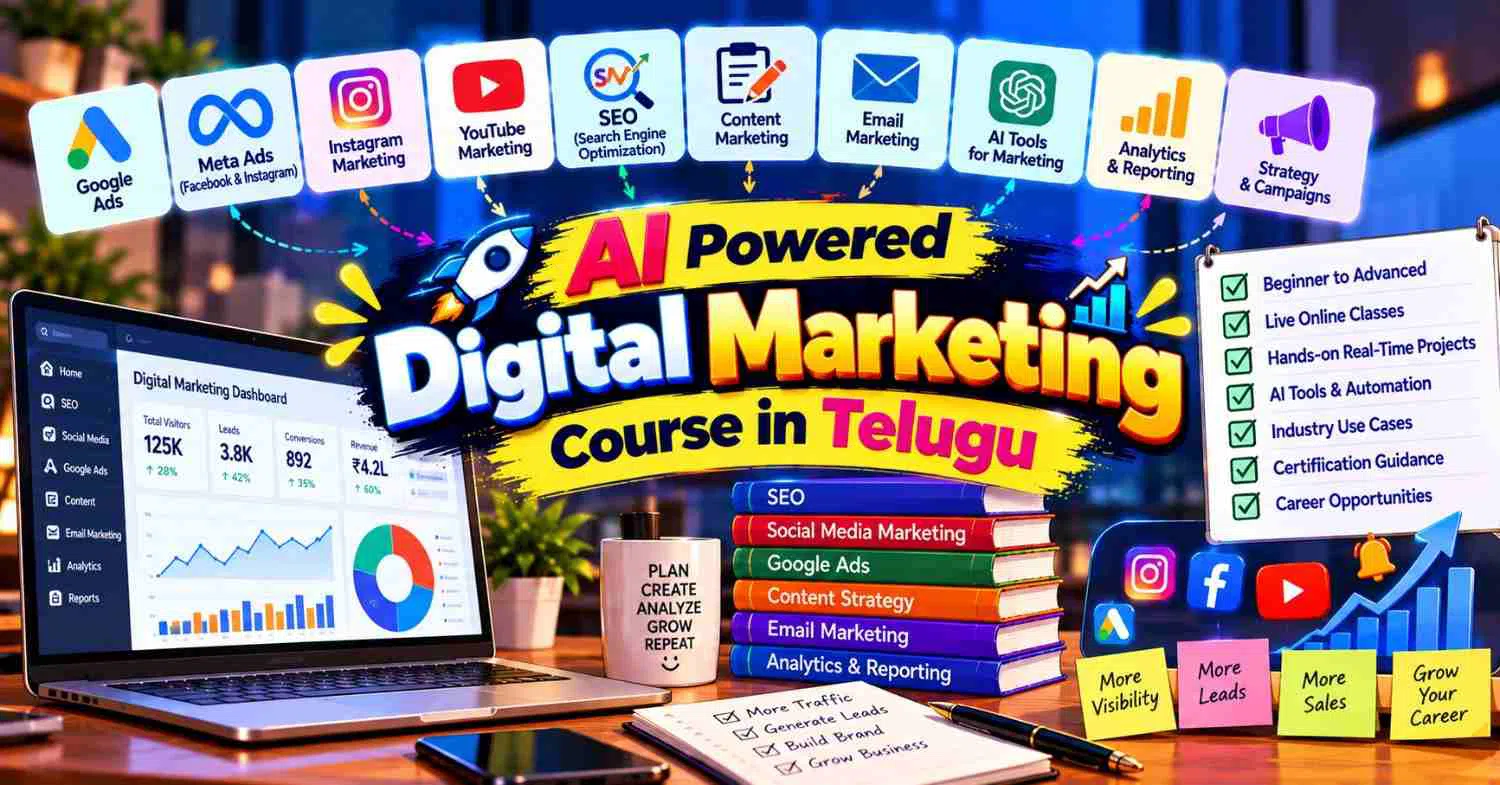
Advertising on Facebook and Instagram can involve thousands of possible combinations of audiences, placements, creatives, and user behaviors. Manually deciding which advertisement should reach each person would be difficult at scale. Meta uses machine learning and automated systems to help predict which ads may be relevant to users and which opportunities align with an advertiser’s objective. In an Ai Powered Digital Marketing Course in Telugu, understanding AI in Meta Ads means learning how automation supports targeting, delivery, creative testing, budgeting, and optimization while marketers continue to control the broader campaign strategy.
AI Helps Decide Who May See an Ad
A Meta advertising campaign begins with an objective and information about the audience the business wants to reach.
Traditionally, advertisers often spent significant time manually narrowing audiences using interests, demographics, locations, and other available targeting options. AI-supported advertising can use campaign information and available signals to help identify people who may be more likely to perform the desired action.
Depending on the campaign setup, relevant signals can include:
User interactions
Previous ad engagement
Audience information
Conversion signals
Campaign objectives
Placement context
Advertiser-provided data
The system can evaluate patterns across these signals at a scale that would be difficult to reproduce manually.
Campaign Objectives Give Automation Direction
AI needs to know what result the advertiser values.
A campaign designed to generate website purchases should not necessarily behave in the same way as one designed to increase video views.
Meta Ads campaigns can be structured around objectives connected with different marketing outcomes. The selected objective helps the advertising system understand what kind of result it should prioritize.
For example, one business may want online sales, while another may want potential customers to submit lead information.
This distinction matters because a large number of clicks does not automatically mean that a campaign is successful.
The useful metric depends on the business objective.
AI Can Support Broader Audience Discovery
An advertiser may have an initial idea of the ideal customer but may not know every characteristic shared by people likely to convert.
Machine-learning systems can use available campaign signals to explore delivery opportunities beyond simple assumptions about an audience.
Suppose an online store sells running accessories.
The advertiser might expect only people explicitly associated with running-related interests to respond. However, conversion patterns could reveal relevant opportunities among users whose broader behavior suggests interest even if they do not fit the marketer’s original assumptions perfectly.
This is where automated audience expansion and AI-supported delivery can become useful.
It allows campaign performance data to contribute to audience discovery rather than forcing every decision to depend on manual targeting.
Creative Optimization Is an Important AI Application
Meta platforms are highly visual, so creative quality strongly influences campaign performance.
Advertisers may provide different images, videos, text variations, headlines, and other assets. Automated systems can help determine how creative elements are delivered across available opportunities.
Generative AI can also assist before advertisements are uploaded.
Marketers can use AI to brainstorm:
Ad headlines
Primary text variations
Video concepts
Image ideas
Different hooks
Calls to action
Product-focused angles
Problem-focused messaging
These suggestions make creative experimentation faster.
However, an AI-generated advertisement should not be published without review. Product claims, pricing, discounts, visual details, and brand language must remain accurate.
AI Makes Creative Testing Easier to Scale
Imagine a marketer promoting an online productivity application.
One advertisement emphasizes saving time. Another focuses on managing deadlines. A third highlights collaboration between team members.
Instead of assuming which message is strongest, the advertiser can test different creative approaches and examine actual performance.
AI-supported delivery can help allocate impressions based on available campaign signals and optimization objectives.
This changes the marketer’s role.
Rather than trying to predict one perfect advertisement before launch, the marketer can develop meaningful creative variations and use performance information to understand which messages connect with the audience.
Automated Placements Expand Delivery Opportunities
Meta advertising can appear across different placements within its available ecosystem.
Manually selecting placements can sometimes be appropriate, but automated placement approaches allow the system to evaluate opportunities across eligible placements according to the campaign setup.
The same advertisement may not perform identically everywhere.
A vertical video may naturally fit one environment better than a landscape creative, while another placement may require different visual consideration.
Marketers should therefore create assets suitable for the environments in which they may appear.
Automation can decide delivery opportunities, but it cannot rescue a creative that is difficult to understand on a mobile screen.
AI Can Assist with Budget Distribution
Budget allocation is another area where automation can play a role.
Suppose a campaign contains several opportunities to reach potential customers. Spending the same amount in every situation may not be the most efficient approach.
Automated systems can use performance signals to influence how budget and delivery are distributed according to the campaign configuration.
For marketers, this reduces some repetitive manual adjustment.
However, automation should still be monitored.
A campaign may generate inexpensive results that appear attractive inside the advertising dashboard but produce low-quality leads or weak business outcomes later.
The lowest cost is not always the highest value.
Conversion Data Helps the System Learn
AI-driven advertising becomes more meaningful when the platform receives useful information about outcomes.
Suppose an e-commerce advertiser wants purchases but tracks only landing-page visits.
The system receives a signal about visitors, not necessarily buyers.
Accurate measurement helps distinguish between people who merely interact with an advertisement and those who complete valuable actions.
Depending on the advertiser’s setup, website and customer-event information can contribute to campaign measurement and optimization.
Marketers should therefore pay close attention to:
Conversion events
Tracking implementation
Event quality
Campaign objectives
Attribution interpretation
Business outcomes
Poor measurement can lead automation toward the wrong result.
Generative AI Can Speed Up Ad Production
Paid social campaigns often require frequent creative refreshes.
An advertisement may perform well initially but become less effective after repeated exposure to the same audience.
Generative AI can help marketers develop new creative directions more quickly.
For example, one product could be presented through a customer problem, product benefit, comparison, use case, question, demonstration, or short story.
AI can produce starting concepts for each angle.
Designers and marketers can then develop the strongest ideas into finished advertising assets.
This workflow uses AI for creative acceleration without handing over brand judgment entirely.
AI Can Help Marketers Analyze Meta Ads Reports
Campaign dashboards contain large amounts of information.
AI-assisted analysis can help marketers organize metrics and identify areas worth investigating.
A marketer might use AI to examine questions such as:
Which campaigns are consuming budget without enough conversions?
Which creatives receive clicks but weak downstream results?
Which campaigns show a rising cost per result?
Where has conversion performance changed?
Which advertisements deserve further testing?
AI can highlight patterns, but marketers must interpret why those patterns exist.
A poor result could come from the creative, audience, offer, landing page, tracking setup, or several factors working together.
Automation Does Not Remove the Need for Strategy
Meta can automate many campaign-level decisions, but it does not automatically understand the complete economics of a business.
A campaign generating 100 leads may appear stronger than one generating 60. If most of those 100 leads are unqualified, the second campaign could actually produce more business value.
In an Ai Powered Digital Marketing Course in Telugu, learners should therefore connect platform metrics with real outcomes.
Human marketers remain responsible for:
Defining campaign goals
Understanding customers
Developing offers
Reviewing creative quality
Setting appropriate budgets
Checking tracking
Evaluating lead or sales quality
Making strategic decisions
AI works best when these inputs are meaningful.
Frequently Asked Questions
FAQ 1: How does AI help with Meta Ads targeting?
AI can analyze available audience, engagement, campaign, and conversion signals to help identify delivery opportunities aligned with the advertiser’s objective.
FAQ 2: Can AI create Facebook and Instagram ads?
Generative AI can assist with headlines, primary text, visual concepts, hooks, and creative variations, but marketers should review all generated material before publishing.
FAQ 3: Why is conversion tracking important in Meta Ads?
Conversion information helps marketers measure meaningful actions and gives automated systems stronger signals about the outcomes the campaign is intended to achieve.
FAQ 4: Can Meta Ads automation replace manual audience research?
No. Automation can support audience discovery, but marketers still need to understand their customers, market, offer, and the quality of results being generated.
FAQ 5: Does a lower cost per lead always mean better AI optimization?
No. Cost per lead measures acquisition cost, not necessarily lead quality. Marketers should evaluate whether those leads ultimately contribute to valuable business outcomes.
Conclusion
AI supports Meta Ads through audience discovery, campaign delivery, creative optimization, placement decisions, budget allocation, conversion-based learning, and performance analysis. Generative AI can also accelerate the production of new advertising ideas and creative variations.
The strongest results depend on the quality of the strategy surrounding that automation. Clear objectives, reliable measurement, useful creatives, relevant offers, and careful analysis give AI better information to work with. Rather than removing marketers from paid social advertising, AI shifts more of their attention toward strategy, experimentation, creative direction, and business-level evaluation.