When done well, email marketing is a terrific digital marketing strategy that can drive a ton of traffic and generate new leads to your website.
In fact, according to several studies, email marketing produces $44 for every $1 spent. If that isn’t a pretty amazing ROI, I don’t know what is!
With email marketing, you can reach your target audience regularly, provide them with personalized offers, and can give them a much needed new reason to visit your website.
There is also a plethora of great automated tools now available to help you not only create your campaigns, but also schedule them, send them, design them, and even troubleshoot them. So now not only is email marketing a great marketing strategy, but the return on investment is even better than before with time-saving tools like these.
So, needless to say, the value of email marketing in your digital marketing campaigns has been proved. But, in order to make sure it brings as much value to your business as it can, you need to be sure your campaigns are optimized.
To do so, you need to monitor the right stats with an email marketing report – something that would look a little like this:
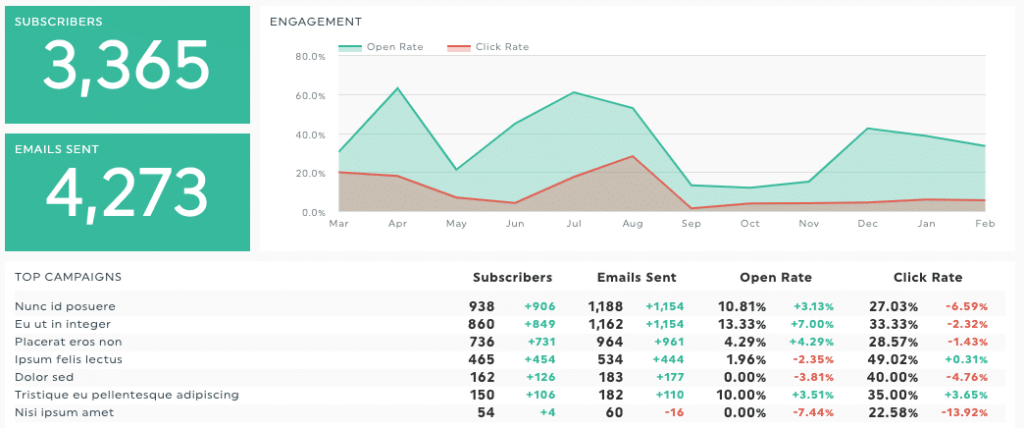
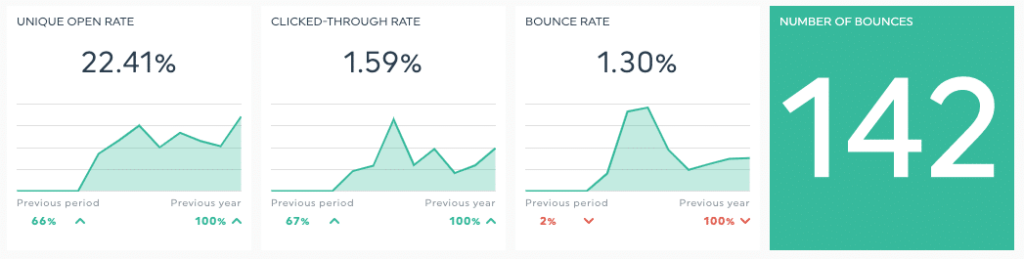
Having a marketing report that’s tracking the right email marketing KPIs is of the utmost importance, since it allows you to make sure that not only are your emails being opened, but also that you get the traffic, conversions, and sales that you were aiming for.
Without proper tracking, your email campaigns can become nothing less than a monumental waste of time; even worse, they can have a negative effect by increasing your unsubscribe rate, as we will see a little further in this article.
Tracking your different KPIs gives you a much better chance of determining what’s bringing your strategies down, and what’s working best. Therefore giving you time to adjust your campaigns, tweak different things like your subject lines, your call to action, your email design, your segmentation, and more.
So create your marketing report right now, and include these 7 essential email marketing key performance indicators to get the most out of your email campaigns.
1. Number of subscribers
This email marketing metric tells you the number of people who have opted in to receiving promotional or marketing emails from you.
Fundamentally, it’s a measure of how many potential eyeballs will see your email marketing efforts, so monitoring your list growth rate (the number of new subscribers and your unsubscribe rate) can be a gauge of the level of interest in your products or services.
You want to keep your number of subscribers as high as possible and ensure a low churn rate. Also keep this number in mind when you do campaigns to gain new subscribers for your newsletter, contests, or other marketing efforts to grow your subscriber list.
2. Open rate
The open rate tells you how many people on your email list opened a campaign email you sent out.
There are a few things that affect email open rates, such as the bounce rate, subject line of the email, the relevance of the email to your target audience, or whether the emails are landing up in the spam folder instead of the inbox.
So, needless to say, this is one of the most important metrics to track in order to optimize your campaigns. If you see your open rate declining, you’ll want to investigate a bit further and fix any issues.
3. Click-through rate (CTR)
This important metric measures the total number of subscribers who clicked a link in one of your emails.
There are two types of click-through rates you can measure:
- Total click-through rate
- Unique click-through rate
It’s generally best to focus on the unique click-through rate, which measures the number of people who clicked on links, rather than the total number of clicks an email has received. After all, what you really want to know is how many people were attracted by your email or offer, not how many times they clicked on it.
4. Number of email bounces
Bounces have to do with email deliverability – an email “bounces” when it’s not able to be delivered to a recipient for some reason or another. There are two kinds of bounces: hard bounces and soft bounces.
Hard bounces occur when there’s no possible way for the email message to be delivered, such as when the email address no longer exists.
Soft bounces, on the other hand, mean there’s just a temporary reason for non-delivery, such as when the recipient’s inbox is full.
You’ll want to ensure good email list hygiene and delete email addresses that result in a hard bounce.
5. Website traffic
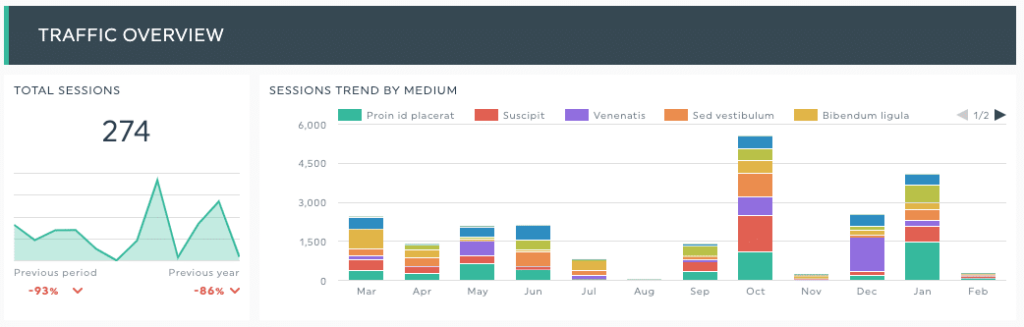
Email marketing is just one piece of the puzzle – you need to monitor how all your marketing channels, from SEO to social media, affect one another by tracking important metrics in Google Analytics and social media analytics tools.
Ultimately, the goal of an email marketing strategy, apart from lead generation, is to bring in website traffic and conversions. Tracking how your email marketing campaigns are affecting web traffic with dashboards tracking Google Analytics data is a simple and effective solution for ensuring you’re getting optimal results.
Make sure you’re tracking not only your overall traffic, but your traffic by medium, as well as a month-over-month or year-over-year comparison, to really see the trends.
6. Number of unsubscribes
The unsubscribe rate shows you how many people have unsubscribed from one of your email marketing campaigns.
Of course, your number one goal is to retain your subscribers as much as possible. To do so, you should investigate some of the possible reasons for an increase in the number of unsubscribes, such as sending emails too frequently or presenting irrelevant content.
Thank you for reading this part of the article! To read full version and discover what tool you can use to track the KPIs click here!