Introduction
The software industry is changing rapidly, but one skill continues to remain valuable across every company and every technology stack—Data Structures and Algorithms (DSA). Whether you're a college student preparing for campus placements or a working professional planning a career transition, strong Java DSA skills can significantly improve your programming ability and career opportunities.
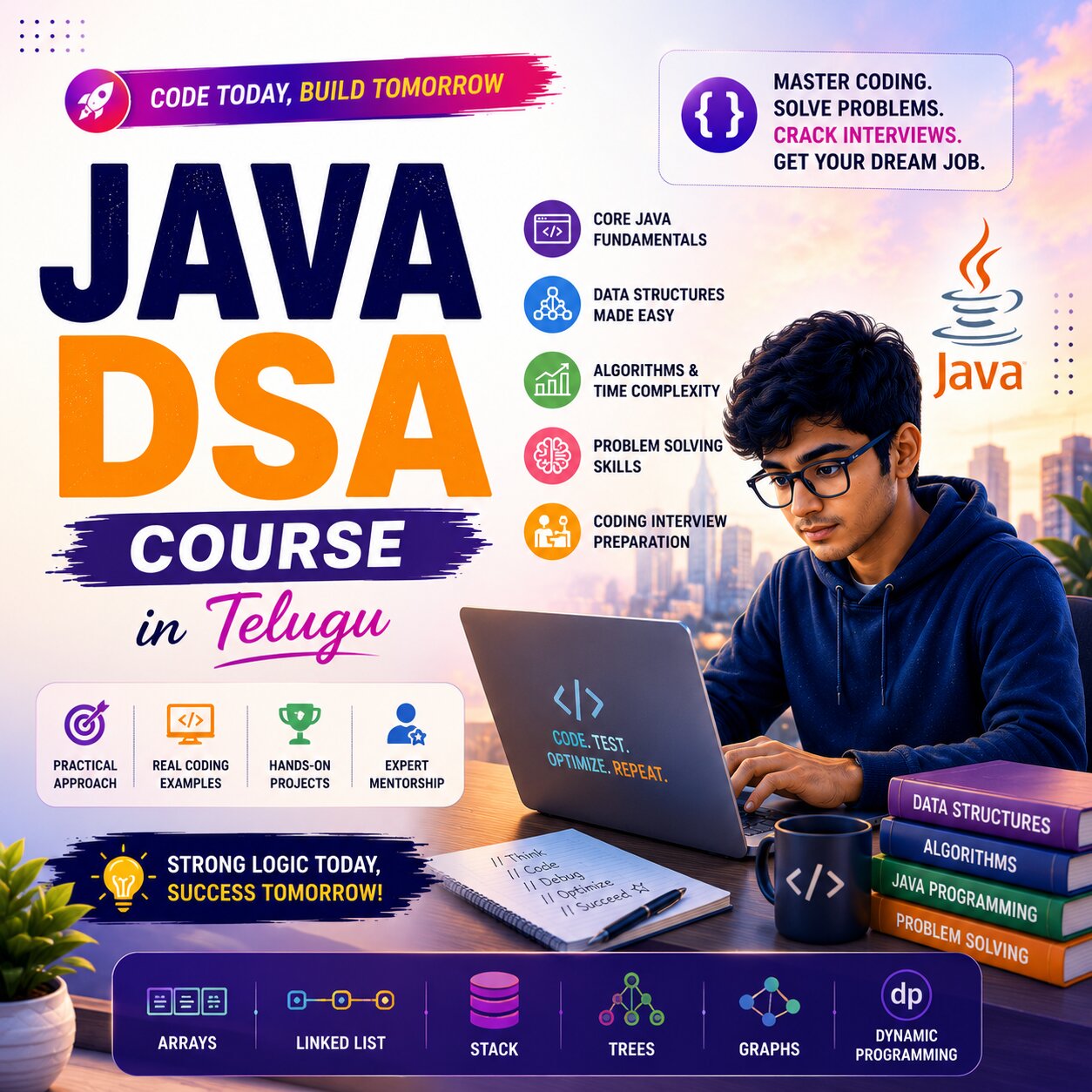
Many learners assume DSA is only useful for coding interviews. In reality, it plays an important role in building scalable applications, improving software performance, solving business problems, and writing efficient code. Students benefit by building a strong programming foundation, while experienced professionals use DSA to prepare for product-based companies, internal promotions, and advanced technical roles. A Java DSA Course in Telugu offers structured learning that suits both beginners and experienced developers through practical coding, projects, and interview-oriented exercises.
Why Students Should Learn Java DSA Early
College is the best time to build programming fundamentals.
Learning DSA early helps students:
- Improve logical thinking.
- Perform better in coding contests.
- Prepare for placements.
- Build stronger projects.
- Understand programming deeply.
- Solve interview questions.
- Gain confidence.
- Develop long-term coding skills.
A strong foundation makes learning advanced technologies much easier later.
Why Working Professionals Benefit Too
Experienced developers also gain significant advantages by strengthening DSA.
Professionals use Java DSA to:
- Switch companies.
- Prepare for product companies.
- Improve coding efficiency.
- Handle larger projects.
- Learn System Design.
- Improve debugging.
- Optimize applications.
- Increase technical confidence.
Continuous improvement helps developers stay competitive throughout their careers.
A Real Career Example
Consider two software developers with similar work experience.
One focuses only on frameworks.
The other regularly practices Java DSA while improving problem-solving skills.
When both attend technical interviews for senior roles, the second developer performs better because they can:
- Analyze complex problems.
- Optimize solutions.
- Explain algorithms.
- Discuss scalability.
- Handle coding rounds.
- Solve unfamiliar challenges.
Strong DSA knowledge creates a noticeable professional advantage.
A Learning Roadmap for Everyone
Students and professionals can follow a structured learning path.
Recommended progression:
- Core Java.
- Object-Oriented Programming.
- Arrays.
- Strings.
- Linked Lists.
- Trees.
- Graphs.
- Dynamic Programming.
Following this sequence develops strong programming ability gradually.
Practical Skills Developed
Java DSA strengthens several workplace skills simultaneously.
Learners improve:
- Coding logic.
- Debugging.
- Algorithm design.
- Complexity analysis.
- Code optimization.
- Problem-solving.
- Communication.
- Technical confidence.
These skills remain valuable regardless of experience level.
Common Challenges
Every learner encounters obstacles while studying DSA.
Typical challenges include:
- Finding study time.
- Understanding recursion.
- Maintaining consistency.
- Solving difficult problems.
- Avoiding frustration.
- Improving coding speed.
- Debugging efficiently.
- Revising regularly.
Small daily improvements are more effective than irregular long study sessions.
Practical Projects
Building projects reinforces DSA concepts.
Useful applications include:
- Banking software.
- Student portal.
- Inventory management.
- Hospital management system.
- Library application.
- Contact manager.
- Expense tracker.
- Task scheduler.
Projects help learners connect theory with practical implementation.
Growing Beyond Java DSA
After building strong DSA fundamentals, learners can confidently explore Backend Development, Spring Boot, Cloud Computing, Artificial Intelligence, Microservices, and System Design. Strong programming foundations make learning these advanced technologies significantly easier.
Conclusion
Java DSA is valuable for both students beginning their programming journey and working professionals aiming to advance their careers. Strong Data Structures and Algorithms knowledge improves logical thinking, coding efficiency, interview performance, and software development capabilities. By practicing consistently, solving real coding problems, and building practical projects, learners develop skills that remain valuable throughout their careers. A Java DSA Course in Telugu provides structured guidance, practical coding exercises, and industry-focused learning that helps students and professionals confidently achieve their software engineering goals.