Introduction
The future of software development will depend heavily on scalable, distributed, cloud-based, and intelligent applications. As organizations continue to adopt digital technologies, software engineers need to understand how to design systems that can adapt to changing requirements and increasing workloads.
Future-ready software architecture is not limited to selecting the latest technology. It involves understanding fundamental architecture principles, scalability, reliability, maintainability, security, and the trade-offs involved in technical decisions.
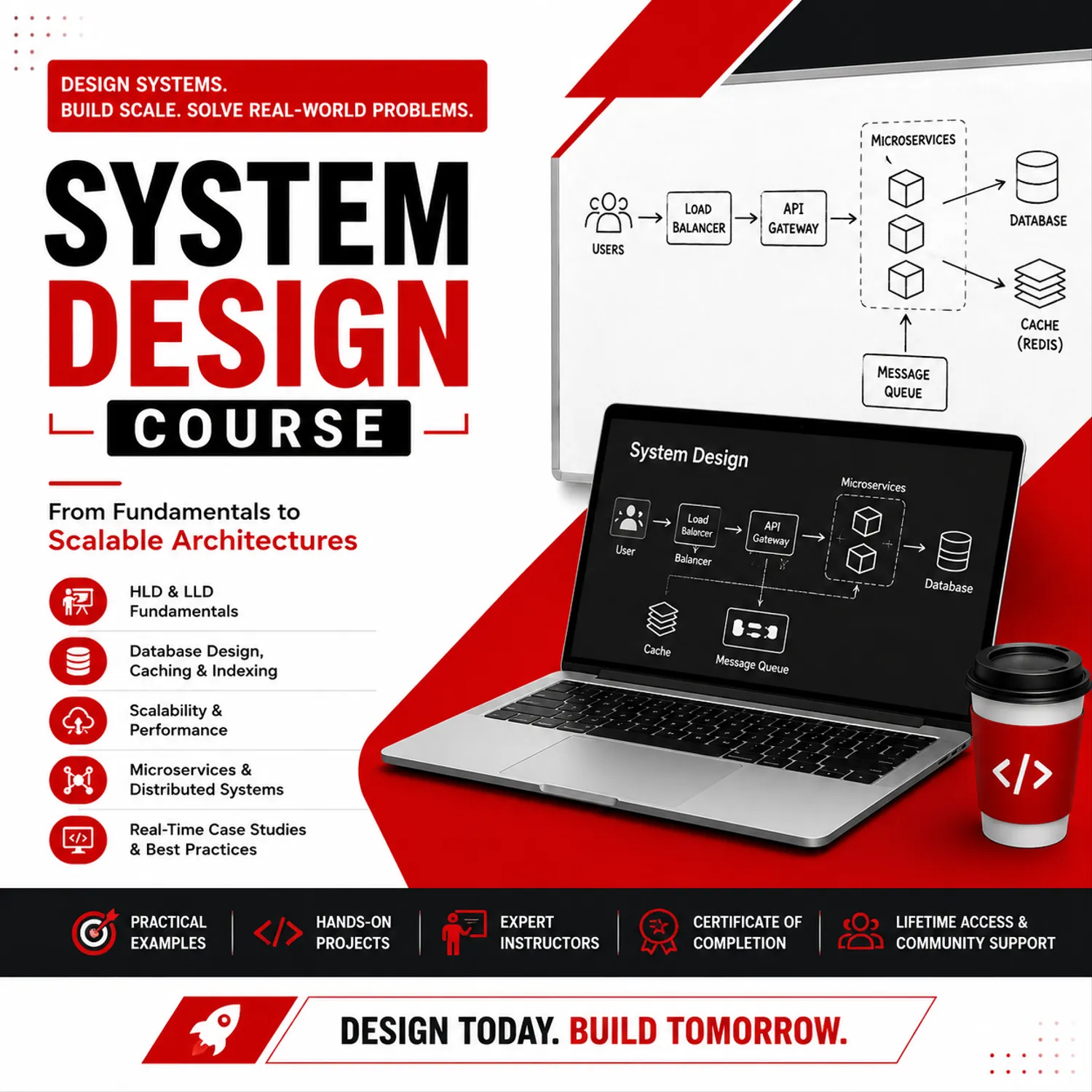
A System Design Course helps software professionals build these skills through structured learning, practical projects, real-world case studies, and modern architecture concepts.
Build a Strong Foundation
Future-ready architecture begins with strong fundamentals.
Students learn about clients, servers, APIs, databases, networking, storage, and communication patterns.
These concepts remain important even as technologies evolve.
A strong foundation allows engineers to adapt to new tools and platforms more easily.
Learn Scalable Architecture
Applications must be able to support growth.
Students learn horizontal scaling, load balancing, caching, replication, partitioning, and auto-scaling.
These techniques help systems handle increasing traffic without major performance problems.
Understand Cloud and Distributed Systems
Cloud platforms have changed how applications are developed and deployed.
Students learn how cloud infrastructure can provide flexible computing, storage, networking, and database resources.
They also explore distributed systems and microservices that allow large applications to operate across multiple services and machines.
Develop Reliable Systems
Future-ready systems must remain available even when individual components fail.
Students learn redundancy, fault tolerance, retries, timeouts, health checks, and graceful degradation.
These techniques help create systems that can recover from unexpected problems.
Focus on Maintainability
A system should not only work today; it should also be easy to modify in the future.
Students learn modular architecture, clean interfaces, reusable components, and design patterns.
These principles make applications easier for engineering teams to maintain and extend.
Learn Security Considerations
Security is an important part of modern architecture.
Students understand basic concepts such as authentication, authorization, secure API communication, access control, and data protection.
Including security considerations during the design stage helps reduce future risks.
Practice Future-Oriented Projects
A System Design Course can include projects based on modern applications such as:
- Cloud-based E-commerce Platforms
- Real-Time Communication Systems
- Streaming Applications
- Online Financial Platforms
- Large-Scale Social Applications
These projects help learners apply architecture principles to realistic scenarios.
Develop Continuous Learning Skills
Technology changes quickly, so software engineers must continue learning.
Strong System Design fundamentals make it easier to understand new technologies because engineers can evaluate them based on architecture requirements rather than simply following trends.
This creates a foundation for long-term professional growth.
Career Opportunities
Future-ready architecture skills can support career progression toward:
- Software Engineer
- Backend Engineer
- Senior Software Engineer
- Technical Lead
- Solutions Architect
- Software Architect
Conclusion
Future-ready software architecture requires a balance of strong fundamentals, modern technologies, scalability, reliability, security, and maintainability. Engineers who understand these principles can adapt to changing technologies and contribute effectively to complex software projects.
A System Design Course provides practical training in HLD, LLD, distributed systems, cloud architecture, scalability, databases, and modern design techniques. By developing these skills, software professionals can prepare themselves for advanced engineering roles and long-term career growth.