Sintering is the process by which fragile molded metal powders are transformed into compact, strong, and precise parts through careful heating control. An essential process in metal injection molding, it allows for the production of parts with near-theoretical density and highly complex designs and creates minimal waste. Sintering is the conjoiner of strength, efficiency, and sustainability, a prime candidate in producing high-performance components for aerospace, automotive, medical, and several other advanced engineering applications.
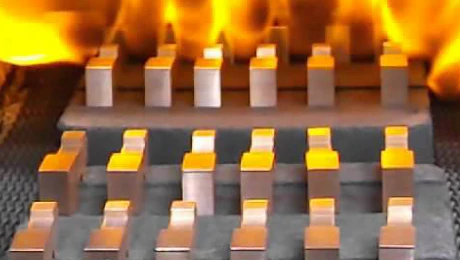
Sintering is a silently critical process in producing various modern-day products. Sintering means compacting and heating powdered material, most typically metal or ceramic, below the melting point to produce a solid, remarkably durable structure. Now, there is far more to MIM Sintering than that! Sintering results in some pretty awe-inspiring effects.
These effects are achieved via precise control over time and temperature so that at the microscopic level the individual powder particles bond together. During the transition, the structure gains strength, dimensional accuracy, and mechanical strength while avoiding full melting. Hence, sintering manufacturers complicated and high-performance components with minimal material wastage and good repeatability.
A Critical Phase in Metal Injection Molding
The Sintered Metal Parts in Metal Injection Molding (MIM) are the heart of this process. After the metal powders are mixed with a binder and injection molded for a desired shape, the formed part (called the "green part") stays too fragile for any action until sintering solidifies it.
During the first part of the operation, it is heated in a furnace until the binder is removed under controlled atmospheric conditions so that the powder particles merge, shrink, and densify, typically approaching 98% theoretical density. Thus, the resulting part, when finished, is virtually indistinguishable from machined or cast parts, with vastly superior design freedom and material efficiency.
Precision Engineering at Its Finest
The ability of sintering to produce parts to extremely tight tolerances with fine features is among its best attributes. The engineers can design components with intricate geometry, inside channels, and micro details that are difficult, if not impossible, with subtractive techniques.
Due to predictable and uniform powder behavior during sintering, manufacturers are very accurate in their ideas about shrinkage and dimensional change. Particularly, important because accuracy is anything but optional; it is mission-critical in aerospace, automotive, and medical applications.
Material Versatility and Customization
Sintering applies to diverse materials—from stainless steels and low-alloy steels to titanium and even to ferromagnetic alloys. Manufacturers can optimally match powder composition, grain size, and environment during sintering for the required application to give the part features such as hardness, corrosion resistance, strength, and porosity.
For example, under high stress, sintered parts would be engineered for added fatigue resistance. Controlled porosity becomes a plus in filtration systems. All these give the process maximum leeway in solving practical design problems.
The Sustainability Advantage
Sintering is not conventional machining, which entails carving material off a solid block; sintering begins with what is needed, and not much else. This drastically reduces raw material waste, conserves energy, and, in many cases, permits excess powders to be reused. Lean manufacturing, by definition, fits within present-day sustainable development goals without compromising performance.
Explore the possibilities of sintering technology—where strength meets precision, and innovation is forged in heat.