A student may attend classes regularly but struggle to complete assignments. Another may perform well in early assessments but gradually stop participating in online learning activities. Without organised academic information, these changes can be difficult for faculty members and administrators to identify early.
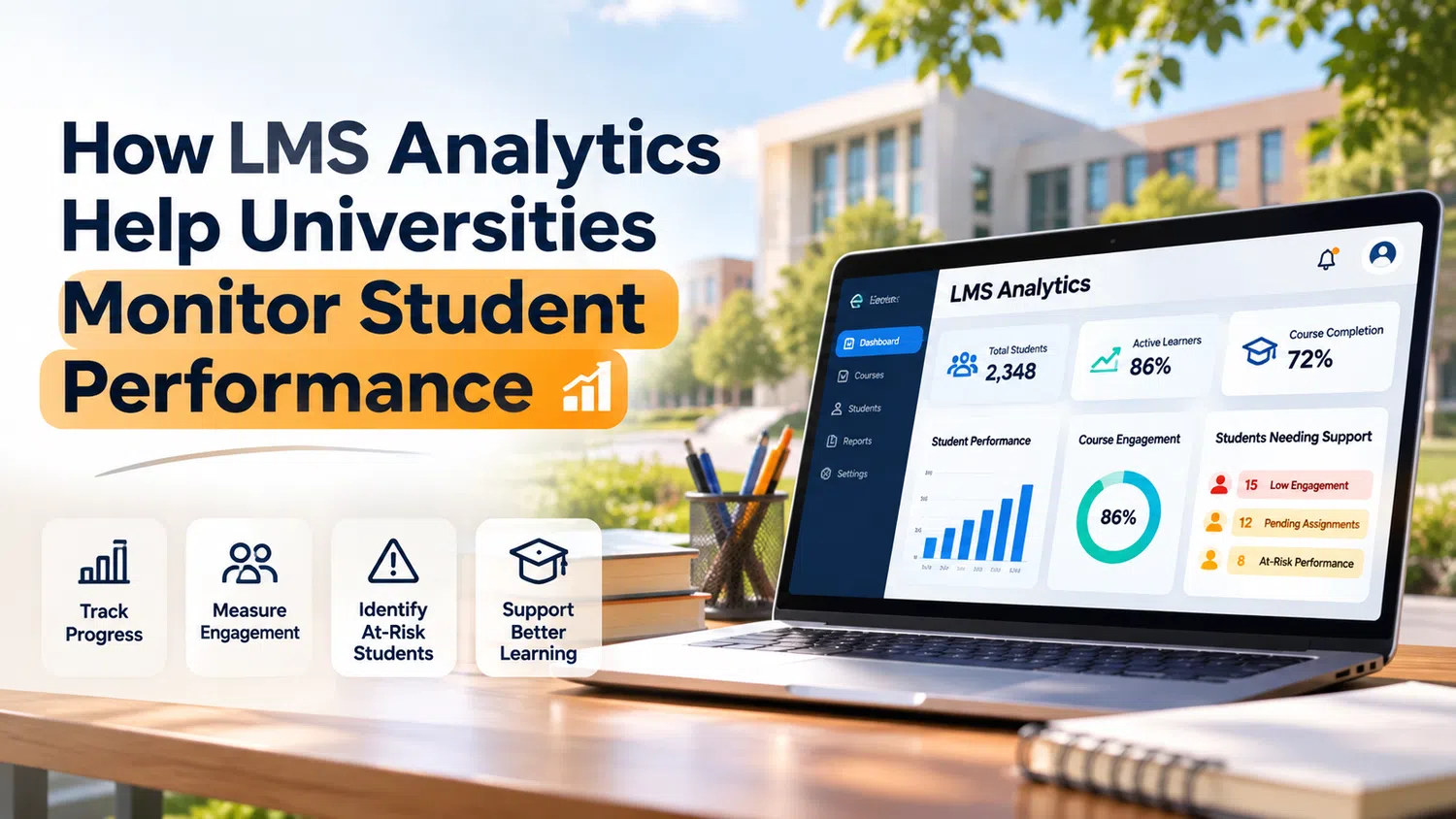
This is where Learning Management System (LMS) analytics becomes useful. By bringing together information about course participation, attendance, assessment results and learning progress, an LMS can help educational institutions understand how students are engaging with their courses and identify areas where additional academic support may be needed.
What Are LMS Analytics?
LMS analytics refers to the collection and analysis of learning-related data generated through a Learning Management System. It helps institutions understand student participation, course engagement, assessment performance and learning progress through reports and dashboards.
Instead of reviewing separate spreadsheets and academic records, faculty and administrators can use an LMS to access relevant learning information in one place.
The purpose is not simply to collect student data. It is to help educators understand learning patterns and make informed academic decisions.
Why Are LMS Analytics Important for Universities?
Universities manage large numbers of students, courses, departments and assessments. Tracking every student's academic progress manually can become difficult, particularly when information is spread across different systems.
LMS analytics can help institutions:
Monitor student participation in online courses.
Review assignment submissions and completion rates.
Understand assessment performance.
Identify students who may need additional academic support.
Compare course and batch-level learning progress.
Generate reports for academic review and planning.
These insights can help faculty members respond to learning difficulties before they become more serious academic concerns.
7 Important LMS Analytics Features for Student Performance Tracking
1. Student Progress Tracking
Progress tracking helps faculty understand how much of a course or learning module a student has completed. It can show completed lessons, pending activities and learning milestones.
This information helps educators identify students who may be falling behind and determine whether additional guidance is required.
2. Attendance and Participation Reports
Attendance and participation information can help institutions understand whether students are consistently engaging with their academic activities.
When attendance records are considered alongside assessment performance and course participation, faculty can get a broader view of student engagement.
3. Assignment Submission Tracking
Assignment tracking allows faculty members to review submission status, identify pending work and monitor completion patterns.
Repeated late submissions or missed assignments may indicate that a student needs clarification, additional guidance or academic support.
4. Assessment and Quiz Performance Analysis
Assessment analytics helps educators review quiz results, test scores and patterns in student performance.
For example, if many students perform poorly on a particular topic, faculty may need to revisit that concept or provide additional learning materials.
5. Course Engagement Reports
Course engagement reports can show how students interact with learning materials, lessons and activities.
These insights may help faculty understand which resources students use and where participation is declining. However, activity data should be interpreted carefully because logging in frequently does not automatically mean that a student understands the subject.
6. Faculty and Course-Level Reports
LMS dashboards can help faculty and administrators review performance across different courses, subjects and student groups.
This makes it easier to identify subjects that require attention and understand whether course delivery or learning materials need improvement.
7. Early Identification of Students Who Need Support
When multiple indicators are reviewed together, institutions may identify students who could benefit from early academic intervention.
For example, declining assessment scores combined with incomplete assignments and reduced participation may indicate a potential learning difficulty.
These indicators should be used to guide conversations and provide support, not to label students or make decisions automatically.
How LMS Analytics Help Identify At-Risk Students
Identifying students who may need academic assistance requires more than looking at a single test score.
An institution can consider multiple indicators, such as:
Repeatedly missing assignment deadlines.
Declining assessment performance.
Incomplete course modules.
Reduced participation in learning activities.
Irregular attendance.
Lack of progress across multiple subjects.
When these patterns appear together, faculty can review the student's situation and decide whether additional support is appropriate.
For example, a faculty member may arrange a discussion, provide additional learning resources or recommend academic mentoring.
The final decision should involve educators and relevant student support teams rather than relying entirely on automated analytics.
How Universities Can Use LMS Data to Improve Teaching
LMS analytics is useful not only for monitoring students but also for improving teaching practices.
If a large percentage of students struggle with the same lesson, faculty can review the teaching materials and assessment approach. They may introduce additional examples, recorded explanations or practice exercises.
Similarly, course-level reports can help academic administrators understand participation patterns across departments and identify areas where faculty training or curriculum improvements may be useful.
This creates a more informed approach to academic planning.
What Should Universities Consider Before Choosing an LMS Analytics Platform?
Not every LMS provides the same reporting capabilities. Universities should evaluate the platform based on their academic requirements.
Important considerations include:
Student-level and course-level performance reports.
Attendance and assignment tracking.
Assessment analytics.
Faculty and administrator dashboards.
Role-based access to student information.
Data security and privacy controls.
Exportable academic reports.
Mobile accessibility.
Integration with existing academic systems.
Institutions should also check whether reports are easy to understand and whether faculty members can use the information without requiring advanced technical knowledge.
For a wider overview of institutional requirements, explore this guide on LMS software for institutions.
The Role of AI in LMS Analytics
Artificial Intelligence can extend the capabilities of learning analytics by helping institutions identify patterns across larger amounts of academic information.
Depending on the platform's capabilities, AI-supported features may help analyse learning activity, identify possible performance concerns and recommend relevant learning resources.
However, AI-generated insights should be treated as decision-support information. Student circumstances, teaching context and faculty observations remain important when deciding what support a student needs.
Universities should also evaluate how student data is collected, protected and used before adopting AI-supported learning tools.
Explore MH Cognition's Learning Management System
MH Cognition provides an AI-led Learning Management System designed to support course management, learner progress tracking and learning activities.
For educational institutions looking to organise digital learning and monitor academic progress, an LMS can provide a more structured way to manage learning information.
Explore LMS solutions from MH Cognition and read more about Learning Management Systems in education.
Universities can also refer to the guide on choosing an LMS for universities to understand the important considerations when evaluating a platform.
Conclusion
LMS analytics helps universities understand student participation, assessment performance and course progress through organised learning information. By reviewing these indicators, faculty members can identify students who may need additional support and make more informed teaching decisions.
The real value of LMS analytics is not simply collecting reports. It is using relevant information to improve teaching, support students and strengthen academic planning.
Universities should choose an LMS that provides useful reporting capabilities, protects student information and supports the institution's academic requirements.