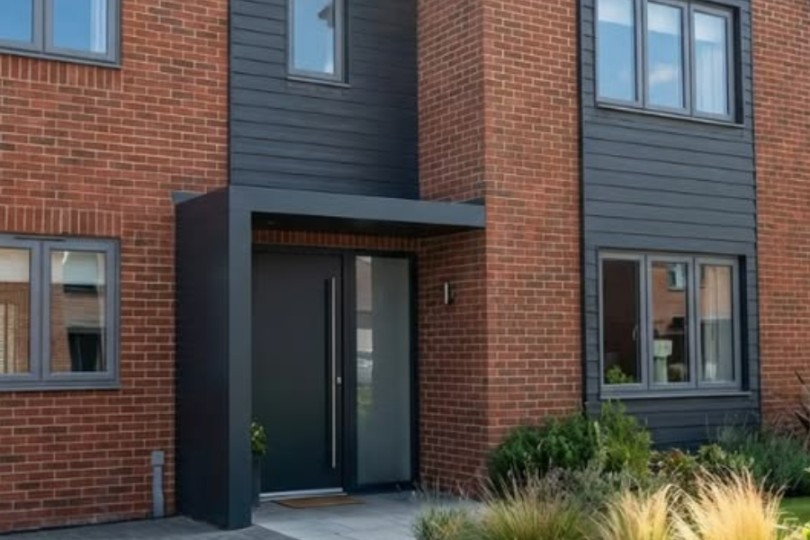
One Country, Six Weather Challenges, One Canopy to Handle Them All
The UK has a reputation for bad weather, but "bad weather" undersells the complexity. The weather is not just bad. It is varied, persistent, and regional. The driving horizontal rain that batters a west-facing door in Cornwall is a completely different challenge from the light but relentless drizzle that mists an entrance in Manchester. The salt-laden gales that hit a coastal property in Norfolk have nothing in common with the still, frosty mornings that ice up a threshold in the Cotswolds. And the intense summer UV that bakes a south-facing door in Essex behaves differently from the diffuse, low-angle light that reaches a north-facing entrance in Scotland.
A door canopy that works perfectly in one location may underperform in another. A shallow canopy that provides adequate shelter in a sheltered London garden offers almost no protection on an exposed hillside in Wales where the rain comes horizontally. A canopy that handles gentle English drizzle beautifully may struggle with a Scottish downpour that overwhelms its drainage capacity in minutes.
This guide approaches door canopy selection from the weather perspective: understanding the specific challenges that British weather throws at your entrance, and specifying the canopy to handle them. It is not about aesthetics or style (those are covered elsewhere). It is about performance: getting the projection, the pitch, the material, the fixings, and the drainage right for the weather your canopy will actually face.
Challenge 1: Driving Rain
What It Is
Driving rain is rainfall carried at a steep angle by wind, hitting the facade and the entrance at angles well below vertical. In severe conditions, rain can travel almost horizontally, reaching surfaces that a vertical downpour would never touch. The western and north-western regions of the UK receive the highest volumes of driving rain, but any exposed entrance on any building can experience it during storms.
How It Affects the Canopy
A canopy that only protects against vertical rain offers little shelter when the rain is wind-driven. The wind pushes the rain under the canopy and onto the door, the threshold, and the person standing beneath it. The shallower the canopy projection, the less effective it is against driving rain. A canopy with a 600mm projection provides reasonable protection against vertical rain but almost none against rain driven at a 45-degree angle.
What to Specify
For exposed locations or west-facing entrances, specify a deeper projection: 900mm to 1,200mm minimum. Consider a canopy with side returns (partial side panels that block wind-driven rain from the sides). Ensure the canopy width extends at least 200mm beyond the door frame on each side, so that wind-driven rain approaching from an angle is still intercepted before it reaches the door. An angled (mono-pitch) canopy with the slope directing water to the front edge is more effective than a flat canopy, because the slope moves the leading drip edge further from the wall.
Challenge 2: Persistent Drizzle and Low-Intensity Rainfall
What It Is
Much of the UK's total rainfall does not come in heavy downpours. It comes as persistent, light drizzle that lasts for hours or days. This drizzle is fine enough to seem insignificant, but over the course of a day, it saturates surfaces, accumulates on thresholds, and creates the damp, grey conditions that characterise the British climate for much of the year.
How It Affects the Canopy
Drizzle does not challenge the canopy's drainage capacity (the volume is low). But it does challenge the canopy's ability to keep the threshold truly dry. Fine drizzle can drift under even a reasonably deep canopy on a still day, settling on the step and the door like a mist. The threshold stays damp, moss and algae grow, and the entrance never fully dries out between rain events.
What to Specify
A solid aluminium roof panel (not glass or polycarbonate) blocks drizzle more effectively because there are no joints, seams, or gaps for fine moisture to penetrate. A modest projection (800mm to 1,000mm) is adequate for drizzle conditions because the rain angle is near-vertical. Focus on the drip edge detail: a well-formed drip lip at the front of the canopy ensures that even the lightest film of water is shed cleanly forward rather than tracking back along the underside of the canopy and dripping onto the threshold.
Challenge 3: High Winds
What It Is
Wind loading on a door canopy is the force exerted by wind pushing up from below and pulling from above. In the UK, design wind speeds vary by region and altitude, from approximately 21 m/s in sheltered lowland areas to 30 m/s or more in exposed coastal and upland locations. Gusts during winter storms can significantly exceed these design values.
How It Affects the Canopy
Wind exerts uplift force on the canopy, trying to pull it away from the wall. A canopy that is inadequately fixed can loosen, vibrate, or detach entirely in high winds. The wider and deeper the canopy, the greater the wind loading it experiences, and the more robust its fixings need to be. Wind also pushes rain under the canopy, reduces the effective shelter zone, and generates noise if the canopy vibrates or flexes.
What to Specify
For exposed locations, specify a canopy with heavy-duty wall brackets rated for the local wind speed. Use stainless steel fixings (not zinc-plated) to prevent corrosion weakening the connection over time. Ensure the fixings penetrate into solid masonry, not just the outer leaf of a cavity wall. A solid aluminium canopy with no flexible elements (no polycarbonate panels, no open joints) is more wind-resistant and quieter than a framed canopy with a separate roof panel. For very exposed sites, a canopy with a structural engineer's wind loading calculation provides the reassurance that the design is adequate for the conditions.
Challenge 4: UV Exposure and Solar Gain
What It Is
UV radiation degrades many building materials over time. It fades paint, yellows uPVC, bleaches timber, and breaks down the polymer chains in plastics and sealants. South-facing entrances in the southern half of England receive the highest annual UV exposure, but any entrance that faces south to west is significantly affected.
How It Affects the Canopy
A canopy that is made from a UV-sensitive material (uPVC, GRP, untreated timber) will degrade faster on a south-facing wall than on a north-facing one. Polycarbonate roof panels yellow and become opaque after 15 to 20 years of UV exposure. Timber canopies dry out, crack, and lose their finish. The canopy itself becomes the maintenance problem rather than the solution.
What to Specify
Aluminium with a polyester powder-coated finish is the most UV-stable canopy material available for domestic applications. The powder coating resists UV degradation for 25+ years without fading, chalking, or discolouring. Avoid polycarbonate roof panels on south-facing entrances unless they are UV-stabilised and you accept that the panels will need replacing after 15 to 25 years. A solid aluminium roof panel (opaque, fully coated) provides the best UV performance and the longest colour stability.
A canopy also protects the front door from UV, significantly extending the life of the door finish. For south-facing entrances, this protective benefit is as valuable as the rain shelter. Metal Profiles Ltd powder coats all of their aluminium products in-house using a polyester powder-coating system that resists UV, moisture, and atmospheric pollutants for the life of the product.
Challenge 5: Frost and Ice
What It Is
In colder regions of the UK and in areas with limited sun exposure, the front doorstep is one of the first surfaces to freeze in winter. Water accumulates on the threshold from rain, from condensation, or from foot traffic, and when the temperature drops below zero, it forms a thin layer of ice that is almost invisible and extremely slippery. Frost also forms on exposed metal surfaces, including the canopy itself.
How It Affects the Canopy
A canopy reduces the volume of water reaching the threshold, which in turn reduces the amount of ice that can form. However, if the canopy directs water onto the approach path rather than into a drainage system, it can create an ice hazard on the path instead. The canopy fixings and material must also handle freeze-thaw cycling without degrading: water that enters a screw hole or a joint freezes, expands, and can crack rigid materials like GRP or loosen fixings over successive cycles.
What to Specify
Ensure the canopy sheds water forward, away from the threshold and the approach path, or into an integrated gutter that directs the water to a downpipe. Avoid flat canopies that allow water to pool on the roof surface, as pooled water freezes and adds weight to the canopy when temperatures drop. Specify stainless steel fixings (which handle freeze-thaw cycling without corroding) and aluminium construction (which does not crack in cold weather, unlike uPVC and GRP). For very cold regions, a steeper pitch (10 to 15 degrees) helps shed water and snow more quickly, reducing the risk of ice formation on the canopy roof itself.
Challenge 6: Coastal Salt Spray
What It Is
Within approximately 5 kilometres of the coast, the air carries significant concentrations of salt particles deposited by wind from the sea. This salt accelerates the corrosion of exposed metals, degrades coatings, and creates a harsher environment for every external building component. Properties directly on the seafront or on exposed clifftops experience the highest salt concentrations.
How It Affects the Canopy
Salt spray accelerates the corrosion of steel fixings, stains and corrodes galvanised surfaces, and can cause premature failure of lower-quality powder coatings. A canopy that performs perfectly in an inland location may develop surface staining, fixing corrosion, or coating breakdown within a few years of coastal exposure.
What to Specify
Use aluminium construction throughout (aluminium is naturally resistant to salt corrosion). Specify marine-grade stainless steel fixings (A4 / 316-grade, not standard A2 / 304-grade). Ensure the powder coating is a polyester system rated for coastal exposure (some budget coatings are not). Wash the canopy with fresh water at least twice a year to remove salt deposits before they accumulate and damage the coating. Avoid galvanised steel components, which corrode quickly in coastal environments. Aluminium is the clear material choice for coastal locations.
Region-by-Region Specification Guide
South-East England (London, Essex, Kent, Surrey, Sussex)
Moderate rainfall, lower wind exposure than the west, significant UV on south-facing entrances, frost risk in rural areas. Specification: aluminium canopy, 800mm to 1,000mm projection, solid roof panel recommended for south-facing doors, standard stainless steel fixings. Match to the building's aluminium fascia and guttering for a coordinated exterior. Metal Profiles Ltd, based in Chelmsford, Essex, manufactures the full range of aluminium roofline products in-house, making them the local manufacturer for south-east projects.
West and North-West England, Wales, Western Scotland
High rainfall, frequent driving rain, elevated wind exposure. Specification: aluminium canopy, 1,000mm to 1,200mm projection (deeper than average to combat driving rain), angled pitch to shed water efficiently, heavy-duty fixings rated for higher wind speeds, integrated gutter recommended on larger canopies. Side returns advisable on fully exposed west-facing entrances.
Coastal Locations (All UK Coasts)
Salt spray, elevated wind, driving rain, humid conditions. Specification: aluminium construction (non-negotiable for corrosion resistance), marine-grade A4 stainless steel fixings, coastal-rated polyester powder coating, twice-yearly fresh-water washing schedule. Avoid galvanised steel and standard stainless steel fixings.
Exposed Upland and Rural Areas
High wind speeds, heavy snowfall in winter, driving rain, significant frost risk. Specification: aluminium canopy with engineer-certified wind loading, steeper pitch (10 to 15 degrees) to shed snow and ice, heavy-duty fixings into solid masonry, solid roof panel (not polycarbonate, which can be damaged by wind-borne debris and heavy snow loads).
Urban and Sheltered Locations
Lower wind exposure, moderate rainfall, pollution and grime deposits, UV exposure depending on orientation. Specification: aluminium canopy, 800mm projection is typically adequate, standard fixings into solid masonry, any roof covering (solid, glass, or polycarbonate) suitable. Annual cleaning to remove urban grime and pollution deposits from the powder-coated surface.
How Canopy Materials Perform in UK Weather
Aluminium: Performs well in all six UK weather challenges. Does not corrode (even in coastal salt), does not degrade in UV, handles freeze-thaw cycling without cracking, is lightweight (reducing wind-induced stress on fixings), and maintains its powder-coated appearance for 25+ years. Aluminium is the safest all-round specification for any UK location.
Steel: Strong and affordable but vulnerable to rust if the coating is breached. Galvanised steel performs adequately inland but corrodes in coastal environments. Requires more robust fixings due to its higher weight. Suitable for sheltered inland locations where cost is the primary driver.
Timber: Vulnerable to moisture, UV, and frost. Requires annual treatment or painting. Susceptible to rot in high-rainfall western regions. Not recommended for exposed, coastal, or high-maintenance-averse locations. Best suited to sheltered, period-style properties where the timber aesthetic is essential.
GRP (fibreglass): Becomes brittle in UV and cold weather. Can crack under impact from wind-borne debris. Fades and discolours over time. Lowest-cost option but shortest lifespan. Not suitable for exposed or coastal locations.
Polycarbonate (as roof panel): Yellows in UV over 15 to 20 years. Can flex and make noise in high winds. Adequate for sheltered inland locations as a budget roof covering. Replace with solid aluminium or glass for south-facing, exposed, or coastal sites.
Drainage: The Weather Factor Most People Forget
A canopy collects rainwater. That water has to go somewhere. If the canopy has no drainage plan, the water cascades off the front edge in a curtain, soaking anyone who walks through it, creating a splash zone on the approach path, and potentially causing erosion or ponding at the base of the wall.
For small domestic canopies in moderate-rainfall areas, the water simply drips off the front edge with no formal drainage. This is acceptable if the approach path is not directly beneath the drip line and the rainfall volume is modest. For deeper canopies, larger canopies, or canopies in high-rainfall areas, an integrated mini-gutter at the front or rear edge channels the water to a downpipe, which carries it to the ground-level drainage system.
When specifying canopy drainage, consider what sits below. If the canopy drips onto a hard surface (paving, concrete), the splash zone will get wet and potentially icy in winter. If the canopy drips onto a soft surface (gravel, planting), the water disperses harmlessly. Aluminium box gutters and downpipes from Metal Profiles Ltd can be scaled down for canopy applications, providing colour-matched drainage that integrates visually with the canopy and the building's main roofline system.
The UK-Proof Canopy: A Specification Summary
For a door canopy that handles everything the British climate can deliver, the following specification covers all six weather challenges.
Material: Aluminium body and roof panel, polyester powder coated in any RAL or BS colour.
Projection: 900mm to 1,200mm (deeper for exposed and western locations, 800mm acceptable for sheltered urban sites).
Pitch: 5 to 15 degrees, sloping forward to shed water away from the wall and threshold.
Width: Door width plus 200mm to 300mm each side minimum.
Roof: Solid aluminium panel for maximum weather, UV, and maintenance performance.
Fixings: Stainless steel (A2 inland, A4 coastal) into solid masonry.
Drainage: Integrated mini-gutter and downpipe for projections over 900mm or in high-rainfall areas.
Finish: Polyester powder coat rated for coastal exposure, colour-matched to the building's fascia, guttering, and downpipes.
This specification delivers a canopy that handles driving rain, persistent drizzle, high winds, UV, frost, and coastal salt for 40+ years with no maintenance beyond an annual wash. It is the specification that a single-source aluminium manufacturer like Metal Profiles Ltd can deliver as part of a fully coordinated building envelope package, ensuring the canopy matches the roofline in material, colour, and quality.
Wrapping Up
The right door canopy for a UK home is not the most expensive one, the largest one, or the most decorative one. It is the one that is specified for the weather conditions it will actually face. A sheltered urban entrance in south-east England needs a different canopy specification from an exposed coastal entrance in Cornwall or a hillside property in the Lake District.
Understanding the six weather challenges, driving rain, drizzle, wind, UV, frost, and salt, and knowing how each one affects the canopy's projection, pitch, material, fixings, and drainage means you can specify a canopy that performs properly from day one and continues performing for decades. Aluminium is the material that handles all six challenges, which is why it has become the default canopy material across the UK, from the mildest inland garden to the most exposed coastal clifftop.
Specify the right canopy for your weather, match it to the building's roofline, and the entrance is sheltered, protected, and looking its best through every season the British climate can throw at it. That is the point. Not just looking good on the day it is installed, but looking good and performing perfectly through every rainy Tuesday, every frosty December morning, and every sun-baked July afternoon for the next 40 years.
Frequently Asked Questions
What projection depth do I need for driving rain?
For exposed locations or west-facing entrances where driving rain is common, specify a projection of at least 900mm to 1,200mm. Standard 600mm to 700mm projections provide adequate shelter in vertical rain but offer very little protection when rain is wind-driven at an angle. The deeper the projection, the larger the sheltered zone beneath the canopy. For very exposed sites, side returns (partial side panels) provide additional protection from rain approaching at an angle.
Does the canopy material really matter for UK weather?
Yes, significantly. Aluminium handles all six UK weather challenges (rain, drizzle, wind, UV, frost, and salt) without degradation. Timber rots in persistent moisture. GRP becomes brittle in UV and cold. uPVC warps and discolours. Steel rusts if the coating is breached. In a climate where the canopy is exposed to every weather type throughout the year, the material that survives all of them without maintenance is the right choice. That material is aluminium.
Do I need special fixings for a coastal canopy?
Yes. Within approximately 5 kilometres of the coast, standard stainless steel fixings (A2 / 304-grade) can show surface corrosion from salt exposure. Specify marine-grade stainless steel fixings (A4 / 316-grade) for any coastal canopy installation. Also ensure that the powder coating on the canopy is rated for coastal exposure, and plan to wash the canopy with fresh water at least twice a year to remove salt deposits.
Should I choose a solid roof or a transparent roof for my canopy?
For maximum weather performance and longevity, a solid aluminium roof panel is the best choice. It blocks all rain (including fine drizzle), reflects UV, does not yellow or degrade, and requires no maintenance. A glass roof provides light transmission and a premium appearance but needs regular cleaning and is heavier. Polycarbonate provides light transmission at lower cost but yellows in UV over 15 to 20 years. For south-facing, exposed, or coastal sites, solid aluminium is the safest specification.
How do I maintain a canopy in the UK climate?
An aluminium canopy needs only an annual wash with warm water and a soft cloth. In coastal areas, wash twice a year with fresh water to remove salt deposits. In urban areas, an annual wash removes pollution deposits that can dull the powder-coated finish over time. Check the fixings annually for tightness, particularly after winter storms. If the canopy has an integrated gutter, clear it of leaves and debris in autumn and spring. That is the total maintenance requirement for a canopy that will last 40+ years in any UK weather condition.
Further Reading
For more detail on canopy specification and how the canopy fits into a weather-resistant building envelope, the following resources are recommended:
Metal Profiles Ltd - Guide to aluminium fascia and soffit benefits, covering how aluminium roofline products perform in all UK weather conditions and why they outperform timber and uPVC over the life of the building: metal-profiles.co.uk
Metal Profiles Ltd - Guide to installing aluminium coping, covering weather sealing, thermal expansion, and fixing details that apply equally to canopy installations: metal-profiles.co.uk