Search has changed quietly—but completely.
In 2026, ranking well is no longer just about keywords, backlinks, or even content volume. It’s about something much harder to manufacture: credibility that holds up when both humans and AI are evaluating your content at the same time.
That’s where E-E-A-T for AI search 2026 comes in.
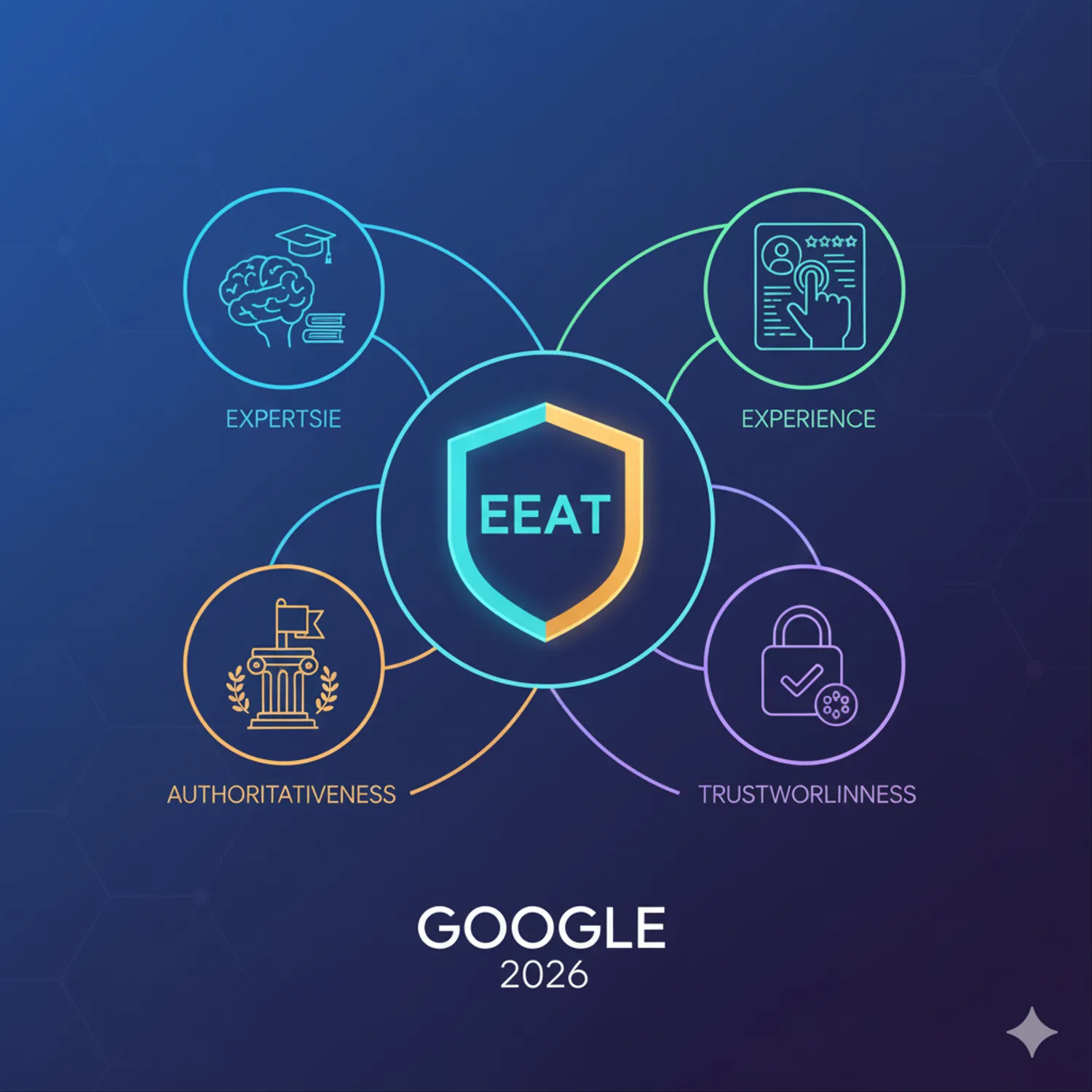
Google’s framework—Experience, Expertise, Authoritativeness, and Trust—has existed for years. What’s new is how aggressively Google and AI-powered search systems now rely on it to decide who gets surfaced, summarized, cited, or ignored.
And one part of E-E-A-T now outweighs the rest.
Experience.
Why E-E-A-T matters more in the AI search era
AI-powered search results don’t behave like traditional search results.
Instead of presenting a list of links, AI systems often:
- Summarize information
- Compare sources
- Cite only a handful of pages
- Filter out content that feels repetitive or generic
In that environment, content that merely sounds correct isn’t enough anymore. AI systems are trained to look for signals of real-world use, depth, and reliability.
Google has been clear on one thing: AI-generated content is not inherently bad. What matters is whether content is helpful, accurate, and people-first. The challenge is that AI can already generate “helpful-sounding” text at scale.
What AI cannot easily replicate is first-hand experience.
That is why E-E-A-T has evolved from a quality guideline into a competitive moat.
The updated meaning of E-E-A-T in 2026
Let’s break down how each pillar functions today—not in theory, but in practice.
1. Experience: The hardest signal to fake
Experience is no longer optional. It is the foundation.
In 2026, experience means:
- You have actually done the thing you’re writing about
- You’ve seen results, problems, edge cases, and trade-offs
- You can explain what worked, what didn’t, and why
This is where most content fails.
Generic advice articles, even well-written ones, are easy to reproduce. Content that includes real scenarios, decisions, mistakes, screenshots, data points, or outcomes is not.
Strong experience signals for SEO include:
- Case studies with timelines and constraints
- Real examples from projects or audits
- Process details that aren’t obvious to beginners
- Lessons learned from failure, not just success
If your content could have been written without ever doing the work, Google and AI systems are increasingly able to tell.
2. Expertise: Demonstrated depth, not titles
Expertise is not about claiming authority. It’s about showing it.
In 2026, expertise looks like:
- Clear explanations without oversimplification
- Specific recommendations, not vague best practices
- Knowing when not to apply advice
- Understanding context and limitations
Expertise becomes obvious when content answers questions before the reader asks them. This is especially important for AI search optimization, where systems prioritize sources that reduce ambiguity.
Practical ways to show expertise:
- Write with precision, not fluff
- Address common misconceptions directly
- Reference patterns you’ve observed repeatedly
- Explain “why,” not just “what”
3. Authoritativeness: Recognition beyond your website
Authoritativeness is no longer built in isolation.
In 2026, authority is reinforced when:
- Other credible sites mention or reference your work
- Your insights appear across multiple platforms
- Your authors are visible outside your own domain
- Your content contributes to broader industry conversations
This is where topical authority SEO and digital PR for SEO intersect.
Google and AI systems trust sources that are validated by others. That validation doesn’t need to be massive—but it does need to be real.
4. Trust: The silent deal-breaker
Trust is the baseline that everything else rests on.
Even the best content fails if trust signals are weak.
In practical terms, trust means:
- Clear ownership and accountability
- Transparent updates and sourcing
- Honest claims without exaggeration
- Easy ways to contact real people
- Clean UX without deceptive patterns
For AI systems, trust helps answer a simple question:
Is this a source I would confidently stand behind?
If the answer is uncertain, visibility drops.
How to build “unfakeable authority” in 2026
Here’s what actually works.
Start with evidence, not opinions
Before publishing, gather:
- Real examples from your work
- Data points or observations
- Screenshots, logs, or documentation
- Decisions you made and the reasoning behind them
Then write around that evidence.
This single shift instantly improves E-E-A-T.
Add experience blocks to key pages
Every major page should include a section grounded in reality:
- What you’ve seen repeatedly
- Common mistakes you’ve encountered
- Patterns from audits or implementations
- Results from recent work
These sections signal human involvement in a way AI cannot easily replicate.
Treat author pages as credibility assets
Author pages matter more than most teams realize.
Strong authoritativeness in SEO comes from:
- Clear specialization
- Real background details
- Links to high-quality work
- Consistent identity across platforms
In AI search, authorship helps systems evaluate reliability at a deeper level.
Structure content for AI and humans
To be cited or summarized, content must be:
- Clearly structured
- Easy to extract
- Factually consistent
- Supported by examples
If AI struggles to understand your content structure, it won’t trust it.
The bottom line
In 2026, the internet doesn’t need more content.
It needs proof.
The brands that succeed in AI-driven search will not be the loudest or the most prolific. They will be the ones that consistently demonstrate real experience, deep understanding, and transparent trustworthiness.
If you want to win long-term visibility, don’t try to sound impressive.
Be credibly useful.
Want to strengthen your E-E-A-T?
If your site has strong content but weak authority signals, the solution isn’t more blogs—it’s better foundations.
An E-E-A-T for AI Search 2026 audit can help identify:
- Missing experience signals
- Trust gaps that limit visibility
- Pages that need authority reinforcement
- Opportunities to improve AI citations and organic performance
If you’d like, you can share your website or priority pages, and I can outline a practical E-E-A-T action plan tailored to your industry.