The Aviation Fuel Market: Opportunities and Challenges for Sustainable Aviation Fuel Adoption
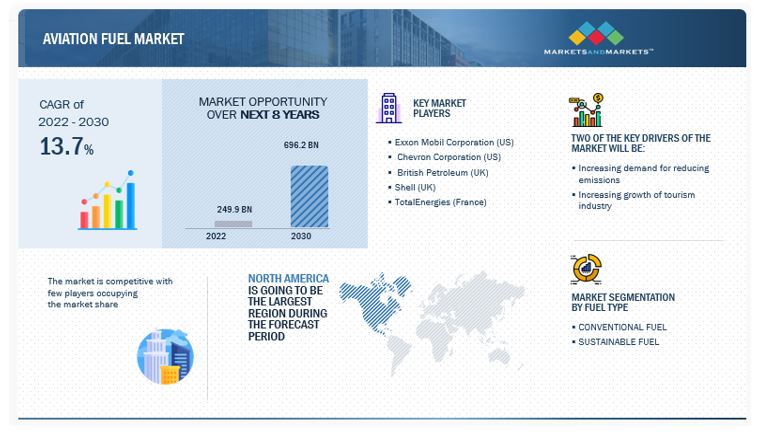
The aviation industry is a significant contributor to greenhouse gas (GHG) emissions, accounting for approximately 2-3% of global CO2 emissions. To address this, sustainable aviation fuel (SAF) has emerged as a key component in meeting the aviation industry’s commitments to decouple increases in carbon emissions from traffic growth. According to a report, the aviation fuel market size is expected to grow from USD 249.9 billion in 2022 and is projected to reach USD 696.2 billion by 2030, at a CAGR of 13.7% during the forecast period. The demand to reduce emissions and rising initiatives by governments to adopt sustainable aviation fuel are expected to drive the growth of the market.
Get More Information Request Sample Copy (Get Higher Priority for Corporate email ID): https://www.marketsandmarkets.com/pdfdownloadNew.asp?id=231148230
Driver: Demand to Reduce Emissions
SAF gives an impressive reduction of up to 80% in CO2 emissions over the lifecycle of the fuel compared to fossil jet fuel. The International Air Transport Association (IATA) fact sheet highlights that SAF will be an eligible option for aircraft operators to meet their obligations under the Carbon Offsetting and Reduction Scheme for International Aviation (CORSIA). SAF production using biomass, biological, and non-biological resources allows it to be approximately carbon-neutral over its lifecycle. Furthermore, SAF contains fewer impurities (such as sulfur), which enables an even greater reduction in sulfur dioxide and particulate matter emissions than present technology has achieved. SAF will allow the use of existing aircraft, including long-range models, but with a substantial collective reduction of GHG emissions.
Restraint: Price Difference Between SAF and Conventional Aviation Fuel
The cost of sustainable jet fuel falls within a price range that is roughly 3–9 times higher than conventional jet fuel. Considering that fuel costs make up 30–31% of airlines' operating expenses, an increase in fuel price creates barriers for airline operators to demand sustainable jet fuel. The availability of very limited technologies and infrastructure for the sustainable aviation fuel market also leads to an increase in the total production cost of sustainable aviation fuel. Though SAF has been emphasized as a viable option for carriers to fulfill their obligations under the International Aviation Carbon Offsetting and Reduction Scheme (CORSIA), it is far more expensive than conventional jet fuel. In addition to this, there has been a surge in the price of jet fuel since 2021 due to political and social crises.
Opportunity: Growing Need for Alternative Aviation Fuel by Airlines
The global demand and substantial challenges to reduce emissions of greenhouse gases and improve environmental sustainability in the face of rapid growth have led to the emergence of the SAF market significantly. Several agreements, contracts, partnerships, etc., have been made for a certain period of time by various stakeholders of the entire demand and supply chain of the SAF market. This opportunity of offtake agreements between researchers, airlines, airports, fixed base operators, fuel producers, fuel suppliers & distributors, feedstock providers, technology providers, etc., will give immense growth prospects to widen the usability of SAF and provide new visibility to the connected markets as well.
Challenge: High Investments for Approval and Certification of SAF
SAF requires strict technical certifications to be fully approved for utilization in aircraft engines. The entire value chain of the SAF market faces stringent approval procedures for the phases of SAF, for application purposes. However, the involvement of various stakeholders and the quantity of fuel required for the testing parameters add to the cost of the approval of SAF. For instance, the OEM-led ASTM D4054 approval and evaluation process is expensive and time-consuming, which is one of the major hurdles in the growth of the sustainable aviation fuel market.
Our Other Publications:
Homeland Security and Emergency Management Market by Vertical (Homeland Security, Emergency Management), Solution (Systems, Services), Installation (New Installation, Upgrade), End Use, Technology, and Region (2021-2026)
Aviation Fuel Market by Fuel Type (Conventional Fuel-Air Turbine Fuel, Avgas, Sustainable Fuel- Biofuel, Hydrogen Fuel, Power-To-Liquid, Gas-To-Liquid), Aircraft Type (Fixed Wing, Rotary Wing, Unmanned Aerial Vehicle) & Region- Global Forecast to 2030
Full-Body Scanners Market by End Use (Transport, Critical Infrastructure), Technology (X-ray, millimeter wave), Type (single view, dual view, 3D), Detection (Manual, Automatic) Component (Hardware, Software) and Region - Global Forecast to 2027
Contact:
Mr. Aashish Mehra
MarketsandMarkets™ INC.
630 Dundee Road
Suite 430
Northbrook, IL 60062
USA: 1-888-600-6441