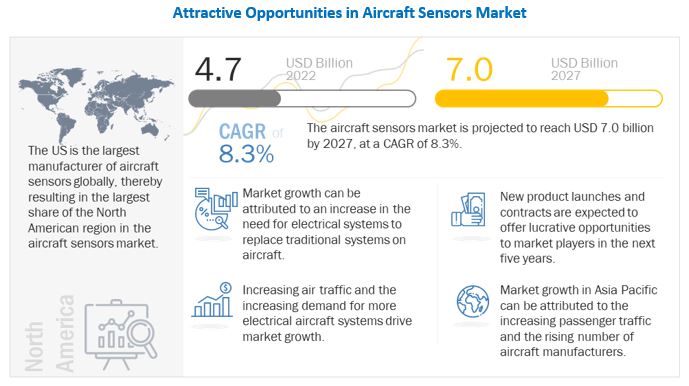
[247 Pages Report] The Aircraft Sensors Market is projected to grow from USD 4.7 billion in 2022 to USD 7.0 billion by 2027, at a CAGR of 8.3% during the forecast period. The growth of the aircraft sensors market can be attributed to several factors, such as the need for adopting advanced sensing solutions to ensure efficient operations of aircraft systems and the safety of the aircraft.
To know about the assumptions considered for the study, Request for Free Sample Report
Aircraft Sensors Market Dynamics:
Driver: Increased usage of sensors for data sensing and measurement
Feedback on a wide range of flying situations as well as the conditions of various flight equipment and systems is necessary for the safe and efficient control of aircraft. These conditions are continuously monitored by a wide range of sensors, which send data to the flight computers for processing before the pilot sees it.
The amount of lubricating oil, liquid coolant, and fluid moving in the fuel transfer and bleed air systems are all detected by flow sensors. Oil, fuel, coolant, and fluid levels in hydraulic reservoirs, collection sumps, and grey (waste) water reservoirs are all monitored using liquid-level sensors. In hydraulic systems, such as those used for braking, moving control surfaces, and raising and lowering landing gear, pressure sensors monitor the pressure. Position sensors, such as rotary variable differential transformers (RVDT) and linear variable differential transformers (LVDT), detect the displacement of different aircraft parts, such as the state of deployment of thrust reversers. Sensors are also used for force and vibration. Temperature sensors are essential to keep track of the temperature in environmental cooling systems as well as the conditions of hydraulic oils, fuels, and refrigerants. Bimetallic temperature gauges, electrical resistance thermometers, ratiometer indicators, and thermocouple temperature indicators are a few examples of temperature sensors.
The criticality of modern military airborne missions has led to highly advanced navigational and surveillance systems, capable of long-range target detection in conditions of low light as well. Missile indication and deterrence systems play a crucial role in combat-driven operations, with sensor systems capable of acting in radar-denied zones. The number of sensors on an aircraft increases with the level of awareness required in its operations. This drives the market for them.
Restraint: Frequent Calibration of Sensors to ensure efficient working of systems
Sensors require frequent calibration and maintenance to provide credible information about systems. For instance, in the case of airspeed sensors, frequent calibrations are carried out to ensure proper auto-throttle modes as well as efficient automatic landing. Sensors also undergo pre flights checks. They need to be calibrated (at least) every 500 flight hours, and different sensors have different calibration methods. Especially sensors that are placed in harsh environments like on the aerostructures and on the engine are extremely susceptible to contaminations and undergo more frequent calibration and testing to ensure efficient working as they provide integral information for the safety of flight.
Opportunity: Increasing adoption of the Internet of things in aviation industry
The Internet of Things and sensor networks are currently undergoing rapid development and gaining increasing attention. The use of wireless sensor networks is widespread across numerous sectors. It serves as a crucial infrastructure for IoT development and is a crucial component of the IoT sensor layer. This is being used in the aviation sector to promote a variety of services, from the safety of the aircraft itself to the improvement of the traveling experience of passengers.
To provide a comfortable journey to passengers, aircraft cabins are fitted with temperature detection-based sensors. Automated temperature control systems that are strategically located around the cabin help to achieve this, allowing the temperature inside to be maintained dependent on the location and weather prediction.
Different parts of the aircraft are equipped with different types of sensors that can measure their velocity, angle, altitude, and attitude and communicate with one another. With an IoT system in place, this data is made available to the pilots or ground authorities, increasing operational efficiency, flight safety, and passenger comfort. IoT systems monitor the on-ground and in-flight conditions of arriving planes as well as the state of each of their individual parts. The concerned engineers can receive this informational data well in advance, allowing them to determine which maintenance task needs to be completed on which aircraft first. This helps in reducing the runway time of the aircraft and ensures proper maintenance.
Challenge: Cybersecurity Risks
The logical next stages for the aviation sector are digitalization and system integration. The aviation sector is evolving into an open ecosystem that is entirely networked and more exposed to the outside world than ever before, replacing closed systems that only communicate with one another. Aircraft OEMs and integrators are making use of the capabilities of the Internet of Things to proactively identify maintenance issues, place orders for replacements of faulty parts, and alert the ground maintenance crew while flying so that everything is ready to be fixed without slowing down operations when the aircraft lands. Thousands of sensors built into each aircraft enable data to be sent in real-time to the ground crew. For instance, the F-35's autonomic logistics information system (ALIS), for instance, uses sensors embedded in an aircraft to detect its performance, compare its parameters to standardized parameters, use sophisticated analytics to predict maintenance needs, and then communicate with maintenance staff so that the appropriate parts are available when needed. The F-35's ALIS acts as its information infrastructure, sending data about the aircraft to the relevant users via a globally dispersed network of technicians. This, however, makes the system prone to cybersecurity attacks from sources that could be placed anywhere around the globe.
Aircraft Sensors Market Ecosystem
Prominent companies who manufacture and provide aircraft sensors, private & small enterprises, distributors/suppliers/retailers, and end customers are key stakeholders in the aircraft sensors market ecosystem. Investors, funders, academic researchers, integrators, service providers, and licensing authorities serve as major influencers in the market.
The OEM segment is estimated to lead the aircraft sensors market in 2022
Based on End Use, the OEM segment of the aircraft sensors market is accounted for the largest growth during the forecast period. The increasing demand for different various aircraft types across different regions, due to the increasing air traffic is expected to drive the demand for aircraft sensors across these regions.
The Proximity Sensor type is expected to have the largest market share during the forecast period
Based on sensor type, proximity sensors type is expected to have the highest market share during the forecast period. Proximity sensors are a type of position sensor widely used to detect the presence of an object without physical contact. They are the most common and affordable solution for object detection without any contact. Proximity sensors emit electromagnetic radiation and detect changes in the field of return signals. In other words, they convert the movement and presence of an object into electric signals.
The north American region is expected to have the highest market share during the forecast period
North American region constitutes the largest aircraft sensors manufacturers among all the regions. Key companies like Honeywell, General Electric, and TE Connectivity all have their headquarters situated in the US. The North American region also designs and manufactures a high number of different aircraft platforms. These factors contribute to the largest growth in the region.
To know about the assumptions considered for the study, download the pdf brochure
Key Market Players
Major players operating in the aircraft sensors market include Honeywell (US), TE Connectivity (US), Meggitt PLC (UK), AMETEK Inc. (US), and Safran (France) among others. These key players offer aircraft sensors and services to different key stakeholders.
Get online access to the report on the World's First Market Intelligence Cloud
- Easy to Download Historical Data & Forecast Numbers
- Company Analysis Dashboard for high growth potential opportunities
- Research Analyst Access for customization & queries
- Competitor Analysis with Interactive dashboard
- Latest News, Updates & Trend analysis
Scope of the Report
Report Metric
Details
Market size available for years
2018-2027
Base year considered
2021
Forecast period
2022-2027
Forecast units
Value (USD)
Segments covered
Sensor Type, Application, Aircraft Type, End Use, Connectivity, and Region
Geographies covered
North America, Europe, Asia Pacific, the Middle East, Latin America and Africa.
Companies covered
Honeywell (US), TE Connectivity (US), Meggitt PLC (UK), AMETEK Inc. (US), and Safran (France) among others.
This research report categorizes the aircraft sensors market into Sensor Type, Application, Aircraft Type, End Use, Connectivity, and Region
By End Use
- OEM
- Aftermarket
By Sensor Type
- Pressure Sensors
- Temperature Sensors
- Force Sensors
- Torque Sensors
- Speed Sensors
- Position & Displacement Sensors
- Level Sensors
- Proximity Sensors
- Flow Sensors
- Optical Sensors
- Motion Sensors
- Radar Sensors
- Smoke Detection Sensors
- GPS Sensors
- Others
By Aircraft Type
- Fixed-wing
- Rotary-wing
- Unmanned Aerial Vehicles
- Advanced Air Mobility
By Application
- Fuel, Hydraulic, and Pneumatic Systems
- Engine/Propulsion
- Cabin & Cargo Environmental Controls
- Aerostructures & Flight Control
- Flight Decks
- Landing Gear Systems
- Weapon Systems
- Others
By Connectivity
- Wired Sensors
- Wireless Sensors
Regions
- North America
- Europe
- Asia Pacific
- Middle East
- Latin America
- Africa
Recent Developments
- In August 2022, The US Navy has awarded Lockheed Martin a contract for the development of the F-35 Joint Strike Fighter program for the UK, Canada, and Australia. The contract deals with the upgrading of the data centre of the F-35s for the development of mission data files gathered by the huge array of sensors and systems installed on the aircraft. The deal will help Lockheed establish a strong brand image in the military segment of the industry and attract global players for its highly advanced product portfolio.
- In July 2022, TT Electronics & Honeywell Aerospace partnered for the development of next-generation inertial navigation units for aerospace and military applications for the purpose of navigation & flight control operations.
About MarketsandMarkets™
MarketsandMarkets™ is a blue ocean alternative in growth consulting and program management, leveraging a man-machine offering to drive supernormal growth for progressive organizations in the B2B space. We have the widest lens on emerging technologies, making us proficient in co-creating supernormal growth for clients.
Contact:
Mr. Aashish Mehra
MarketsandMarkets™ INC.
630 Dundee Road
Suite 430
Northbrook, IL 60062
USA: 1-888-600-6441