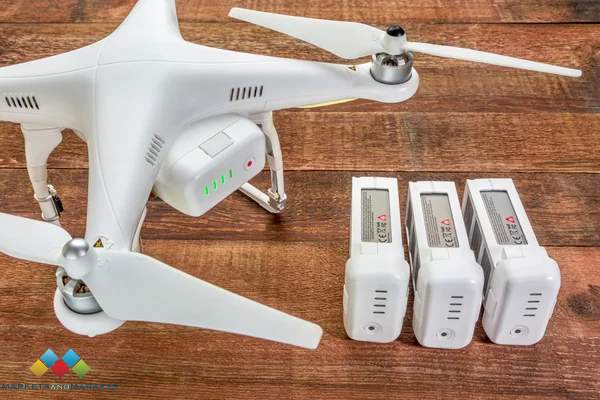
The Drone Battery Market is on an impressive trajectory, poised to grow from USD 4.0 Billion in 2021 to a staggering USD 9.6 Billion by 2026, reflecting a remarkable CAGR of 19.0% during this period. This robust expansion is propelled by the burgeoning utilization of drones for goods delivery within the transportation and logistics sector, unlocking a realm of lucrative prospects for both established drone manufacturers and emerging industry players. Leading market entities are also dedicated to crafting drones with extended flight times, robust payload capabilities, and advanced technologies. Furthermore, the surging global e-commerce sector and its increasing reliance on drones are expected to fuel the demand for high-payload hybrid drones, further galvanizing the growth of the Drone Battery Industry.
Request Sample PDF Report (Use Corporate E-mail ID for Higher Priority): https://www.marketsandmarkets.com/pdfdownloadNew.asp?id=131005766
The Impact of COVID-19
The COVID-19 pandemic has ushered in both immediate disruptions and long-term structural changes, particularly in the e-commerce sector, which has seen a slowdown in growth for new online categories like groceries and home care. This shift has paved the way for the deployment of autonomous solutions such as drones and robots for contactless goods delivery. Furthermore, the healthcare sector's adoption of drones for tasks like disinfectant spraying and the delivery of vital medical supplies, including COVID-19 test kits and samples, has provided a significant boost to the drone battery market. Healthcare organizations are harnessing drones to meet critical needs efficiently.
The energy storage industry, which includes drone batteries, has encountered its share of challenges during the pandemic. These encompass manufacturing disruptions, shipment delays, project development hiccups, and research and development obstacles. The supply chain for batteries and raw materials sourced from China, in particular, has been vulnerable to disruptions, affecting companies like US-based Skydio and China-based DJI. Supply chain bottlenecks and component shortages have led to shipment delays for these major drone manufacturers.
Drone Battery Market Dynamics:
Driver: Increasing Demand Across Diverse Applications
Drones have witnessed soaring demand across various applications, encompassing surveillance, inspection, defense, cinematography, and agriculture, among others, on a global scale. Defense forces, in particular, have sought drones for intelligence, surveillance, reconnaissance (ISR) activities, combat operations, and battle damage assessment. Simultaneously, drones have become instrumental in agricultural applications such as crop spraying, pest control, and crop inspection. They are also pivotal in maritime security, patrolling pirate-prone regions and safeguarding critical shipping lanes by providing real-time data to relevant authorities. Law enforcement agencies benefit from drones for crowd control, management, and surveillance, as exemplified during the COVID-19 pandemic in 2020 and 2021.
Restraint: High Costs of Energy-Dense Batteries
Energy-dense batteries like lithium-sulfur and lithium metal offer greater charge capacities, making them suitable for long-endurance missions. However, the high costs associated with these batteries, coupled with limited manufacturer competition and the technology's relative newness, have hindered widespread adoption. Currently, the most advanced high-capacity batteries are primarily utilized for technology demonstrations and prototypes. Commercial and consumer adoption of these advanced batteries is anticipated to remain limited until they become more cost-effective.
Opportunity: Innovations in Smart Battery Technology
The availability of cost-effective microprocessors has empowered manufacturers like Shenzhen Grepow and Maxell to offer lithium-ion or polymer batteries featuring integrated battery management systems. These systems facilitate charge and discharge management, temperature regulation, short-circuit management, data logging, and other functionalities. They contribute to extended battery life and real-time system monitoring. These smart batteries can be effectively integrated with IoT and smart chargers to optimize charging times and provide diagnostics. With the rise of IoT and systems integration, smart battery technology is poised to become a standard feature for drone batteries in the future.
Challenge: Lack of Safety Standards
Safety standards in the drone battery industry are currently lacking, raising concerns about safety during charging and operation. A study by the Consumer Product Safety Commission (CPSC) revealed 200 drone-related incidents between 2012 and 2017, with 50% of these incidents occurring during charging. This absence of robust safety standards leaves drone batteries susceptible to issues like thermal runaway, which can result in explosions, injuries to operators, and property damage. Drone batteries are especially vulnerable due to their high-altitude operations and exposure to temperature fluctuations, vibrations, and shocks.
Market Segmentation
Lithium-Based Technology Leads the Way
In terms of technology, the lithium-based segment is projected to maintain its leadership position in the drone battery market throughout the forecast period. Advancements in lithium-metal and lithium-sulfur technologies are anticipated to boost the growth of this segment. The increasing demand for alternate modes of transportation, including autonomous urban air mobility, is driving interest in fuel cell batteries for drones.
Battery Management Systems (BMS) Gain Traction
Among components, the battery management system (BMS) segment is poised to experience the highest CAGR during the forecast period. The heightened focus on monitoring critical battery parameters, such as current, voltage, temperature, state of health, and state of charge, underpins this growth. BMS is essential for optimizing battery performance and ensuring safe operations.
Aftermarket Services on the Rise
In terms of point of sale, the aftermarket segment is projected to exhibit the highest CAGR during the forecast period. Increasing demand for modifications and upgrades of commercial and military drones is driving this surge. Most drones come with 1–2 batteries at the time of purchase, but additional batteries are often recommended to meet industry flight demands. Consequently, the aftermarket segment, catering to spare battery management, is experiencing significant growth.
Military Dominates the Platform Segment
In the platform segment, military drones are expected to lead the drone battery market from 2021 to 2026. Increased investments in unmanned aerial systems by the defense sector, coupled with the growing importance of intelligence, surveillance, reconnaissance (ISR), combat operations, and battle management applications, are key factors driving this dominance. Military drones encompass a range of sizes and capacities, with companies like HES Energy Systems, Plug Power, EaglePicher, Inventus Power, and Oxis Energy Ltd serving this segment.
Fixed-Wing Drones Take Flight
Based on drone type, fixed-wing drones are projected to lead the market, owing to their high stability and endurance. Battery-powered fixed-wing drones typically utilize lithium-polymer batteries with high voltage capacity, enabling extended-range flights.
Passenger Drones: The Future of Urban Mobility
Functionally, passenger drones are set to grow at the highest CAGR, driven by their expanding application in urban air mobility, including drone taxis, air ambulances, and air shuttles. These modes of transportation employ hydrogen-based fuel cells and lithium-ion batteries.
North America: The Pinnacle of Drone Battery Market Growth
Geographically, North America is poised to dominate the drone battery market during the forecast period. The region's growth is fueled by the increasing adoption of drones for both commercial and defense applications. In recent years, drone manufacturers have focused on developing cost-effective, energy-efficient, lightweight drones capable of carrying larger payloads over extended distances. This development aligns with commercial applications such as last-mile delivery, including product, medicine, and postal delivery. In 2015, the Federal Aviation Administration (FAA) paved the way for the operation of military, private, and commercial drones in US airspace, expanding the market for drone batteries.
As the Drone Battery Market continues to ascend with a remarkable CAGR of 19.0%, it is evident that drones are reshaping industries from e-commerce to healthcare and defense. The industry's future lies in innovations that reduce costs, enhance safety, and optimize performance. With a robust foundation in lithium-based technology, the proliferation of smart battery systems, and a growing demand for aftermarket services, the drone battery market is well-equipped to soar to new heights. However, addressing safety concerns and establishing robust industry standards will be essential to sustain this growth trajectory.
Speak to an Analyst Or Face-to-face Meeting: https://www.marketsandmarkets.com/speaktoanalystNew.asp?id=131005766
Drone Battery Industry Companies: Key Market Players
The Drone Battery market is shaped by influential players, including Eaglepicher Technologies, Oxis Energy Ltd, Plug Power Inc, HES Energy Systems, Intelligent Energy, RRC Power Solutions, Micromulticopter Aero Technology Co., Ltd., SolidEnergy Systems, Sion Power, Doosan Mobility Innovation, Shenzhen Grepow Battery Co. Ltd., and Epsilor, among others. These market leaders have implemented various growth strategies, such as acquisitions, partnerships, agreements, new product launches, expansions, and contracts, to bolster their presence in the drone battery market.
About MarketsandMarkets™
MarketsandMarkets™ has been recognized as one of America’s best management consulting firms by Forbes, as per their recent report.
MarketsandMarkets™ is a blue ocean alternative in growth consulting and program management, leveraging a man-machine offering to drive supernormal growth for progressive organizations in the B2B space. We have the widest lens on emerging technologies, making us proficient in co-creating supernormal growth for clients.
Earlier this year, we formally transformed into one of America's best management consulting firms as per a survey conducted by Forbes.
The B2B economy is witnessing the emergence of $25 trillion of new revenue streams that are substituting existing revenue streams in this decade alone. We work with clients on growth programs, helping them monetize this $25 trillion opportunity through our service lines - TAM Expansion, Go-to-Market (GTM) Strategy to Execution, Market Share Gain, Account Enablement, and Thought Leadership Marketing.
Built on the 'GIVE Growth' principle, we work with several Forbes Global 2000 B2B companies - helping them stay relevant in a disruptive ecosystem. Our insights and strategies are molded by our industry experts, cutting-edge AI-powered Market Intelligence Cloud, and years of research. The KnowledgeStore™ (our Market Intelligence Cloud) integrates our research, and facilitates analysis of interconnections through applications, helping clients look at the entire ecosystem and understand the revenue shifts happening in their industry.
To learn more, visit www.MarketsandMarkets™.com or follow us on Twitter, LinkedIn and Facebook.
Contact:
Mr. Aashish Mehra
MarketsandMarkets™ INC.
630 Dundee Road
Suite 430
Northbrook, IL 60062
USA: +1-888-600-6441
Email: sales@marketsandmarkets.com