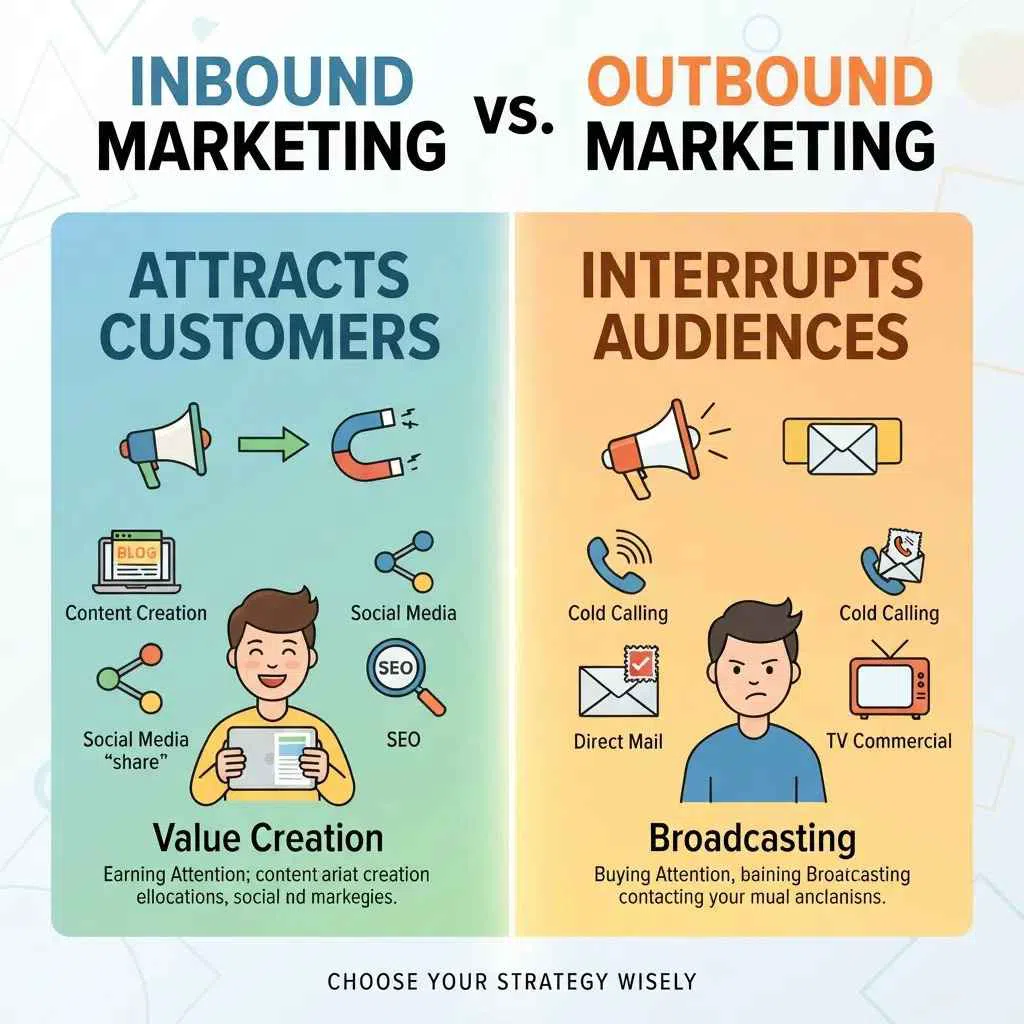
Reaching potential customers is one of the biggest challenges for any growing business. Some people actively look for solutions before discovering a company, while others first become aware of a product through a promotional message. Inbound and outbound marketing address these two situations in different ways. Understanding their roles can help businesses choose channels that fit their audience, resources, and marketing objectives.
Why Customer Discovery Matters
Before someone becomes a customer, they usually interact with a business several times. They may see an advertisement, visit a website, read an article, compare alternatives, or subscribe to an email list.
The first interaction can happen through many channels, which is why businesses need to understand how their audience discovers information.
Inbound and outbound marketing provide two different approaches to this process. This complete inbound marketing vs outbound marketing guide explains how the two methods differ and where each can be useful.
Inbound Marketing Builds Visibility Through Value
Inbound marketing is based on attracting potential customers with information they find useful.
Instead of immediately presenting a sales message, a business can create content that answers questions, explains problems, or helps people make decisions.
Popular inbound tactics include:
Search engine optimization
Blog content
Educational videos
Detailed guides
Case studies
Email marketing
Organic social media
Webinars
For instance, a company that sells website analytics software could publish content about measuring conversion rates. A business owner researching that topic may discover the article and become familiar with the software provider.
The initial interaction happens because the content matches an existing interest.
Outbound Marketing Starts With Direct Communication
Outbound marketing takes a more active approach.
Instead of waiting for potential customers to find the business, marketers distribute a message to an audience through selected channels.
Examples include:
Online advertising
Direct email
Sales calls
Radio campaigns
Television commercials
Print promotions
Sponsored content
Imagine a company introducing a new business service. It can use targeted advertising to make potential customers aware of the service even if they have not searched for it yet.
This makes outbound marketing useful for proactive promotion and awareness-building campaigns.
The Role of Awareness and Intent
Inbound and outbound marketing can meet customers at different points.
Inbound often connects with people who have already shown some form of interest. They may be researching a problem, comparing solutions, or looking for advice.
Outbound can reach people earlier in the process. An advertisement can introduce a product or service and create awareness before the customer begins actively researching.
Neither situation is inherently the same as the other. The message should reflect where the audience is in the buying process.
When Businesses Need Both
A marketing strategy can combine the two approaches.
Suppose an online education company launches a new professional course. It could use outbound advertising to reach potential students. Those advertisements could direct users to an inbound-focused landing page containing course details, useful resources, testimonials, and answers to common questions.
The customer journey might look like:
Paid Promotion → Website → Educational Content → Lead → Follow-Up → Enrollment
Here, outbound activity helps generate initial exposure while inbound resources support research and decision-making.
Resources and Campaign Goals
Businesses should also consider their available resources.
Inbound marketing often requires consistent work in content planning, SEO, research, writing, and distribution. Its assets can continue providing value after publication, although results may take time to develop.
Outbound campaigns can provide direct reach but may require ongoing spending for advertising, creative production, targeting, or outreach.
Campaign objectives also matter. A business launching a short-term promotion may prioritize direct exposure, while a company focused on long-term organic visibility may invest more heavily in content and SEO.
How to Evaluate Performance
Different approaches require different measurements.
For inbound marketing, businesses can monitor:
Organic traffic
Content engagement
Email subscribers
Lead generation
Returning visitors
Conversions
For outbound marketing, useful metrics can include:
Impressions
Click-through rate
Cost per lead
Conversion rate
Customer acquisition cost
Campaign revenue
The goal is not simply to generate activity. Businesses should understand whether their marketing efforts are contributing to meaningful customer actions.
FAQs
1. What is inbound marketing mainly used for?
It is commonly used to attract and educate potential customers through useful content and discoverability.
2. What is outbound marketing mainly used for?
It is used to proactively communicate a promotional message to a selected audience.
3. Is blogging an inbound strategy?
Yes. Blog content is often an important part of inbound marketing, especially when it addresses questions customers search for.
4. Can advertising be part of outbound marketing?
Yes. Paid advertising is one of the most common forms of outbound marketing.
5. Can a company combine both methods?
Yes. A company can use outbound channels for awareness and inbound assets for education, engagement, and lead nurturing.
Conclusion
Inbound and outbound marketing represent two different ways of creating connections with potential customers. Inbound focuses on becoming discoverable through useful information, while outbound actively delivers messages to an intended audience.
The choice does not have to be limited to one method. Businesses can combine both approaches according to their customer journey, campaign goals, budget, and available resources.
Understanding how customers discover, research, and evaluate products makes it easier to build a marketing system around their actual behavior. For additional information, explore this detailed inbound and outbound marketing comparison.
#InboundMarketing #OutboundMarketing #DigitalMarketing #MarketingStrategy