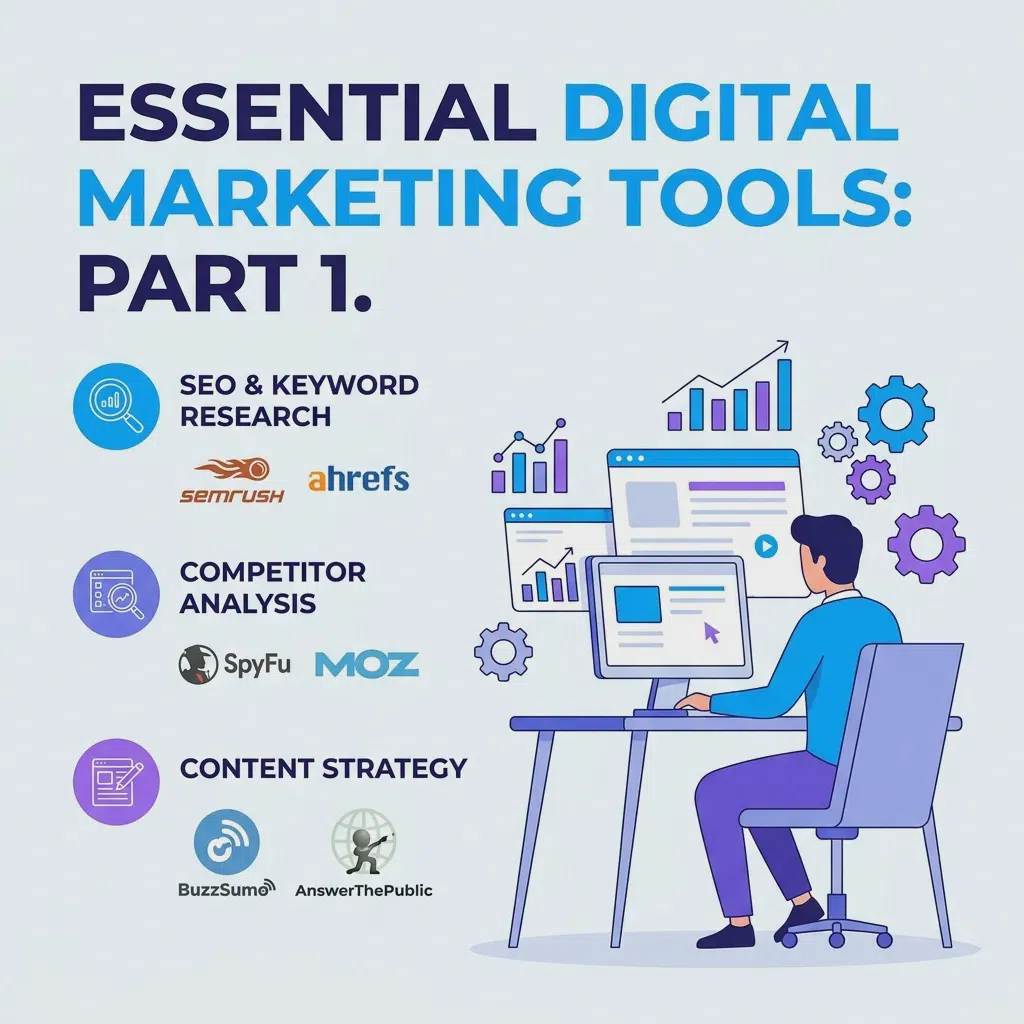
Marketing teams spend a large part of their day researching, creating content, scheduling campaigns, checking data, and preparing reports. The right digital marketing tools can reduce repetitive work and help marketers manage these activities more efficiently. Instead of replacing marketing strategy, technology can give teams more time to focus on creativity, planning, and decision-making.
The Time Problem in Modern Marketing
Digital marketing may look simple from the outside, but daily marketing operations can involve dozens of small tasks.
A marketer may need to:
Research keywords
Analyze competitors
Write content
Create graphics
Schedule social posts
Monitor campaigns
Respond to audiences
Review website data
Prepare reports
Follow up with leads
When these tasks are handled manually, valuable working hours can disappear quickly.
This is where marketing technology becomes useful.
The purpose of a good marketing tool is not simply to add another platform to the workflow. It should make a specific task easier, faster, or more organized.
Marketers looking for software for different areas can explore these essential digital marketing tools to understand the different categories available for modern marketing operations.
Automate Repetitive Marketing Tasks
Automation is one of the simplest ways to reduce unnecessary manual work.
Some repetitive activities can be handled automatically, including:
Email sequences
Social media scheduling
Lead notifications
Report generation
Data collection
Customer follow-ups
Campaign alerts
Automation allows marketers to create a process once and let software handle recurring activities according to predefined conditions.
However, automation should be used carefully.
Not every marketing task should be automated. Strategy, creative decisions, customer relationships, and important communication still require human judgment.
Make Content Planning More Organized
Content marketing can become time-consuming when ideas, keywords, drafts, images, and publishing schedules are stored in different places.
Content planning tools can help teams organize the entire process.
A simple content workflow might look like:
Topic Research → Brief → Writing → Editing → Design → Publishing → Promotion → Analysis
When every step is documented, team members can understand what needs to happen next.
This reduces unnecessary communication and makes it easier to maintain a consistent publishing schedule.
Speed Up Keyword Research
SEO professionals often spend significant time researching search terms and evaluating content opportunities.
Keyword research tools can help marketers discover:
Relevant search terms
Related topics
Search trends
Keyword difficulty
Competitor opportunities
Content ideas
Instead of starting every research project from scratch, marketers can use software to collect and organize information more efficiently.
The time saved during research can then be invested in creating better content and developing stronger SEO strategies.
Simplify Social Media Management
Managing multiple social media accounts can be challenging.
Without an organized system, marketers may need to switch between different platforms repeatedly throughout the day.
Social media management tools can bring several activities into one workflow.
Depending on the platform, marketers may be able to:
Schedule posts
Manage content calendars
Monitor engagement
Review analytics
Organize campaigns
Coordinate with team members
This can be particularly helpful for businesses publishing content across several social networks.
Reduce Time Spent Creating Reports
Reporting is important, but manually collecting information from multiple platforms can be frustrating.
A marketer may need to gather data from:
Search platforms
Social media
Advertising accounts
Email systems
Website analytics
CRM platforms
Reporting tools and dashboards can simplify this process by bringing important metrics into a more organized format.
Instead of spending hours copying numbers into spreadsheets, marketers can spend more time interpreting what the numbers mean.
Improve Email Marketing Efficiency
Email marketing can involve many repetitive activities.
For example, a business may need to send:
Welcome messages
Promotional emails
Follow-ups
Product updates
Educational newsletters
Re-engagement campaigns
Email marketing platforms can automate many of these processes.
A well-designed automation sequence can deliver the right message based on subscriber behavior or predefined conditions.
This saves time while allowing businesses to maintain consistent communication.
Organize Leads More Effectively
Lead management becomes increasingly difficult as a business grows.
Without proper organization, sales teams may forget follow-ups or lose track of where prospects are in the buying process.
CRM and marketing automation tools can help businesses organize customer information and lead activity.
For example, leads can be categorized according to:
Source
Interest
Activity
Purchase stage
Communication history
This makes it easier for marketers and sales teams to determine what action should happen next.
Use AI Carefully to Support Productivity
AI-powered features are becoming increasingly common in marketing software.
They can assist with tasks such as:
Brainstorming
Content ideas
Draft generation
Summarization
Data organization
Campaign variations
Basic analysis
AI can reduce the amount of time spent on repetitive work, but human review remains important.
Marketing content should be checked for accuracy, relevance, originality, tone, and brand consistency before publication.
The best approach is to treat AI as a productivity assistant rather than a complete replacement for marketing expertise.
Connect Your Marketing Platforms
Using separate tools for every task can create another problem: disconnected workflows.
For example, website analytics may contain visitor information while a CRM contains lead information. An email platform may have subscriber data, while an advertising platform contains campaign information.
When these systems are connected, marketers can reduce duplicate data entry and create smoother processes.
Integration should therefore be an important consideration when selecting new software.
Don't Automate a Bad Process
Automation does not automatically fix an inefficient workflow.
If a process is confusing when performed manually, automating it may simply make the same problem happen faster.
Before automating a task:
Understand the current process.
Remove unnecessary steps.
Standardize the workflow.
Identify repetitive activities.
Automate the appropriate parts.
Monitor the results.
This approach makes automation much more effective.
Measure the Time You Actually Save
Marketing tools should provide measurable value.
One useful way to evaluate a platform is to compare the amount of time spent before and after implementation.
For example:
Before: 5 hours per week creating reports
After: 1 hour per week
That represents four hours that can potentially be redirected toward strategy, content, optimization, or customer communication.
Time savings are particularly important for small teams where every working hour matters.
Avoid Tool Overload
There is a difference between using technology effectively and using too much technology.
A business may subscribe to numerous platforms but still have inefficient workflows.
Too many tools can lead to:
Higher expenses
Confusing processes
Duplicate functionality
Data fragmentation
Additional training
Poor adoption
Before adding software, identify the specific problem it needs to solve.
If another platform already handles the task effectively, adding a new subscription may not be necessary.
Build a Practical Marketing Workflow
A productive marketing system does not need to be complicated.
For example:
Research
Use research tools to discover keywords, audiences, competitors, and content opportunities.
Create
Use content and design tools to develop marketing assets.
Publish
Use publishing or scheduling platforms to distribute content.
Measure
Use analytics tools to monitor results.
Improve
Use performance data to identify what should change.
This creates a repeatable process that can become more efficient over time.
Review Your Tools Regularly
Marketing technology changes quickly.
A tool that was useful last year may not be the best option today. At the same time, new features may make an existing platform more valuable.
Review your marketing software periodically.
Ask:
Are we using this tool regularly?
Does it save meaningful time?
Is another platform already providing the same function?
Is the subscription worth its cost?
Does it integrate with our current workflow?
Does the team understand how to use it?
Regular reviews help prevent unnecessary software costs.
Frequently Asked Questions
1. How can digital marketing tools save time?
They can automate repetitive tasks, organize workflows, simplify research, schedule campaigns, collect data, and reduce manual reporting.
2. Can marketing automation replace marketers?
No. Automation can handle repetitive activities, but strategy, creativity, analysis, and important customer decisions still require human involvement.
3. Are digital marketing tools useful for small businesses?
Yes. Small businesses can use tools to save time, manage campaigns efficiently, and handle tasks that would otherwise require significant manual effort.
4. Should every marketing task be automated?
No. Automation is best suited to repetitive and predictable activities. Strategic and creative tasks often require human judgment.
5. How can I know if a marketing tool is worth paying for?
Compare its cost with the value it provides. Time savings, improved productivity, better reporting, and stronger campaign results can all contribute to its value.
6. Can too many marketing tools reduce productivity?
Yes. Too many platforms can create complicated workflows, duplicated tasks, higher costs, and fragmented data.
7. What should I consider before choosing a marketing tool?
Consider its features, usability, pricing, integrations, scalability, support, and whether it solves a genuine problem in your workflow.
Conclusion
Time is one of the most valuable resources in marketing. Spending hours on repetitive activities leaves less time for strategy, creativity, testing, and customer-focused work.
The right technology can help marketers automate routine processes, organize campaigns, simplify research, improve reporting, and manage customer communication more efficiently.
The goal is not to build the biggest possible collection of software. Instead, businesses should create a practical system where every tool has a clear purpose.
If you're researching software that can support different parts of your marketing workflow, this Best Digital Marketing Tools resource is a useful place to explore options across SEO, content creation, social media, analytics, email marketing, advertising, and automation.