Print Label Industry
Summary:
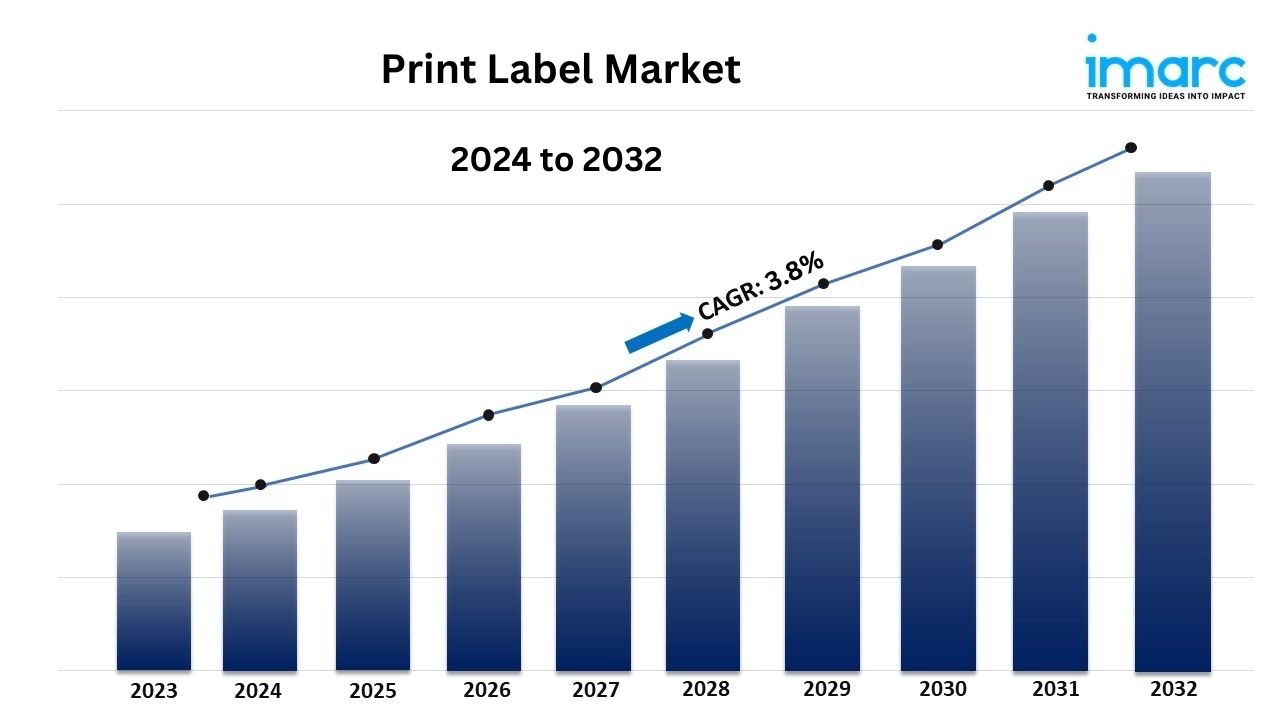
● The global print label market size reached USD 47.1 Billion in 2023.
● The market is expected to reach USD 66.1 Billion by 2032, exhibiting a growth rate (CAGR) of 3.8% during 2024-2032.
● Asia Pacific leads the market, accounting for the largest print label market share.
● Plastic/polymer labels accounts for the majority of the market share in the raw material segment due to their durability, flexibility, and cost-effectiveness, making them suitable for a wide range of applications across various industries.
● Based on the print process, the market has been segmented into offset lithography, gravure, flexography, screen, letterpress, electrophotography, and inkjet.
● Pressure-sensitive labels hold the maximum number of shares as they offer versatility, easy application, and strong adhesion on various surfaces without the need for heat, water, or solvents.
● Food and beverages represent the leading end use segment.
● The increasing demand for product differentiation and brand visibility is a primary driver of the print label market.
● Growth of the food and beverage industry, along with the rising adoption of smart labels with RFID and QR code technologies are reshaping the print label market.
Industry Trends and Drivers:
● Growing demand for sustainable labels:
One of the primary drivers in the print label market is the rising demand for sustainable and eco-friendly packaging solutions. As environmental awareness grows among consumers and businesses alike, industries are seeking alternatives to traditional labels that are less harmful to the environment. Sustainable labels often use recycled materials, biodegradable adhesives, and eco-friendly inks. Brands that adopt sustainable labeling practices are appealing to a more conscious consumer base that prioritizes sustainability in their purchasing decisions. Governments and regulatory bodies are also implementing stricter environmental regulations that push businesses to adopt greener labeling solutions. As companies move toward reducing their carbon footprints, the demand for sustainable labels is rapidly increasing. These labels improve the brand image and align with the global shift toward circular economies and waste reduction. This shift also opens up opportunities for innovation in the print label industry, such as the development of water-based inks and compostable materials, further fueling growth.
● Growth in e-commerce and online retailing:
The rise in e-commerce and online retailing has significantly contributed to the growth of the print label market. With more businesses operating in digital spaces, the demand for shipping and packaging labels has skyrocketed. E-commerce platforms require efficient labeling for shipping, tracking, and inventory management, making labels a crucial part of their operations. These labels need to be durable, legible, and capable of withstanding various environmental conditions during transit. In addition, customized and visually appealing labels are becoming essential for branding in online sales. Consumers are now receiving products directly at their doorsteps, and the packaging plays an essential role in the first impression of the brand. As online shopping grows, so does the need for unique labels that can meet the logistical demands of e-commerce, such as barcode labels, shipping labels, and product labels that comply with various regional and international regulations. The print label industry is responding by developing more efficient solutions that cater to the specific needs of the e-commerce sector, thus driving the market further.
● Technological advancements in printing techniques:
Technological advancements in printing methods are another crucial factor driving the print label market. Digital printing, in particular, has revolutionized the industry by offering faster production times, high-quality outputs, and the ability to handle short-run orders economically. Unlike traditional printing methods, digital printing allows for more flexibility, including variable data printing, which is essential for personalized labels and barcodes. This method is also less wasteful, as it reduces the need for printing plates and allows for easy adjustments. The rise of inkjet and laser printing technologies has further improved the quality and durability of labels, making them more resistant to moisture, heat, and abrasions. These innovations have expanded the applications of print labels across various industries, including food and beverages, healthcare, pharmaceuticals, and logistics.
For an in-depth analysis, you can request a sample copy of the report: https://www.imarcgroup.com/print-label-market/requestsample
Print Label Market Report Segmentation:
Breakup By Raw Material:
● Metal Labels
● Plastic/Polymer Labels
Plastic/polymer labels dominate the market as they offer durability, resistance to moisture and chemicals, and adaptability to various packaging shapes and environments.
Breakup By Print Process:
● Offset Lithography
● Gravure
● Flexography
● Screen
● Letterpress
● Electrophotography
● Inkjet
Based on the print process, the market has been segregated into offset lithography, gravure, flexography, screen, letterpress, electrophotography, and inkjet.
Breakup By Label Format:
● Wet-Glue Labels
● Pressure-Sensitive Labels
● Linerless Labels
● Multi-Part Tracking Labels
● In-Mold Labels
● Sleeves
Pressure-sensitive labels represent the largest segment as they provide versatility, durability, and ease of application across a wide range of industries and surfaces without the need for additional adhesives or complex processes.
Breakup By End Use Industry:
● Healthcare
● Food and Beverages
● Personal Care
● Industrial
● Household Care
● Consumer Electronics
● Others
Food and beverages dominate the market on account of strict regulatory requirements for labeling and the high demand for detailed packaging information, including ingredients, expiration dates, and nutritional facts.
Breakup By Region:
● North America (United States, Canada)
● Asia Pacific (China, Japan, India, South Korea, Australia, Indonesia, Others)
● Europe (Germany, France, United Kingdom, Italy, Spain, Russia, Others)
● Latin America (Brazil, Mexico, Others)
● Middle East and Africa
Asia Pacific holds the leading position owing to a large market for print label driven by its large manufacturing base, rapid industrialization, and growing consumer demand across industries such as food, beverages, and pharmaceuticals.
Top Print Label Market Leaders:
● 3M Company
● Ahlstrom-Munksjo Oyj (Ahlstrom-Munksjö Holding 3 Oy)
● Avery Dennison Corporation
● Fort Dearborn Company
● Fuji Seal International Inc
● Huhtamäki Oyj
● Mondi plc
● Multi-Color Corporation
● Ravenwood Packaging
● Sato Europe GmbH
● Taghleef Industries
● Taylor Corporation
If you require any specific information that is not covered currently within the scope of the report, we will provide the same as a part of the customization.
About Us:
IMARC Group is a global management consulting firm that helps the world’s most ambitious changemakers to create a lasting impact. The company provide a comprehensive suite of market entry and expansion services. IMARC offerings include thorough market assessment, feasibility studies, company incorporation assistance, factory setup support, regulatory approvals and licensing navigation, branding, marketing and sales strategies, competitive landscape and benchmarking analyses, pricing and cost research, and procurement research.