The Autonomous Chemical Laboratory Market is expanding as pharmaceutical companies, chemical manufacturers, biotechnology organizations, and research institutes adopt artificial intelligence, robotics, automation, and advanced data platforms to modernize laboratory workflows. The market is valued at USD 5,748.5 million in 2026 and is projected to reach USD 19,483.4 million by 2035, growing at a CAGR of 14.5% during the forecast period.
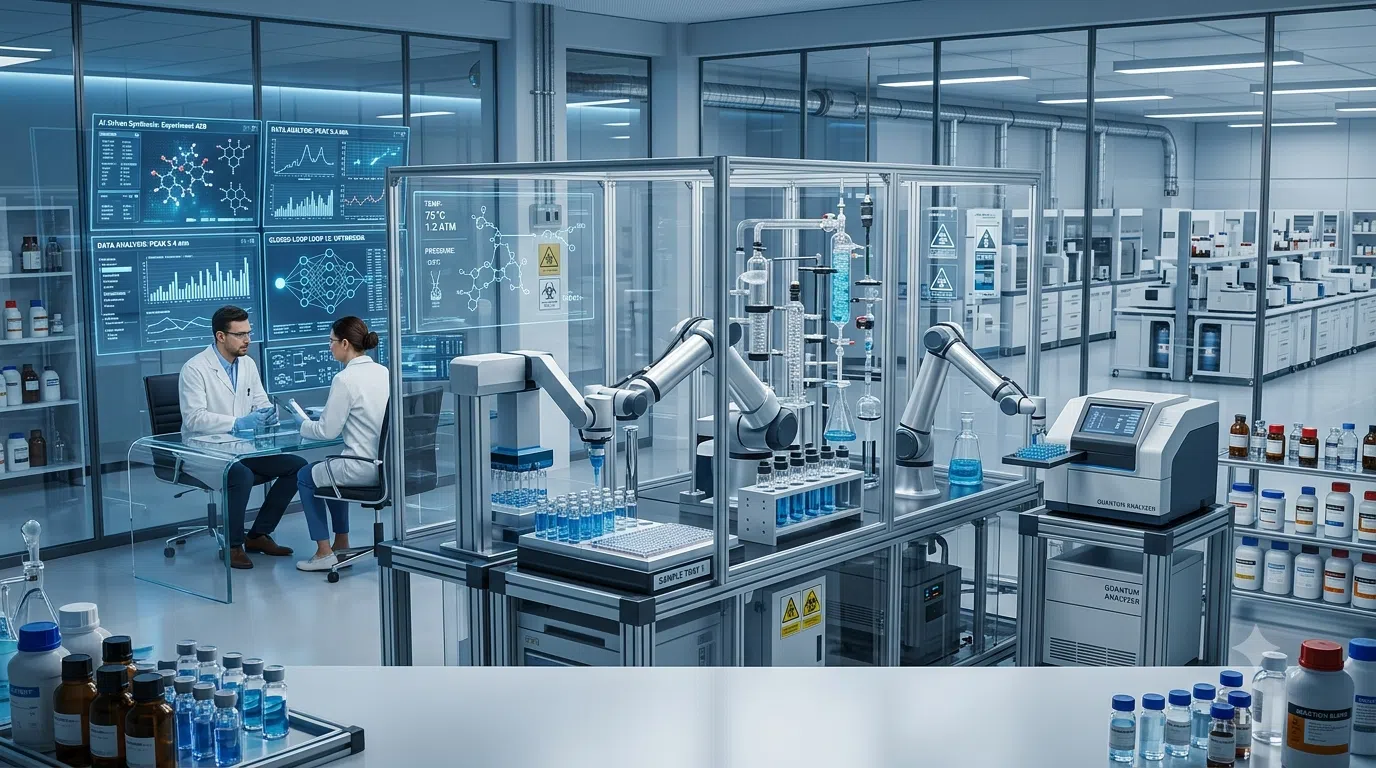
Autonomous chemical laboratories combine hardware, software, and specialized services to automate major stages of chemical research. Robotic arms, automated liquid handlers, analytical instruments, AI and machine learning systems, computer vision, and cloud platforms can work together to execute experiments, analyze results, and determine subsequent experimental steps.
The transition from manual, experiment-by-experiment workflows toward AI-driven and closed-loop experimentation is supporting demand for integrated laboratory platforms. Pharmaceutical research, materials science, specialty chemicals, agrochemical development, and academic research are among the key application areas.
What Is an Autonomous Chemical Laboratory?
An autonomous chemical laboratory is an integrated research environment designed to automate laboratory experimentation with limited human intervention. It combines physical laboratory equipment with software capable of experiment planning, data interpretation, optimization, and workflow management.
Unlike standalone laboratory automation equipment, an autonomous laboratory can connect multiple stages of the research cycle. A typical workflow may include sample preparation, chemical synthesis, experiment execution, analytical testing, data interpretation, and optimization.
AI and machine learning can analyze experimental results and help determine the next experiment, creating a closed-loop research process. Robotic systems then execute the selected experiment, while analytical instruments generate new data for the next optimization cycle.
What Is Driving the Autonomous Chemical Laboratory Market?
Growing Need for Faster R&D
Pharmaceutical and chemical companies are under pressure to shorten research cycles while improving reproducibility and experimental efficiency. Traditional laboratory processes can involve repeated manual preparation, testing, analysis, and optimization.
Autonomous systems can automate repetitive tasks and enable high-throughput experimentation. This allows researchers to spend more time on scientific interpretation and strategic research while automated systems handle standardized laboratory operations.
Increasing Adoption of AI and Robotics
AI, machine learning, robotics, and computer vision are becoming increasingly integrated into laboratory environments. AI systems can interpret multidimensional experimental data, identify patterns, and recommend subsequent experiments.
Robotic systems provide the physical execution layer, including liquid handling, sample preparation, chemical synthesis, and instrument interaction. This combination of AI and robotics is central to the development of self-driving laboratories.
Demand for Reproducible Research
Reproducibility is increasingly important in pharmaceutical, chemical, and materials research. Automated systems can standardize laboratory procedures, digitally record experimental parameters, and generate structured datasets.
This creates opportunities for organizations seeking better data governance, traceability, quality control, and repeatability across research programs.
Download a Complimentary PDF Sample Report:
http://dimensionmarketresearch.com/request-sample/autonomous-chemical-laboratory-market/
What Are the Key Trends in the Market?
Generative AI in Laboratory Research
Generative AI is emerging as an important technology for autonomous laboratory platforms. It can support molecular design, synthesis planning, experimental setup, data interpretation, and research optimization.
Instead of relying exclusively on predefined workflows, AI systems can evaluate experimental results and propose new research directions based on available data.
Cloud-Integrated Laboratory Platforms
Cloud-integrated systems are gaining attention because they allow laboratory equipment, AI software, data platforms, and research teams to operate within connected environments.
Cloud platforms can also support remote collaboration and centralized data management. Hybrid architectures are particularly relevant for organizations that need to connect existing on-premise laboratory equipment with cloud-based AI systems.
Digital Twin Technology
Digital twins are being explored to model laboratory processes and experimental conditions before physical testing. They can support process simulation, optimization, predictive analysis, and reproducibility.
The technology is especially relevant to complex chemical and materials research where organizations want to evaluate experimental conditions before committing laboratory resources.
Domain-Specific Autonomous Laboratories
The market is also moving toward specialized autonomous laboratories designed for specific research areas. Drug discovery, materials science, specialty chemicals, and agrochemical research can require different equipment, workflows, datasets, and regulatory requirements.
Specialized platforms can therefore provide application-specific automation rather than relying on one generic laboratory architecture.
What Opportunities Exist in the Market?
Autonomous Materials Research
Materials science represents a significant opportunity for self-driving laboratories. Autonomous systems can systematically evaluate large numbers of formulations and experimental conditions.
Applications include advanced polymers, catalysts, battery materials, coatings, and specialty materials. Automated experimentation can help researchers explore formulation spaces while maintaining structured experimental records.
Drug Discovery and Development
Pharmaceutical companies can use autonomous laboratories to connect molecular design, synthesis, testing, and optimization.
AI can propose candidate molecules or experimental conditions, robotic systems can perform laboratory procedures, and analytical systems can evaluate the resulting data. This creates a continuous feedback loop between computational research and physical experimentation.
Academic and Research Institutions
Academic laboratories are another important opportunity. Autonomous platforms can help research institutes manage complex experimental workflows while enabling remote access to laboratory equipment and shared research infrastructure.
Cloud-connected systems can also support collaboration between researchers working across different locations.
Agrochemical and Specialty Chemical Research
Autonomous experimentation can support the development and testing of agrochemicals, specialty chemicals, formulations, and industrial materials. Automated systems can provide structured audit trails and consistent experimental execution for research programs that require extensive testing.
Autonomous Chemical Laboratory Market Segmentation
The market is segmented by component, laboratory type, technology, deployment mode, workflow stage, application, and end user.
By Component
Hardware
Software
Services
Hardware represents the leading component segment. Robotic arms, automated liquid handling systems, sensors, spectroscopy platforms, chromatography instruments, and high-throughput screening equipment provide the physical infrastructure required for autonomous experimentation.
By Laboratory Type
Fully Autonomous Laboratories
Semi-Autonomous Laboratories
Modular Autonomous Labs
Integrated End-to-End Autonomous Platforms
Fully autonomous and integrated platforms are gaining attention as organizations seek to connect multiple laboratory processes within a single automated research environment.
By Technology
Artificial Intelligence & Machine Learning
Robotics & Cobotics
Computer Vision
Digital Twin Technology
Internet of Things
Cloud-Based Laboratory Platforms
AI and machine learning are central to autonomous laboratory development because they can support experimental planning, data interpretation, optimization, and decision-making.
By Deployment Mode
On-Premise
Cloud-Integrated
Hybrid Deployment
Cloud-integrated deployment is gaining importance because it supports centralized data management, collaboration, and integration with AI-based research platforms. Hybrid systems can connect legacy laboratory equipment with newer cloud-based technologies.
By Workflow Stage
Sample Preparation
Chemical Synthesis
Experiment Execution
Analytical Testing
Data Interpretation & Optimization
Quality Control
Automation across the entire workflow is becoming increasingly important as organizations seek end-to-end autonomous experimentation rather than isolated automated tasks.
By Application
Drug Discovery & Development
Materials Science
Chemical Manufacturing
Agrochemical Research
Specialty Chemical Development
Academic Research
Environmental Testing
Drug discovery, materials science, and chemical research are major application areas because these fields involve extensive experimentation and data analysis.
By End User
Pharmaceutical Companies
Chemical Manufacturers
Biotechnology Companies
Academic & Research Institutes
Contract Research Organizations
Industrial Laboratories
Pharmaceutical companies and chemical manufacturers represent important end users due to their need for high-throughput research, advanced analytics, and reproducible laboratory workflows. Academic and research institutes are also expected to see increasing adoption.
Regional Outlook
North America is projected to hold the largest share of the market, accounting for 37.1% in 2026. The region benefits from a strong pharmaceutical and biotechnology research ecosystem, established laboratory automation capabilities, AI development, and investment in advanced research infrastructure.
The U.S. Autonomous Chemical Laboratory Market is projected to reach USD 1,793.6 million in 2026 and USD 5,654.2 million by 2035, growing at a 13.6% CAGR. Demand is supported by pharmaceutical R&D modernization, robotics adoption, AI-based research, and closed-loop experimentation.
Europe is estimated at USD 1,670.0 million in 2026 and is projected to reach USD 5,580.0 million by 2035, representing a 14.3% CAGR. Regulatory requirements, specialty chemicals, agrochemical research, and demand for auditable laboratory data are supporting adoption.
Japan is projected to reach USD 580.0 million in 2026 and USD 1,820.0 million by 2035, growing at a 13.5% CAGR. Laboratory modernization, workforce constraints, IoT integration, and the transition from manual processes are important factors supporting market development.
Asia-Pacific is expected to record strong growth as research organizations and chemical manufacturers in countries such as China, Japan, South Korea, and India increase investment in AI, robotics, laboratory automation, and high-throughput experimentation.
Purchase the Report for Comprehensive Details:
http://dimensionmarketresearch.com/checkout/autonomous-chemical-laboratory-market/
Competitive Landscape
The competitive landscape includes laboratory equipment manufacturers, automation companies, AI and software providers, laboratory platform developers, and specialized autonomous laboratory companies.
Key companies identified in the DMR report include Thermo Fisher Scientific, Agilent Technologies, Tecan Group, Hamilton Company, PerkinElmer, Danaher Corporation, Siemens Healthineers, Sartorius AG, Waters Corporation, Qiagen, Eppendorf, Brooks Automation, Biosero, HighRes Biosolutions, Opentrons Labworks, Strateos, Synthace, Emerald Cloud Lab, Automata Labs, and Schrödinger, Inc.
Recent developments also demonstrate increasing activity in self-driving laboratory platforms. DMR identifies developments involving Bruker through Chemspeed and SciY, Ginkgo Bioworks, and Insilico Medicine during 2026, reflecting continued investment in AI orchestration, robotics, laboratory management, and autonomous experimentation.
Key Insights
Market value is USD 5,748.5 million in 2026.
Market value is projected to reach USD 19,483.4 million by 2035.
CAGR is estimated at 14.5% from 2026 to 2035.
North America holds 37.1% share in 2026.
Hardware is the leading component segment.
AI and machine learning are central enabling technologies.
Cloud-integrated deployment is gaining importance.
Pharmaceutical companies and chemical manufacturers are major end users.
Materials science provides a significant growth opportunity.
Generative AI and digital twins are important emerging technologies.
Frequently Asked Questions
What is the size of the Autonomous Chemical Laboratory Market?
The market is valued at USD 5,748.5 million in 2026 and is projected to reach USD 19,483.4 million by 2035.
What is the CAGR of the Autonomous Chemical Laboratory Market?
The market is projected to grow at a 14.5% CAGR from 2026 to 2035.
Which component leads the market?
Hardware is projected to lead the component segment because autonomous laboratories depend on robotic arms, liquid handlers, sensors, analytical instruments, and other laboratory automation equipment.
Which region holds the largest market share?
North America is projected to hold the largest share, accounting for approximately 37.1% in 2026.
What are the major applications of autonomous chemical laboratories?
Major applications include drug discovery and development, materials science, chemical manufacturing, agrochemical research, specialty chemical development, academic research, and environmental testing.
Conclusion
The Autonomous Chemical Laboratory Market is developing rapidly as organizations seek faster, more reproducible, and data-driven approaches to chemical research. The market is projected to increase from USD 5,748.5 million in 2026 to USD 19,483.4 million by 2035, representing a 14.5% CAGR.
AI, robotics, cloud platforms, computer vision, digital twins, and automated analytical systems are transforming laboratory workflows. Pharmaceutical research, materials science, chemical manufacturing, and academic research are creating demand for integrated autonomous platforms that can connect experiment design, physical execution, analysis, and optimization.
As organizations modernize laboratory infrastructure, demand is expected to shift from individual automation tools toward integrated platforms capable of supporting continuous and closed-loop experimentation.