1. What Is Drone Propeller OEM Manufacturing?
Drone propeller OEM manufacturing refers to the end-to-end design, engineering, and mass production of propeller systems built to a client's specific drone platform, motor configuration, and mission profile, rather than selling a single fixed catalog item. Instead of forcing a system integrator to adapt their airframe to a generic blade, an OEM/ODM propeller partner reverse-engineers the power train requirements—thrust curve, RPM range, payload weight, flight environment—and delivers a propeller optimized for that exact use case.
This model has become increasingly important as unmanned aerial vehicles (UAVs) move beyond consumer entertainment into industrial inspection, the low-altitude economy, and competitive racing. Companies such as Gemfan Hobby Co., Ltd., a Ningbo-based UAV propeller R&D and manufacturing enterprise established in 2012, have built vertically integrated factories specifically to support this shift, covering 1,700+ propeller models across 3-inch to 22-inch sizes and holding 60+ design patents at home and abroad.
1.1 Aerodynamic Design and CFD Simulation as the Technical Foundation
Computational Fluid Dynamics (CFD) simulation is the primary methodology used to model airflow behavior around a propeller blade before a physical mold is ever cut. Engineers iterate on airfoil shape, pitch distribution, and blade tip geometry inside a virtual environment to predict thrust output, drag, and stall behavior under different RPM and load conditions.
· Airfoil load distribution: how lift is spread along the blade span, directly affecting whether power delivery feels linear or abrupt.
· Blade tip vortex management: shaping the tip to reduce turbulence, which lowers noise and improves cornering stability at high speed.
· Pitch and disk load optimization: balancing diameter against pitch angle to match a specific motor's KV rating and a platform's takeoff weight.
By validating aerodynamic performance in simulation first, manufacturers reduce physical trial-and-error costs and shorten development cycles—a critical advantage for OEM clients working against tight product launch timelines.
1.2 Precision Manufacturing and Piece-by-Piece Dynamic Balance Calibration
Dynamic balance calibration is the process of testing and correcting each individual propeller so that its mass is evenly distributed around the rotational axis at operating RPM. Uncorrected imbalance at high speed—sometimes exceeding 50,000+ RPM on micro platforms—creates high-frequency micro-vibrations that translate into the "Jello effect" in video footage and premature motor bearing wear.
Facilities equipped with high-precision injection molding machines, CNC machine tools, dynamic balance testers, and tension testers allow every batch to be verified rather than sample-checked, ensuring mass-production consistency across thousands of units destined for OEM partners.
1.3 Material Engineering: Composite Nylon, Glass Fiber, and High-Toughness PC
Propeller performance is inseparable from material selection. Three material families dominate current OEM propeller production:
· Glass fiber reinforced nylon: delivers high tensile strength and impact resistance while remaining lightweight, commonly used in fixed-wing and high-speed propeller series.
· High-toughness polycarbonate (PC): absorbs impact energy through micro-deformation rather than brittle fracture, making it suited to collision-prone environments such as indoor micro UAVs and toothpick builds.
· Gradient stiffness composite structures: combine flexible molecular structuring with reinforced blade roots to resist breaking or severe deformation after high-speed crashes.
Selecting and validating the right composite for a given mission profile—rather than defaulting to a single generic material—is a core differentiator of true OEM/ODM propeller development versus off-the-shelf resale.
2. Industrial Uses of Drone Propellers in Cinematic Aerial Photography
Cinema-grade aerial photography places propellers under a unique combination of stresses: heavy camera payloads, extended hover times, and an absolute requirement for vibration-free footage. Cinelifter propellers, typically spanning 8 to 18 inches, are engineered specifically around these constraints rather than adapted from lighter freestyle designs.
The core pain points in this application are twofold. First, heavier camera gimbals reduce power reserves, tightening control margins during hover and maneuvering. Second, any residual blade micro-vibration is mechanically amplified under heavy load, directly degrading image stability through the "Jello effect." High-altitude cinematic operations above 3,000 meters introduce a third challenge: thinner air reduces blade disk grip efficiency, attenuating thrust exactly when flight safety margins matter most.
2.1 Advantages of Cinelifter and Folding Propeller Customization
· Imaging-grade dynamic balance: stricter piece-by-piece calibration than standard consumer propellers suppresses load resonance at the source, keeping footage clean without post-processing correction.
· High-altitude aerodynamic adaptation: optimized airfoil camber and semi-frosted surface treatments compensate for thin-air thrust attenuation, preserving maneuvering redundancy for plateau or high-elevation shoots.
· Rigid anti-torsion blade root structure: reinforced roots resist deformation and twisting under high-torque motor drives, maintaining aerodynamic consistency across long-endurance heavy-load flights.
· Foldable form factors (8–16 inch range): reduce storage diameter to roughly the blade-root hub size, shrinking transport case volume by approximately 40% while retaining thrust efficiency close to straight-blade equivalents once unfolded—directly addressing field-mobility constraints for production crews operating in remote locations.
3. Industrial Applications of Drone Propellers in Heavy-Lift and Inspection Operations
Industrial UAV operations—spraying, surveying, logistics, and rescue—demand a fundamentally different propeller profile than consumer or cinematic drones. The central contradiction in this sector is that heavier payloads reduce thrust efficiency, which shortens endurance, while continuous high-torque motor output risks overheat protection or outright power interruption mid-mission.
Load-optimized propeller configuration, typically spanning 16 to 22 inches for industrial-grade platforms, is engineered to resolve this contradiction through large-diameter, low-pitch aerodynamic design. Expanding the disk area increases thrust output per unit of power, while a lower pitch angle reduces blade angle of attack, weakening tip vortex strength and lowering both rotational resistance and continuous motor load.For more information, please contact: Contact@gemfanhobby.com
3.1 Advantages for Industrial Drone Performance
· Measurable thrust efficiency gains: proprietary large-diameter, low-pitch aerodynamic configurations have demonstrated thrust efficiency improvements exceeding 12% compared to conventional propellers, translating directly into extended endurance and reduced hover current under identical load.
· Heavy-lift capability at scale: the 16–22 inch propeller range supports quadcopter takeoff weights as high as 16 kg, enabling industrial-grade spraying, surveying, logistics, and rescue missions.
· Wind resistance and attitude stability: optimized disk load distribution allows stable hovering and cruising in wind forces of level 5–7, maintaining operational continuity through gust disturbances in extreme field conditions.
· Motor thermal management: the low-pitch configuration reduces continuous high-torque motor load while optimized airfoil camber lowers airflow separation resistance, suppressing temperature rise accumulation during extended heavy-load flights.
· High-rigidity anti-torsion structure: reinforced blade roots resist torsional deformation under high-torque motors, preserving non-decaying thrust output across long-endurance industrial missions.
4. Applications of Drone Propellers in FPV Racing and Freestyle Flight
Competitive drone racing and freestyle flying represent the highest-performance-sensitivity segment of the propeller market, where milliseconds of throttle response and fractions of a gram in blade weight determine race outcomes. FPV 5-inch racing propellers are engineered around a low moment of inertia—thinned airfoils and inward center-of-gravity distribution—so motors reach target RPM instantly upon start and stop, producing what pilots describe as "point-and-shoot" explosive power.
Freestyle flying introduces a different requirement: rather than raw acceleration, pilots need linear power delivery, where thrust increases smoothly with throttle angle instead of producing an abrupt "stepping sensation." This distinction has driven the development of multiple tuning categories—including Bando, Flow, SBANG, and Juicy profiles—each calibrated for different handling preferences within the same 5-inch class.
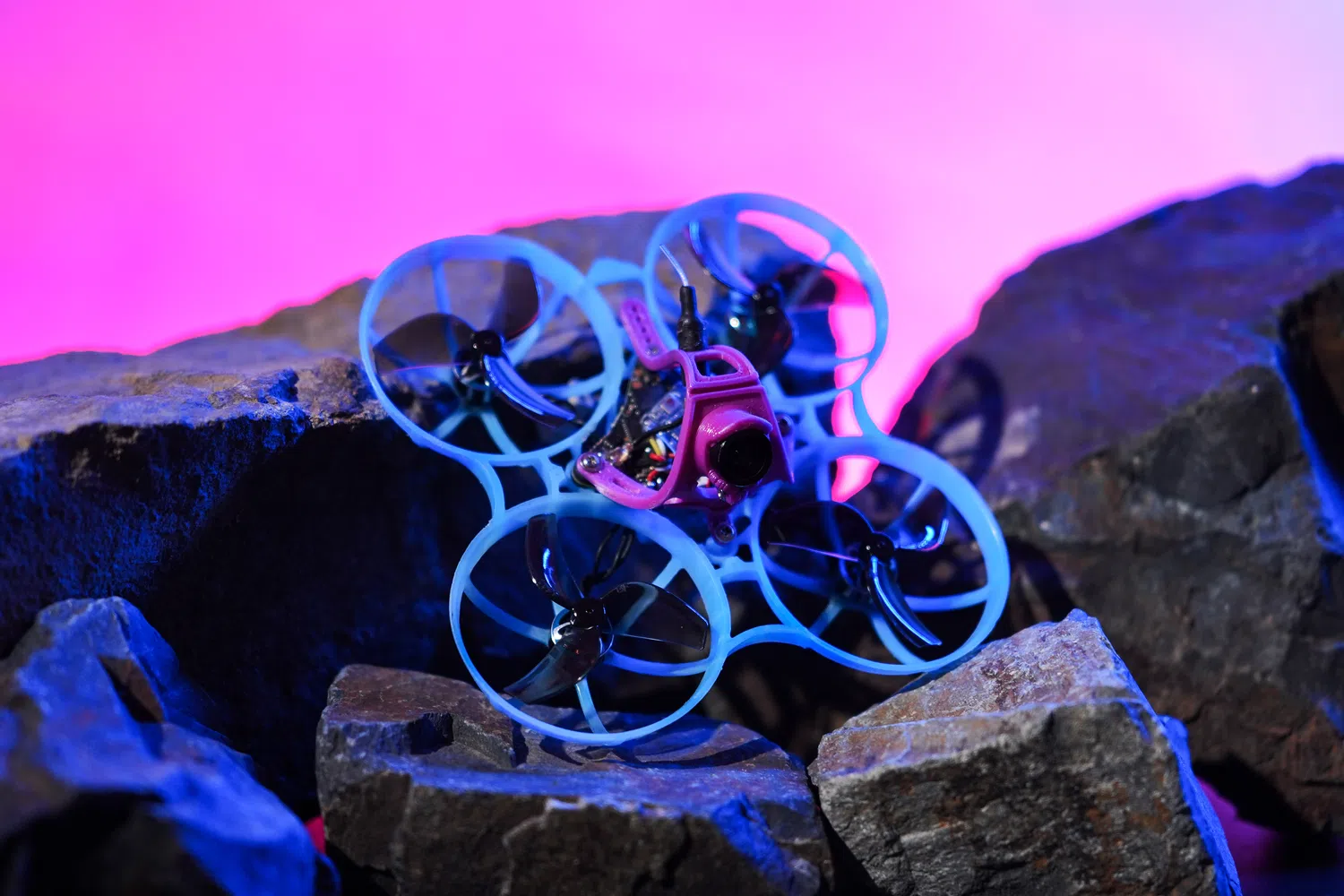
Beyond racing and freestyle, this same design discipline extends to niche competitive formats such as drone soccer, where propellers must survive high-frequency collisions inside a ball cage without power failure, and to ultra-light "toothpick" and indoor whoop platforms measuring as small as 31mm, where blade tip thickness reduction is pushed to its physical limit—exemplified by a 1207 whoop propeller weighing just 0.15 grams per piece.
4.1 Advantages of Racing-Specific Propeller Design
· Strong corner locking: optimized blade tip vortices and disk airflow distribution maintain stable thrust output through high-speed cornering, eliminating side-slip for precise line tracking.
· Dynamic anti-propwash performance: specialized airfoil geometry improves resistance to turbulence during violent maneuvers, preventing sharp thrust drops that would otherwise destabilize attitude control.
· Collision recovery resilience: high-toughness composite materials with gradient stiffness structural design allow blades to withstand impact without breaking or severe deformation, supporting rapid recovery after crashes.
· Champion-verified engineering: joint development with world-championship-level pilots—reflected in signature propeller series—feeds real-world flight feedback directly back into aerodynamic iteration, a validation method distinct from lab-only testing.
· Record-level top-speed performance: proprietary high-speed aerodynamic optimization has enabled a micro-UAV to reach a documented 358.36 km/h, illustrating the upper performance ceiling achievable through dedicated racing propeller engineering.
5. One-Stop OEM/ODM Customization for the US Drone Manufacturing Market
US-based drone manufacturers and system integrators face a common structural challenge: developing a proprietary propeller in-house requires aerodynamic design expertise, CFD simulation infrastructure, and high-precision mold development capability that most companies do not maintain internally. The result is either a prolonged, high-cost R&D cycle or reliance on generic standardized blades that fail to match a specific model's power characteristics and mission requirements.
A one-stop OEM/ODM customization service addresses this gap by providing full-chain delivery—from conceptual design and CFD simulation through mold development, mass production, and patent licensing—within a single vertically integrated relationship. This model allows a US brand to move from concept to mass-produced propeller without assembling an internal aerodynamics team.
5.1 Advantages of Partnering with a Vertically Integrated Propeller Manufacturer
· Requirement analysis and system matching: propeller design is coordinated with motor and ESC specifications from the outset, ensuring the finished component is optimized for the client's complete power system rather than treated as an isolated part.
· Material flexibility: access to multiple composite options—including PC and glass fiber reinforced nylon—allows the strength, weight, and cost balance to be tuned to the specific mission, whether that is agricultural plant protection, logistics delivery, or underwater propulsion.
· Full-process quality control: every production batch passes through modern testing equipment, including dynamic balancers and tension testers, before shipment, supporting consistency across large OEM order volumes.
· IP support and patent licensing: access to a portfolio of 60+ domestic and international design patents provides compliance guarantees and intellectual property layout guidance for customized products entering competitive markets.
· Global distribution readiness: manufacturers already exporting to more than 60 countries and regions, and reaching customers through international e-commerce channels such as Alibaba International and Amazon, bring established cross-border logistics experience that simplifies market entry for US-facing product lines.
· Certification alignment: ISO 9001:2015 quality management certification and EU mechanical safety compliance (EN ISO 12100 and EN 60204-1) demonstrate the kind of regulatory documentation increasingly expected by commercial and industrial UAV buyers evaluating OEM partners.
Taken together, these capabilities illustrate why drone propeller OEM manufacturing has evolved from a narrow component-supply function into a strategic engineering partnership—one that spans cinematic aerial photography, industrial heavy-lift operations, and competitive FPV racing under a single technical framework.