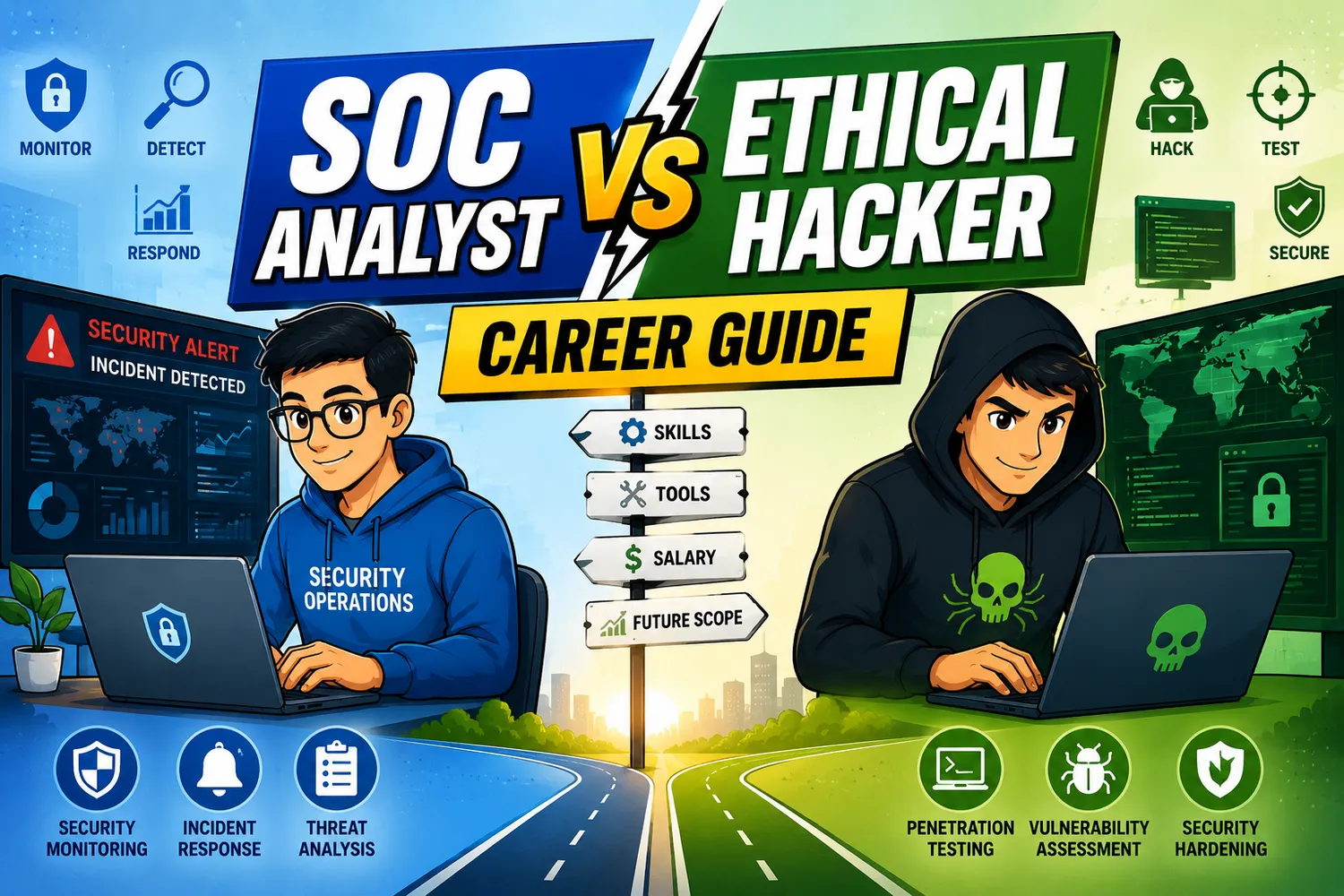
Quick Answer: There is no wrong choice here. Both the SOC Analyst and Ethical Hacker careers offer purpose, strong pay, and long-term growth. Start building your foundation today, stay consistent with your learning, and you will carve out a powerful career in one of the most exciting fields in the world.
If you are standing on the crossroads of a cybersecurity career and thinking about a choice between being a SOC Analyst or an Ethical Hacker, you are not alone. This is the problem that thousands of aspiring professionals face every year.
Both roles are sought after, both are lucrative and both are essential to protecting the digital world. But they are very different in kind, in skill set, in the day-to-day reality.
Let's break it all down to help you make a confident, informed decision.
What Does a SOC Analyst Actually Do Every Day?
A SOC (Security Operations Center) Analyst is your organization's first line of defense. You sit inside a monitoring hub, watching dashboards, analyzing alerts, and responding to threats in real time. Your job is to detect suspicious activity before it turns into a full-blown breach.
You're triaging security incidents every day, investigating logs, and coordinating with other teams to contain threats. You work shifts, you have structured playbooks and you stay sharp when the pressure is on. It’s a fast-paced, high-responsibility role that demands sharp analytical thinking and a cool head in a crisis.
What Does an Ethical Hacker Do and Why Does It Matter?
An Ethical Hacker, also known as a penetration tester, does the opposite — they attack systems legally to find weaknesses before the bad guys do. You think like a criminal, act like one, and then report everything you find so the organization can fix it.
Understanding Ethical Hacking Basics is the starting point for anyone who wants to pursue this path. At its core, ethical hacking is about simulating real-world attacks — phishing, SQL injection, privilege escalation, and more — in a controlled and authorized environment. The goal is always to strengthen security, not exploit it.
SOC Analyst vs Ethical Hacker: Core Skill Sets Compared
This is where it gets interesting. The skills required for each role differ, and understanding the distinction allows you to choose the appropriate training path from day one.
SOC Analyst skills to build:
- Gain Experience with SIEM tools such as Splunk, IBM QRadar, or Microsoft Sentinel
- Good understanding of log analysis and network traffic monitoring and incident response
- Knowledge of threat intelligence frameworks such as MITRE ATT&CK
- Ability to triage and prioritize alerts quickly under pressure
- Familiarity with firewall rules, IDS/IPS systems, and endpoint detection tools
Ethical Hacker skills you need to master:
- Deep knowledge of Ethical Hacking Fundamentals including reconnaissance, scanning, exploitation, and reporting
- Hands-on experience with tools such as Metasploit, Burp Suite, Nmap and Wireshark
- Scripting abilities in Python, Bash or PowerShell
- Understanding of web application security, network protocols and OS vulnerabilities
- Ability to create concise professional penetration testing reports for customers
Both positions require a strong foundation in networking, operating systems and security concepts. But using that knowledge is something else entirely.
Certifications That Define Your Career Path in Each Role
Cybersecurity certifications help validate your skills and improve your job opportunities. Whether you choose SOC analysis or ethical hacking, certifications can accelerate your career growth.
Best Certifications for SOC Analysts
- CompTIA Security+
- Cisco CyberOps Associate
- Certified SOC Analyst (CSA)
- GIAC Certified Incident Handler (GCIH)
Top Certifications for Ethical Hackers
- Certified Ethical Hacker (CEH)
- Offensive Security Certified Professional (OSCP)
- eLearnSecurity Junior Penetration Tester (eJPT)
- CompTIA PenTest+
Certifications not only strengthen your resume but also improve your practical cybersecurity knowledge.
Salary, Job Market, and Career Growth: Where Do You Stand?
Let us talk numbers, because career decisions are also financial decisions.
SOC Analysts typically start between $65,000 and $71,000 annually, with senior analysts and SOC leads earning well over $90,000.
The demand is massive — organizations of every size need around-the-clock monitoring, which means job stability is exceptionally strong.
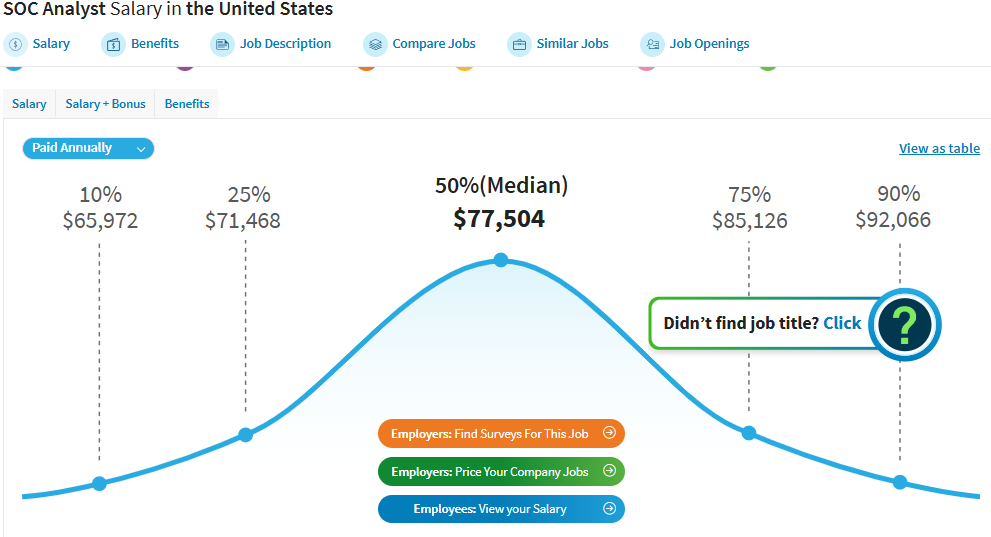
Source: https://www.salary.com/research/salary/listing/soc-analyst-salary
For Ethical Hackers and penetration testers, the earning potential climbs higher. According to ZipRecruiter, the average annual pay stands at $119,895.
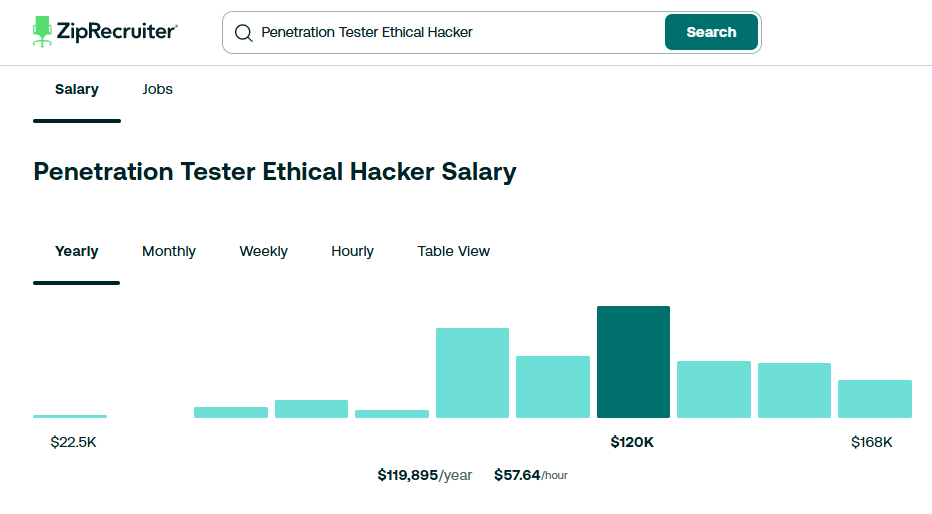
Source: https://www.ziprecruiter.com/Salaries/Penetration-Tester-Ethical-Hacker-Salary
Also Explore: Is Ethical Hacking a High Income Career in 2026?
How Ethical Hacking Essentials Shape the Way You Think as a Security Pro
Whether you choose the SOC path or the offensive security path, learning Ethical Hacking Essentials will make you a sharper, more well-rounded professional. Understanding how attackers think and operate helps SOC Analysts detect threats with far greater accuracy and context.
When you know what a phishing campaign looks like from the attacker's side, you catch it faster on the defender's side. Ethical Hacking Essentials are not just for penetration testers — they are a mindset shift that every cybersecurity professional benefits from.
The best SOC Analysts always carry some offensive knowledge, and the best ethical hackers understand how defense works.