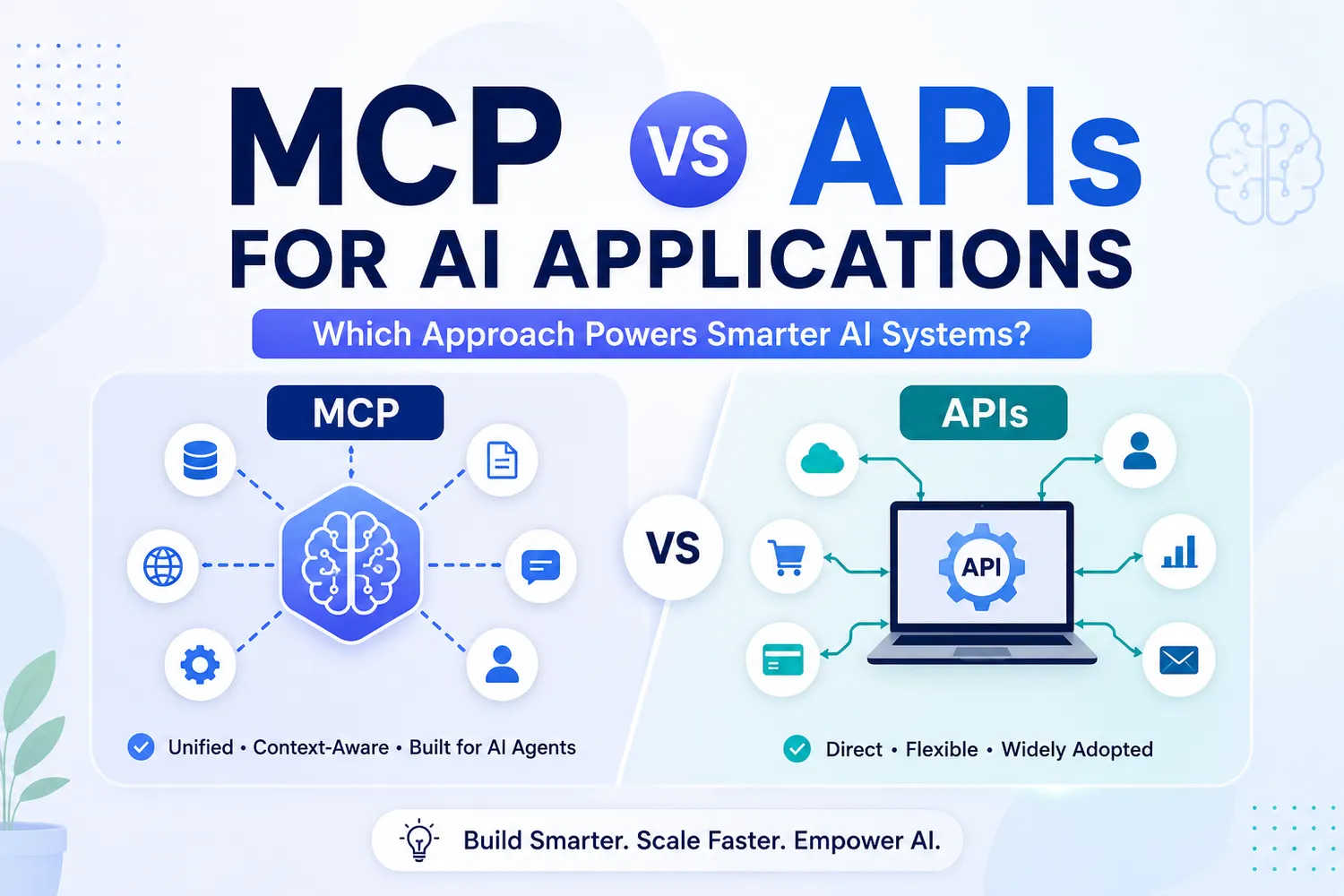
The way AI applications communicate with the world is evolving at a breakneck pace. For years, APIs were the undisputed standard — the universal handshake between software systems.
But as AI agents grow more autonomous, more capable, and more context-aware, a new protocol is entering the conversation: MCP, or the Model Context Protocol.
If you're building AI applications today, understanding how MCP and APIs differ — and when to use each — is one of the most consequential technical decisions you'll make.
What Are APIs and How Have They Powered AI Applications?
APIs, or Application Programming Interfaces, are the bedrock of modern software communication. They define exactly how two systems exchange data — typically over HTTP using REST or GraphQL — with structured requests and predictable responses. For AI applications, APIs have long served as the essential bridge between a model and the external world it needs to interact with.
When an AI system needs to retrieve data, trigger a service, or push an action, it makes a specific API call with precise headers, authentication tokens, and parameters. This structure is reliable, well-documented, and battle-tested across every industry you can think of.
The problem it has it that its inherently rigid — and rigidity becomes a liability the moment your AI needs to think, plan, and act autonomously across unpredictable real-world scenarios.
What Is MCP and Why It's Reshaping How AI Agents Communicate
MCP — the Model Context Protocol, developed by Anthropic — is an open standard that enables AI models to dynamically discover and interact with tools, data sources, and services without needing hard-coded API logic written in advance by a developer. Instead of pre-programming every tool interaction, MCP allows the model to understand what's available and decide in real time how to use it.
That's a real architectural change in how we think about AI connectivity. APIs are instruction-heavy and developer-driven, while MCP is intent-driven and agent-native. MCP is one of the early foundational patterns you will be introduced to if enrolled in a Agentic AI course. It is at the heart of how autonomous agents perceive, reason and act in their environments.
Key Differences Between MCP and APIs in AI Application Development
Let's get specific. Here's how MCP and APIs compare across the dimensions that matter most when you're building real AI systems:
- Discoverability: APIs are static — you must know an endpoint exists before you can call it. MCP enables agents to discover available tools dynamically at runtime, with no prior developer configuration required.
- Context Awareness: APIs return raw structured data. MCP passes context-rich information that the model can actively interpret and reason over — not just consume and forward blindly.
- Tool Orchestration: With APIs, orchestration logic lives in developer-written application code. With MCP, the agent itself decides which tools to invoke and in what sequence, based on its reasoning.
- Error Recovery: API errors require pre-written fallback paths baked into your codebase. MCP-powered agents can reason about failures and attempt alternative strategies entirely on their own.
- Developer Overhead: APIs demand significant integration work, documentation upkeep, and maintenance cycles. MCP abstracts that communication layer so your agent handles more of the complexity itself.
These distinctions are central to the Agentic AI fundamentals that every serious AI developer needs to internalize before designing systems that can actually perform in production environments.
When APIs Still Make the Smarter Choice in Your AI Stack?
MCP is a powerful and exciting technology, but it is not the best choice for every situation. In many cases, traditional APIs are still a simpler and more effective option. Understanding when to use APIs and when to use MCP is essential for building efficient and successful AI applications. Check the following points for more details.
- Simple, predictable workflows: When your AI consistently follows one or two fixed call patterns, APIs are faster to configure, easier to monitor, and far simpler to debug under pressure.
- Legacy enterprise compatibility: Most enterprise infrastructure still runs on REST APIs. You don't need to rip and replace what already works well — APIs bridge the gap efficiently and cost-effectively.
- Fine-grained control requirements: APIs give you exact governance over retry logic, authentication flows, rate limiting, and response formatting that MCP can't always replicate with the same precision.
- Latency-critical workloads: In scenarios where every millisecond counts, a direct API call can outperform routing traffic through an MCP server layer quite substantially.
- Third-party services without MCP support: The MCP ecosystem is growing fast, but most SaaS platforms still speak REST. APIs remain the practical default for those integrations today.
When MCP Becomes the Better Option?
MCP shines in environments where AI systems need extensive interaction with multiple tools and resources.
Consider MCP when:
- Building autonomous AI agents
- Managing numerous external integrations
- Creating complex multi-step workflows
- Scaling AI capabilities across departments
Also Read: What is MCP in AI Development?
Final Verdict
The debate between MCP and APIs is not about choosing a winner. Instead, it is about selecting the right tool for your specific AI objectives.
APIs remain the foundation of modern software integration, offering reliability, security, and widespread adoption. MCP introduces a new layer designed specifically for AI agents, providing streamlined access to resources, improved context management, and enhanced scalability.
If your AI project involves straightforward integrations, APIs may be all you need. However, if you're building sophisticated AI agents capable of interacting with multiple tools and systems autonomously, MCP deserves serious consideration.
As AI technology continues to evolve, understanding both MCP and APIs is becoming increasingly important. Whether you're exploring AI for the first time or enhancing your skills through an Agentic AI course, mastering these technologies will help you build smarter, more efficient, and future-ready AI applications.