If you are a developer trying to figure out where to start with Agentic AI, you are not alone. Space is moving fast, the terminology is everywhere, and it honestly feels like everyone already knows something you do not. But here is the truth — most people are just getting started too.
This roadmap is for developers who want a clear, step-by-step path to actually learning Full Stack Agentic AI, from the foundational concepts all the way to building systems that can think, plan, and act on their own.
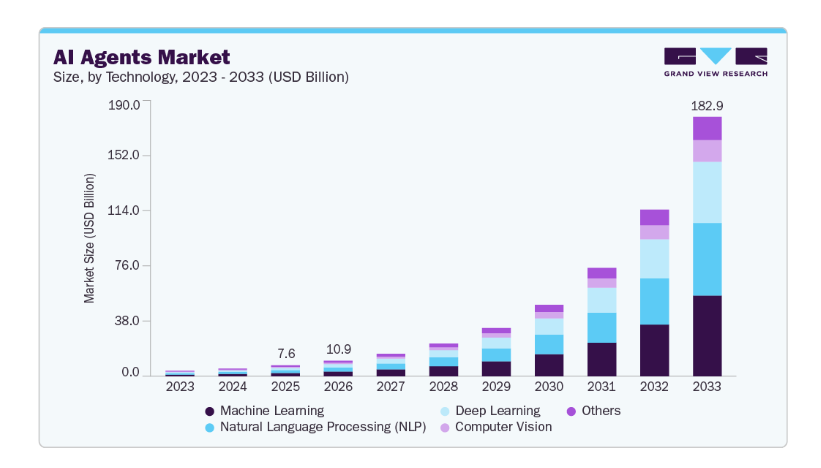
Source: https://www.grandviewresearch.com/industry-analysis/ai-agents-market-report
What Full-Stack Agentic AI Actually Means?
Before you start learning anything, it is important to know what you are actually learning. Full Stack Agentic AI is not just about calling an API and getting a response back. It is about building AI systems that can take a goal, break it down into steps, use tools, make decisions, and complete tasks — all without you holding their hand at every turn.
The "full-stack" part means that you are working on more than one layer. You are setting up the backend logic, deciding what tools and memory the agent can use, keeping track of the state between actions, and often making a frontend interface where users can talk to these agents. It covers a lot of ground, which is what makes it so useful. It is hard to find developers who understand the whole picture, and companies are paying a lot of money to find them right now.
Why Are Developers Rushing to Learn This?
There is a reason your LinkedIn feed is full of posts about agents. This is not just another tech trend. The demand is real, and here is why developers are prioritizing this skill set above almost everything else right now:
- Job market shift: Companies are not just hiring AI researchers anymore. They want developers who can build AI-powered products from end to end, and Agentic systems sit right at the center of that demand.
- Automation at scale: Agents can handle workflows that previously required entire teams. Developers who can build these systems are essentially multiplying with productivity, and businesses know it.
- It builds on what you already know: If you know Python, APIs, and basic backend development, you already have most of the prerequisites. Agentic AI is an extension of your existing skills, not a full restart.
- The tooling has matured: Frameworks like LangChain, CrewAI, and AutoGen have made it much more accessible to build agents without needing a PhD in machine learning.
- Competitive advantage: Getting ahead of this curve now puts you years ahead of developers who wait until the market is saturated.
Where to Begin Your Learning Path?
The best place to start is structured learning. Jumping straight into documentation works for some people, but most developers find they move faster with a proper curriculum behind them.
If you are looking for something with broad credibility, Agentic AI Coursera programs are worth exploring. The platform lets you learn at your own pace, which is a huge plus if you are balancing this with a full-time job.
Start with a course that covers the theory first, then moves into hands-on projects. Theory without practice leads nowhere, and practice without theory leads to messy, unmaintainable code.
What Does the Right Learning Program Actually Cover?
When you are evaluating a program, here is what solid Agentic AI training should include:
- Agent reasoning and planning: Understanding how agents decompose goals into subtasks and how they recover when a step fails.
- Tool integration: How to give your agent access to web search, databases, code execution, APIs, and external services.
- Memory systems: Short-term context vs. long-term vector storage and knowing when to use each.
- Multi-agent collaboration: How to build systems where multiple agents work together, delegate tasks, and communicate.
- Evaluation and safety: How to test agent behavior, catch failure modes, and make sure your agent does not go rogue on production.
- Deployment: Moving from a Jupyter notebook to a live, scalable system that real users can interact with.
Should You Pursue a Certification?
This is a question a lot of developers sit on. Certifications are not magic, but in a field this new, they do carry weight. An Agentic AI certification signals to employers and clients that you went through a structured curriculum, did the projects, and have a baseline competency that can be verified.
More practically, going through an Agentic AI certification course forces you to actually finish the material. A certification gives you a deadline, a goal, and something concrete to put on your resume when you are done.
How to Build Real Projects While Learning?
Roadmaps without projects are just reading lists. At every stage of your learning, you should build something. Start small — a simple agent that can search the web and summarize results. Then level up to multi-step workflows. Then try building something with memory that can carry context across sessions.
The goal is not to build something perfect. The goal is to understand what breaks, why it breaks, and how to fix it. Real learning in Agentic AI happens at the edges of what your system can handle. Push your agent into edge cases on purpose. That is where the real understanding lives.
How to Keep Moving Once the Basics Click?
Once you know the basics, the roadmap changes from structured learning to ongoing discovery. Every few weeks, new agent frameworks and methods come out. Join groups where developers talk about what they are working on. Contribute to open-source agent projects. Start writing about what you are learning — explaining something clearly is one of the best ways to find gaps in your own understanding.
Also, revisit your Agentic AI course material. Concepts that felt abstract in week one will make complete sense after you have built three or four projects. Repetition with context is underrated.
Conclusion
Learning advanced Full Stack Agentic AI as a developer is genuinely one of the best investments you can make in your career right now. The path becomes clear when you follow it one step at a time. Pick something structured and credible to start — there are solid programs through Agentic AI Coursera offerings that pair theory with real project work and give you something worth putting on your profile when you are done.
You do not need to learn everything at once. You just need to start, stay consistent, and keep building. The developers who do that right now are the ones who will be in the best position as this technology becomes the new standard across every industry.
The roadmap is in front of you. The next step is yours.