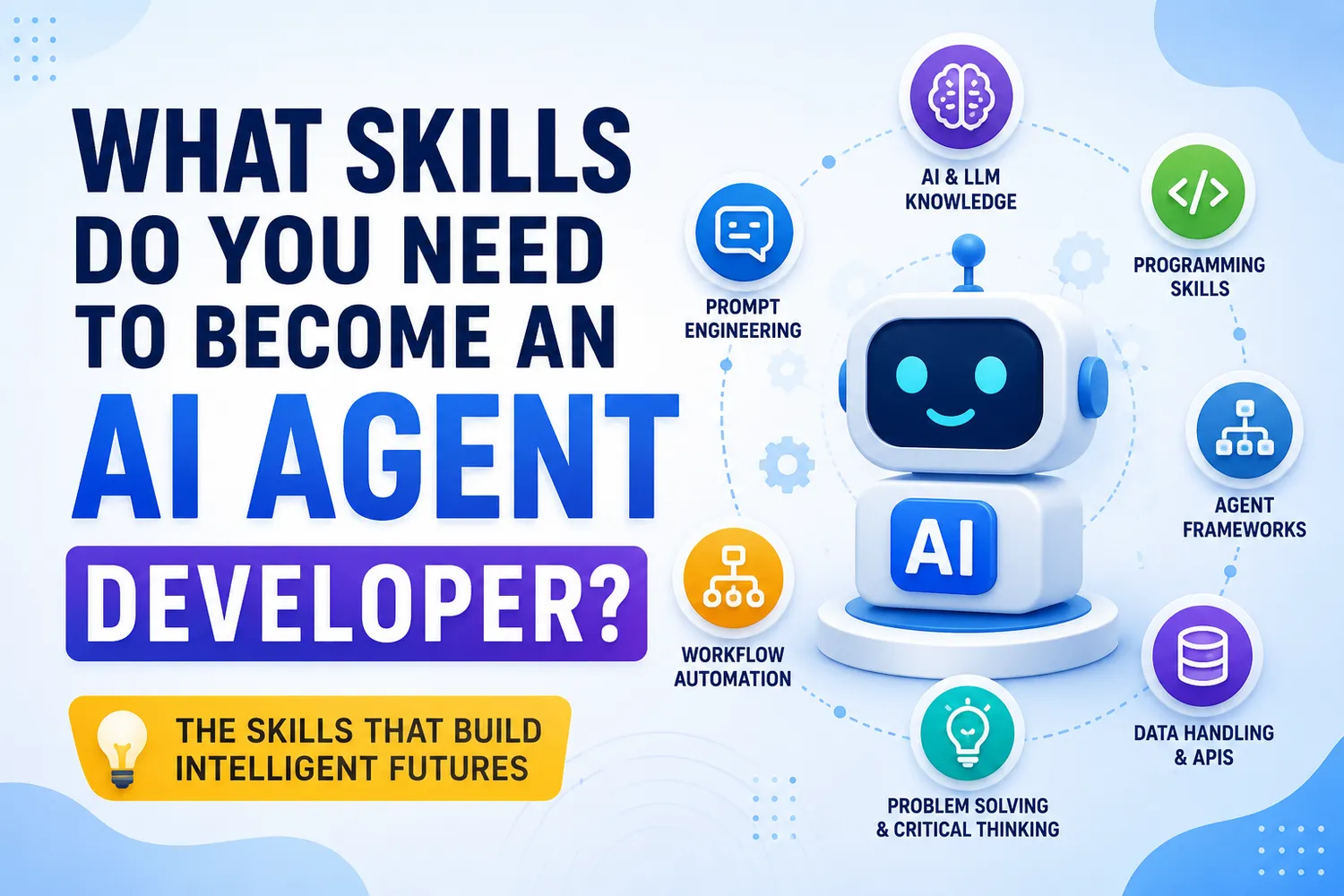
AI agents are rapidly transforming the way businesses work.
From automating tasks to making intelligent decisions, these systems are creating huge demand for professionals who know how to build and manage them.
The opportunity is exciting—but becoming an AI Agent Developer requires more than just learning a few AI tools. You need the right mix of technical skills, problem-solving ability, and practical knowledge of how AI agents operate.
Let's explore the essential skills that can help you build a successful career in this exciting field.
The Programming Skills Every AI Agent Developer Must Have
If you want to build AI agents professionally, learning Python is non-negotiable. It powers the most popular agent frameworks — LangChain, AutoGen, CrewAI — and has the richest ecosystem of AI libraries available anywhere.
In addition to Python, you'll need a working knowledge of APIs, asynchronous programming, and Git version control. These are not optional add ons — they are the scaffolding that keeps actual production systems standing.
When your agents interact with web environments or browser-based tools, JavaScript is also involved.
Understanding AI and Machine Learning at a Functional Level
You don't need a research background to become a great AI agent developer — but you do need to understand how LLMs work. Knowing how models generate outputs, how prompts shape behavior, and how memory and context windows affect reasoning will directly influence how well your agents perform.
Grasping the Agentic AI fundamentals things like tool use, chain-of-thought reasoning, and multi-step planning — separates developers who build working agents from those who build demo-only systems.
Study topics like neural network architectures, tokenization, and embeddings. The deeper your grasp of these foundations, the more control and precision you'll have over your agent's behavior.
The Must-Have Soft Skills AI Agent Developers Rarely Talk About
Technical ability will get you started, but it's the soft skills that make you exceptional — and employable. Here's what you genuinely need alongside your coding chops:
- Systems thinking: AI agents rarely operate alone. They fit into larger pipelines, coordinate with other agents, and interact with external tools. You need to see how each component affects the whole — not just the piece you're building.
- Problem-solving mindset: Great agent developers love breaking down messy, open-ended problems into precise, executable steps. If you enjoy puzzles and logical structure, this role is built for you.
- Adaptability: The AI space moves at a blistering pace. New models, new frameworks, and new best practices emerge constantly. Developers who stay curious and keep learning will always stay ahead.
- Clear communication: Whether you're explaining your agent's logic to a non-technical stakeholder or documenting your code for your team, the ability to articulate complex ideas simply is incredibly valuable.
- Attention to detail: A poorly structured prompt or a missed edge case can bring an entire agent pipeline down. Precision in your thinking translates directly into reliability in your systems.
Tools and Frameworks That Power Production-Ready AI Agents
Knowing which tools to reach for — and when — is a real competitive edge in this field. Start with LangChain and LangGraph for building complex, multi-step agent workflows. These frameworks handle memory management, tool integration, and conditional decision logic with remarkable elegance.
You must be comfortable with vector databases like Pinecone or ChromaDB, which lets your agents retrieve and reason over large knowledge bases in real time. If your agent interacts with the web, reads files, or runs code, tools like Playwright and the OpenAI function-calling API become essential parts of your stack.
Orchestration is another skill set worth prioritizing. Knowing how to coordinate multiple agents, manage shared state, and build in failure recovery is what takes your systems from prototype to production.
Building Real Projects Is Where Learning Becomes Expertise
Here's something most people underestimate — you learn more from building one imperfect agent than from reading ten tutorials. Real projects expose you to the edge of cases, failures, and constraints that no course can fully prepare you for.
Keep it simple. Make an automation agent. Then a research agent scans the web and synthesizes results. Gradually work towards multi-agent pipelines where different agents work together towards a common goal.
Every project you complete enhances your understanding of the Agentic AI fundamentals in ways that pure theory just can’t.
Put your work on GitHub, write about what you’re building, and engage with developer communities. Building in public is one of the fastest ways to learn things faster than anything else.
You can also explore: What Is The Best Way To Learn Agentic AI in 2026?
Choosing the Right Learning Path
With countless online resources available, selecting the right learning path can be challenging.
Many courses cover AI concepts, but not all focus specifically on agent development. This is why learners often look for programs that combine theory with practical implementation.
One option worth considering is the Agentic AI Foundations: MERN, RAG, and MCP course on Coursera. Unlike general AI courses, it focuses on the technologies and concepts that are becoming increasingly important in modern AI agent development.
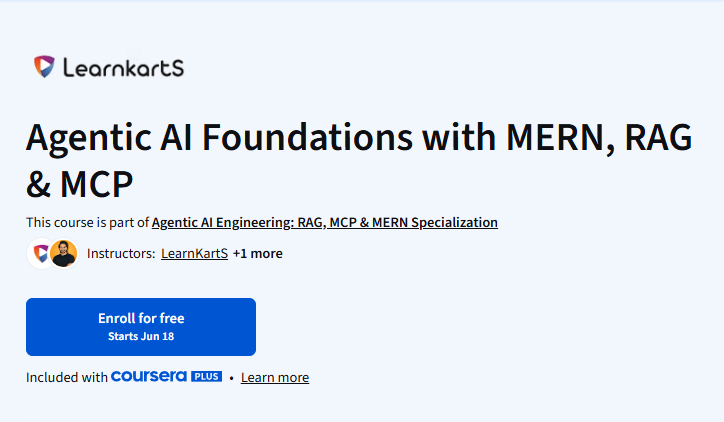
The course helps learners build a strong understanding of Agentic AI foundations while introducing practical concepts such as Retrieval-Augmented Generation (RAG), the Model Context Protocol (MCP), and full-stack AI application development.
This hands-on approach can make it easier to understand how real-world AI agents are built and deployed.
Conclusion
Becoming an AI Agent Developer is not about mastering one skill—it is about combining several complementary abilities that work together.
You need programming knowledge, an understanding of Large Language Models, Prompt Engineering expertise, API integration skills, and strong problem-solving capabilities. On top of that, learning system design and staying updated with industry trends will help you remain competitive in this rapidly evolving field.
The journey may seem challenging at first, but every skill you learn brings you one step closer to building intelligent systems that can transform how businesses and individuals work.