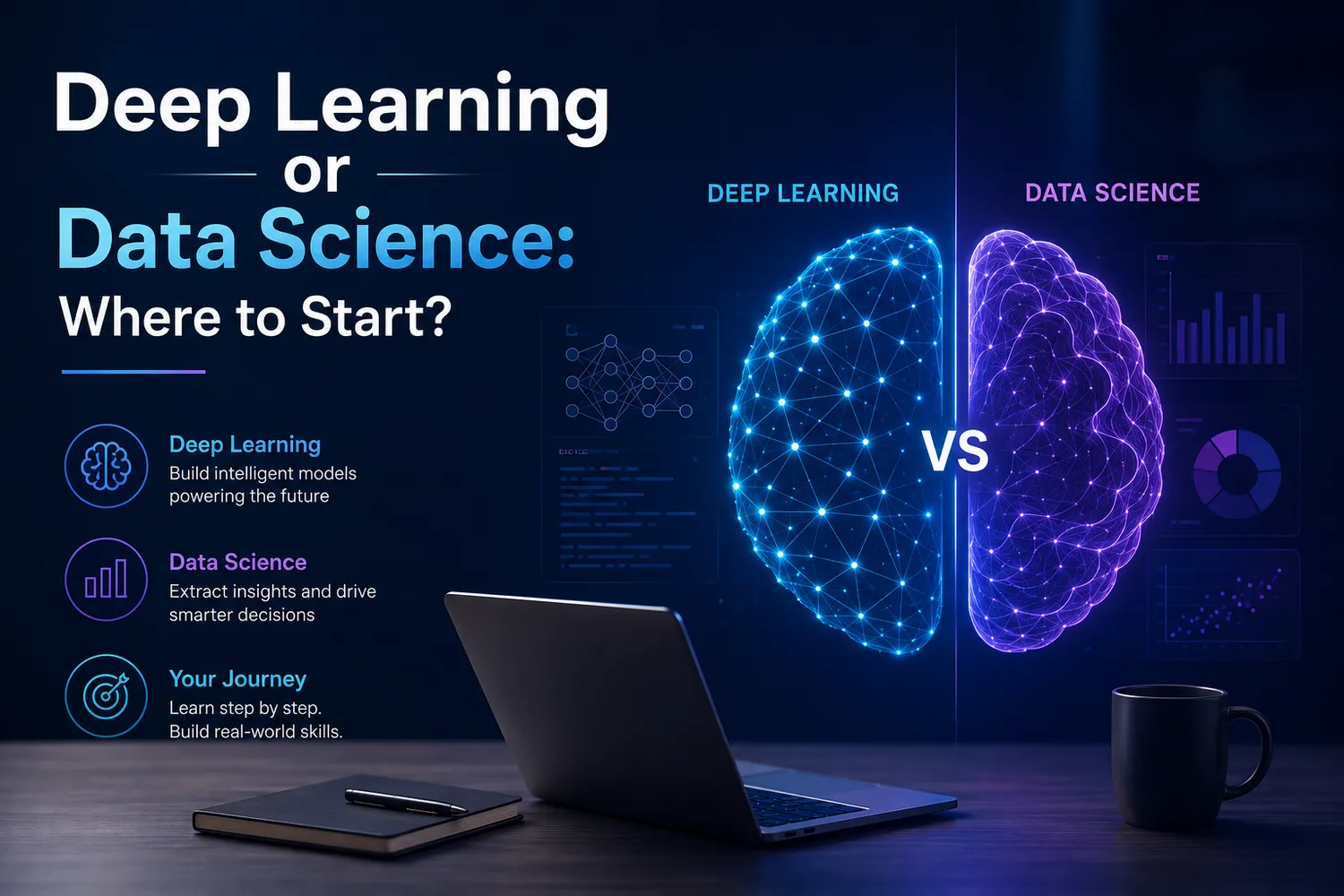
Understanding Data Science First
Data science focuses on extracting insights from data. It combines statistics, programming, data visualization, and analytical thinking to solve business and research problems. Data scientists work with structured and unstructured data, identify trends, build predictive models, and help organizations make informed decisions.
For beginners, data science often feels more approachable because it introduces fundamental concepts such as data cleaning, exploratory analysis, and machine learning. These skills create a strong foundation for working with AI systems later.
Many professionals begin their journey in data science because it provides exposure to real-world datasets and practical problem-solving techniques before moving into more advanced AI topics.
What Is Deep Learning?
Deep learning is a specialized branch of machine learning that uses neural networks to process large amounts of data. It powers technologies such as image recognition, voice assistants, recommendation engines, and autonomous systems.
Unlike traditional machine learning models, deep learning architectures can automatically identify complex patterns in data. However, this capability comes with increased complexity. To fully understand how these models work, learners often need a solid grasp of programming, mathematics, and machine learning concepts.
This is why many experts recommend learning some data science concepts before diving deeply into neural networks.
When Should You Start Deep Learning?
Starting directly with deep learning can be a good option if your primary goal is to work on AI applications such as computer vision, natural language processing, or generative AI.
However, beginners should first understand the deep learning basics before exploring advanced architectures. Learning neural networks without understanding data preparation, model evaluation, and machine learning principles can make the process much harder.
Data Science vs. Deep Learning: Which Is Easier?
For beginners, data science is generally easier to start with because it introduces concepts in a more gradual way. You'll learn how data is collected, analyzed, and transformed into meaningful insights.
Deep learning, on the other hand, often requires additional knowledge of mathematics, optimization techniques, and neural network architectures. While modern tools simplify implementation, understanding the underlying concepts remains important.
If you're unsure where to begin, data science usually provides the smoother learning curve.
A Practical Learning Path
Rather than viewing data science and deep learning as competing choices, think of them as complementary skills.
A practical roadmap looks like this:
- Learn Python programming.
- Understand statistics and data analysis.
- Study machine learning fundamentals.
- Explore neural networks and AI concepts.
- Build projects using modern deep learning frameworks.
This approach helps you learn deep learning more effectively because you'll already understand how data flows through the entire AI pipeline.
Learning Resources Matter
Today, there are numerous online programs designed to help beginners transition from machine learning to advanced AI concepts. Deep Learning course on Coursera often provide guided projects, quizzes, and hands-on exercises that simplify complex topics.
For those interested in understanding how neural networks work behind the scenes, studying deep learning from scratch can provide valuable insights into model design and training processes. Comprehensive beginner-friendly courses that focus on foundational concepts can be especially helpful for building long-term AI expertise.
Final Verdict
If you're completely new to AI, starting with data science is often the safest and most effective choice. It builds analytical thinking, introduces machine learning concepts, and creates a strong foundation for advanced AI topics.
However, if your goal is to work specifically in artificial intelligence, computer vision, or generative AI, transitioning to deep learning after mastering the basics of data science can accelerate your growth significantly.
The best approach isn't choosing one over the other—it's understanding how both fit together in the modern AI ecosystem and building your skills step by step.