
In 2026, cybersecurity is not just a buzzword—it’s one of the most durable and fastest-growing career industries across countless countries around the world. While companies continue to battle ever-greater digital threats, the need for skilled defensive talent is growing exponentially.
The demand for cybersecurity experts is expected to increase roughly 32 percent during the next decade, according to industry estimates, far outpacing the average rate of growth for other jobs.
If you’re a complete beginner here with no experience, however, you are looking to start out strong in your journey into information security, selecting the best first course for you can be an exciting yet daunting choice.
When there are many more options to choose from in 2026, how will you know which is actually value for your money, good basic knowledge, and relevant to your career?
This article is designed to answer that question—and it’ll direct you toward a single course we recommend above all, but one which falls within the wider landscape of related certifications like CompTIA certification, as well as Security+ certification.
Why a Strong Foundation Matters?
Before embarking on more complex subjects like ethical hacking or digital forensics, a beginner in the industry should have a good understanding of basic concepts in cybersecurity—things like risk management, threat environment, access control, and cryptography.
Our students who get these basics down are not only feeling more confident, but also significantly increasing their chances to land entry-level jobs such as an IT security analyst or security operations associate and become a junior SOC (Security Operations Center) specialist.
Information Security Foundations — A Standout Beginner Course
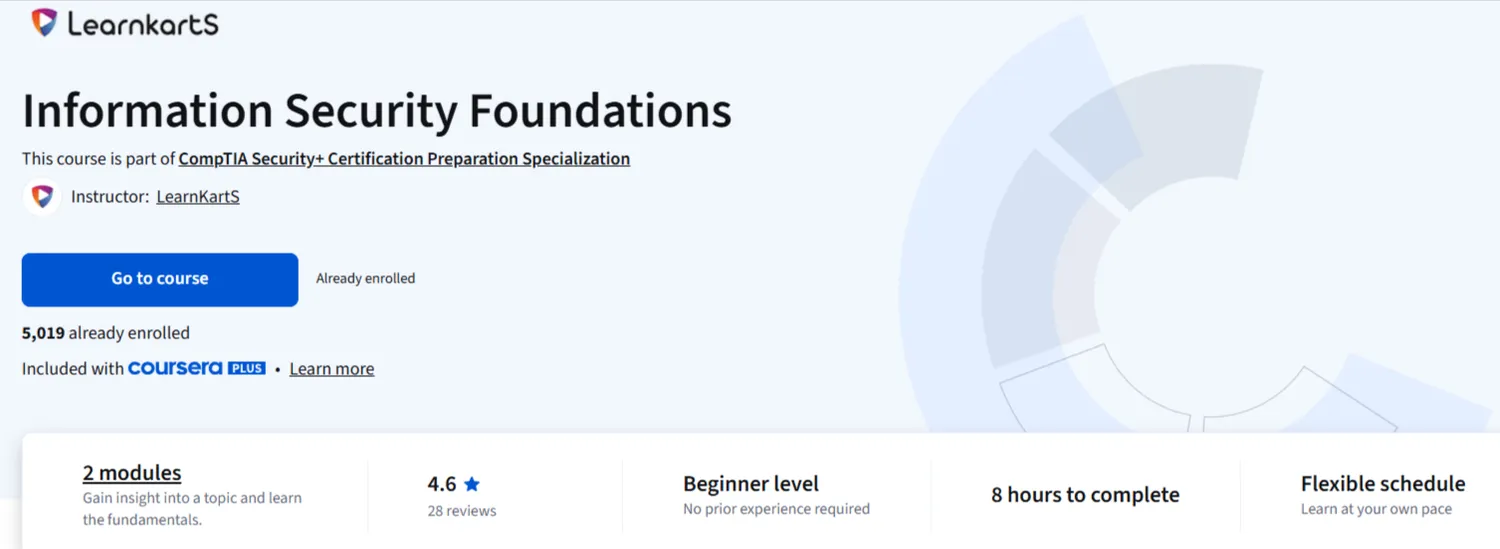
One such course ideal for this purpose is Coursera’s Information Security Foundations. Great for beginners, this course provides an introductory understanding of information security concepts, including the CIA triad (confidentiality, integrity, and availability), threat modeling, risk management, and real-world application of different attack vectors.
Here’s why it makes for a great entry point:
- No prerequisites necessary: You don’t need to have any prior IT experience.
- Flexible pacing: The program can be finished in approximately 8 hours, so working professionals, students, or career changers looking for a quick stint of self-guided learning will find the offering appealing and accessible.
- Solid basics: It provides the tools you need to develop a strong foundation from which you can pursue higher-level training, covering everything from the fundamentals of cryptography to threat analysis.
- Rolls up into a complete certification: It’s part of a broader preparation series for the CompTIA Security+ course specialization, too, so you can make connections between what you learn and industry-accepted credentials.
This balance between accessibility and rigor makes it an excellent entry point to the world of cybersecurity.
The Role of CompTIA Security+ in Your Learning Journey
Once enrolled and you have a solid foundation, you will want to go on to industry-recognized certifications such as the Security+ certification.
CompTIA Security plus certification is one of the most important international entry-level certifications in the field of IT security. It measures vital competencies across several security disciplines such as threat detection, risk management, and network troubleshooting.
Here’s why the CompTIA Security certification is so valuable:
- It’s vendor-neutral, so it is relevant for various technologies and job roles.
- A lot of employers make Security+ a minimum requirement for junior cybersecurity jobs.
- It’s the link between theoretical understanding and practical experience, something that will make your resume stronger and help increase your employability.
The CompTIA Security plus training normally comes with an organized and structured training for the Security+ examination, which also includes practice labs that help prepare you to succeed even if you have no prior experience with computer security.
Comparing the Path Forward
There are more beginner-friendly options, but the course series that starts with Information Security Foundations and continues through to CompTIA Security+ strikes a wise balance between depth, industry recognition, and employability.
- Foundational programs ground you in theory and practice, establishing confidence and clarity.
- Security+ certification jobs give you more opportunities for a better job and show that you are competent in the core security concepts.
This twofold strategy makes certain that you not only learn cybersecurity, but that you can verify your knowledge in a way employers trust.
Conclusion: Your First Step Into a Fast-Growing Field
If you’re ready to start an exciting and future-proof career in information security, first consider studying from a structured, well-crafted foundational course, then move on up by taking a CompTIA certification like CompTIA Security+, which makes perfect sense.
With a robust job market for security professionals and clear career paths forward, 2026 is an excellent time to make the leap.