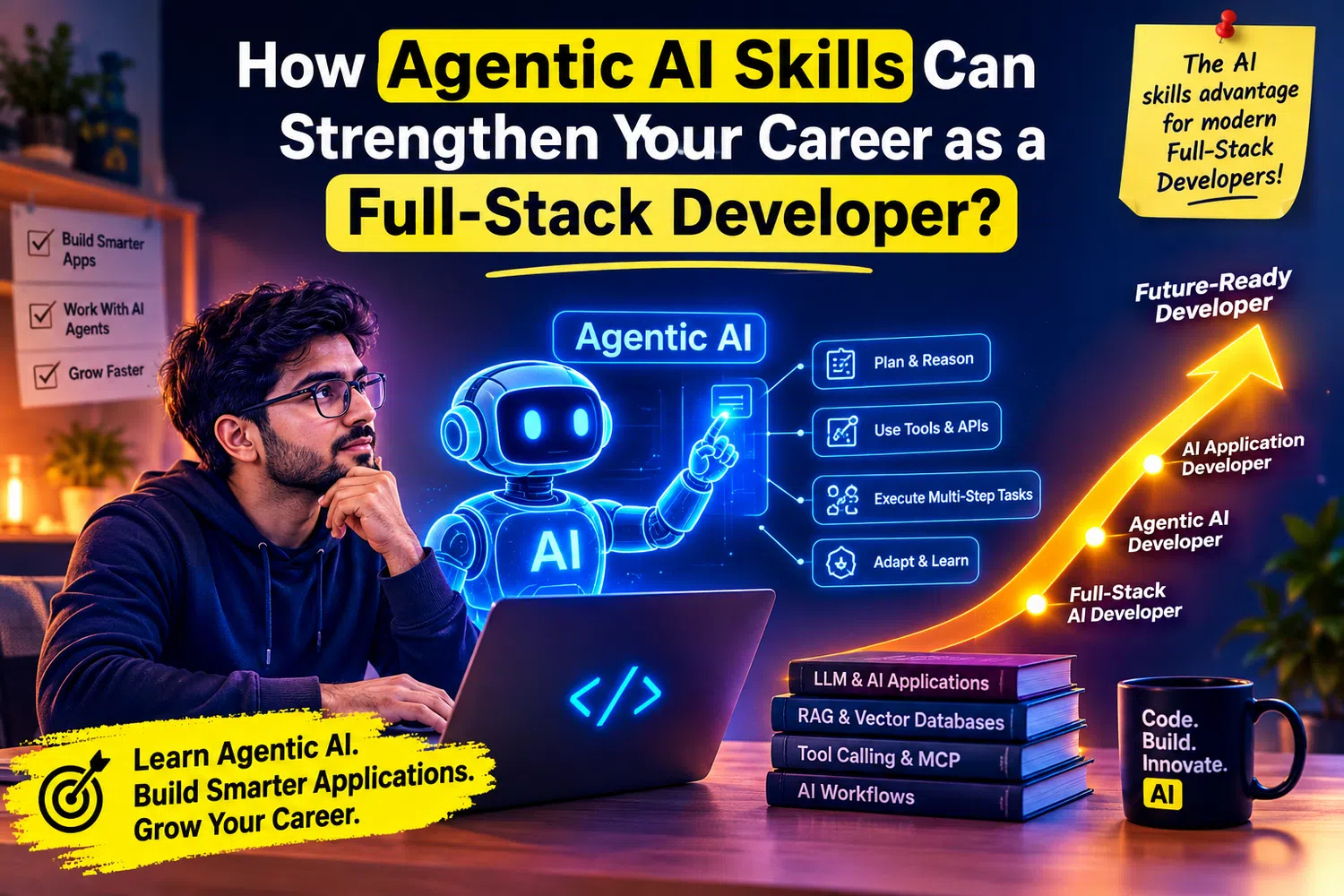
Agentic AI skills can strengthen a full-stack developer’s career by combining traditional software engineering with AI systems that can reason, use tools, execute multi-step tasks, and adapt to changing inputs. This combination can help developers move beyond building conventional applications toward designing intelligent, AI-powered products.
The role of a full-stack developer is already evolving. Developers are no longer expected to only build interfaces, APIs, databases, and backend services. As AI becomes increasingly integrated into software products, understanding how intelligent systems operate—and how to connect them with real applications—is becoming an increasingly valuable technical capability.
What Is Agentic AI and Why Does It Matter for Developers?
Agentic AI refers to AI systems that can interpret goals, plan actions, use tools or APIs, evaluate results, and continue working toward an objective with limited human intervention. Unlike a conventional chatbot that primarily responds to prompts, an AI agent can participate in a multi-step workflow.
For full-stack developers, this creates an important opportunity.
Imagine a customer-support application that does more than answer questions. An agent could retrieve information from a knowledge base, check an order through an API, identify the appropriate action, update a backend system, and return the result to the customer.
Building such applications requires more than knowledge of AI models. It requires frontend development, backend engineering, APIs, databases, authentication, deployment, data handling, and AI orchestration.
That is where full-stack development and agentic AI intersect.
How Agentic AI Skills Complement Full-Stack Development?
Full-stack developers already understand how different layers of an application work together. Agentic AI adds an intelligent decision-making layer to that foundation.
A developer with agentic AI skills can potentially work across areas such as:
Frontend: Creating interfaces through which users interact with AI agents.
Backend: Building services that manage agent workflows and business logic.
APIs and tools: Connecting agents with external services and applications.
Databases: Storing information, context, embeddings, and application data.
RAG systems: Enabling AI applications to retrieve relevant information before generating responses.
Agent workflows: Designing systems that can plan, execute, evaluate, and continue multi-step tasks.
Modern agentic systems commonly combine reasoning with tools, memory, APIs, and feedback loops.
This means your existing full-stack knowledge does not become obsolete. Instead, it becomes the foundation for building more intelligent applications.
5 Career Advantages of Learning Agentic AI
Build More Intelligent Applications
Learning agentic AI enables developers to move from conventional CRUD applications and static workflows toward applications capable of intelligent task execution.
For example, instead of creating a simple dashboard, you could build an AI-powered business assistant that analyzes data, retrieves information, calls APIs, and recommends or executes actions.
2. Expand Beyond Traditional Full-Stack Roles
A developer who combines JavaScript, backend development, databases, APIs, and AI engineering can position themselves for emerging opportunities such as AI application developer, AI engineer, agentic AI developer, or full-stack AI developer.
The emerging software landscape increasingly emphasizes the ability to integrate AI capabilities into production software rather than simply experiment with AI models. Research and industry discussions also point toward verification, validation, and system-level engineering becoming increasingly important as AI agents take on more implementation work.
3. Work With RAG, MCP, and Vector Databases
Modern AI applications often need more than an LLM. They may require retrieval systems, external tools, structured data, memory, and integrations.
Learning technologies such as Retrieval-Augmented Generation (RAG), Model Context Protocol (MCP), vector databases, embeddings, and tool calling can therefore give full-stack developers a broader technical toolkit.
These technologies also provide practical ways to connect AI models with real-world applications and data.
4. Increase Your Ability to Automate Complex Workflows
Traditional automation generally follows predefined rules. Agentic systems can introduce greater flexibility by allowing AI to determine the next action based on context and intermediate results.
For a developer, this can mean building systems for tasks such as research, customer support, data processing, software testing, internal operations, and workflow automation.
5. Stay Relevant as Software Development Evolves
AI is changing how developers write, test, review, and maintain software. The emerging shift is not simply about AI generating code; it is increasingly about developers supervising intelligent systems that can perform larger portions of development workflows.
Developers who understand both how to build software and how to engineer AI-powered systems can therefore develop a stronger long-term skill profile.
What Should You Learn in an Agentic AI Course?
A useful agentic AI course should go beyond prompt engineering and introduce the technologies required to build functional AI applications.
A practical learning path can include:
Large language model fundamentals and AI application architecture
Prompt engineering and structured outputs
RAG and embeddings
Vector databases and semantic search
Tool calling and API integration
MCP and agent communication
Agent workflows and orchestration
Backend integration with AI systems
Frontend interfaces for AI applications
Deployment, evaluation, security, and production considerations
This approach makes agentic AI training particularly valuable for full-stack developers because it connects AI concepts with the software engineering skills they already possess.
Is an Agentic AI Certification Course Worth It for Full-Stack Developers?
An agentic AI certification course can be useful when it provides structured learning and, more importantly, opportunities to demonstrate practical skills.
However, the certificate itself should not be the only goal.
For developers, the strongest outcome is being able to explain and demonstrate how an AI application works—from the frontend and backend to retrieval, tool calling, agent workflows, databases, and deployment.
A portfolio containing one or two meaningful AI-powered applications can make your learning much more tangible to employers.
How to Start Learning Full-Stack Agentic AI?
If you already understand full-stack development, you do not necessarily need to start from zero. Begin by strengthening your understanding of LLM-based applications, then progress toward RAG, vector databases, tool calling, MCP, and autonomous agent workflows.
One structured option is the Full Stack Agentic AI Course on Reed.co.uk by Learnkarts. The course covers full-stack RAG applications, Angular and Node.js, MCP server design, tool-calling systems, agent workflows, vector databases, MongoDB, and distributed RAG pipelines.
This kind of full stack agentic ai course can help bridge the gap between knowing AI concepts and understanding how to integrate them into end-to-end applications.
The Future Belongs to Developers Who Can Build With AI
Agentic AI does not eliminate the value of full-stack development—it can amplify it.
The strongest developers in an AI-first environment are likely to be those who understand both sides of the equation: how software works and how intelligent systems can work within software.
By developing skills in agentic AI, RAG, APIs, databases, tool calling, and AI application architecture, full-stack developers can expand their capabilities from building applications to building applications that can intelligently interact, reason, retrieve information, and take action.
The goal is not simply to become an AI user.
The bigger opportunity is to become a developer who can engineer intelligent software.