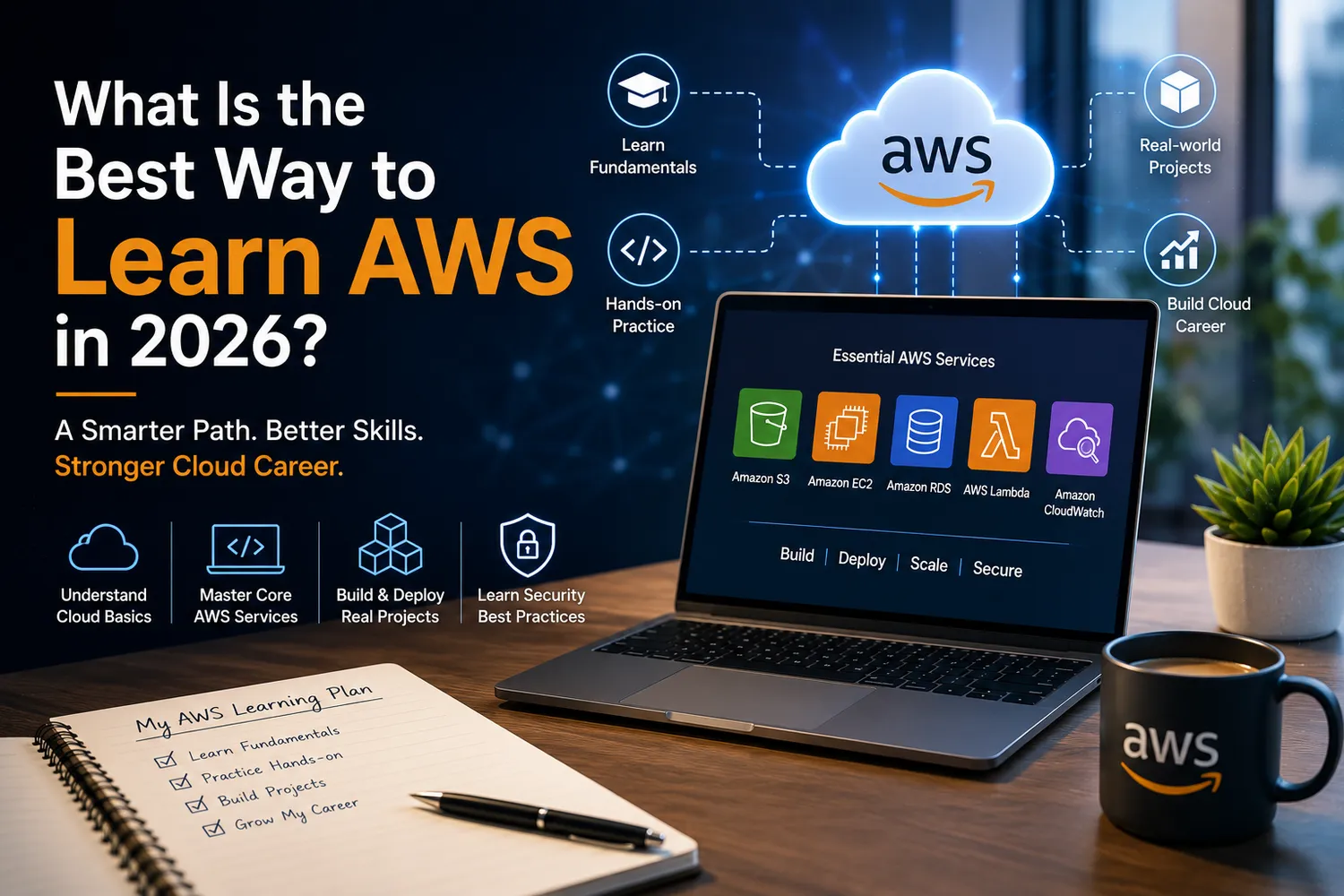
The best way to learn AWS in 2026 is to combine a structured learning path, hands-on practice, real-world projects, and a strong understanding of cloud computing fundamentals rather than relying on scattered tutorials or memorizing services.
AWS remains the world's most widely adopted cloud platform, powering everything from startups and e-commerce stores to banking systems, streaming platforms, healthcare applications, and artificial intelligence workloads. As organizations continue to move their infrastructure to the cloud, professionals with AWS skills are in higher demand than ever.
However, many beginners make the same mistake: they try to learn dozens of AWS services individually without understanding how they work together. The result is confusion, information overload, and slow progress. Instead, your goal should be to build practical cloud knowledge step by step while understanding the bigger picture.
Start with Cloud Computing Fundamentals
Before exploring AWS services, it's important to understand the principles behind cloud computing. This foundation helps you learn faster because you'll know why services exist, not just what they do.
Focus on concepts such as virtualization, networking, storage, databases, security, scalability, and high availability. These ideas appear throughout AWS and are essential for making informed architectural decisions.
If you build a solid foundation early, advanced topics become much easier to understand.
Learn the Core AWS Services First
AWS offers more than 200 cloud services, but most beginners don't need to learn all of them immediately.
Start with the services that appear in everyday cloud applications. These typically include Amazon EC2, Amazon S3, AWS Identity and Access Management (IAM), Amazon VPC, Amazon RDS, AWS Lambda, CloudWatch, and Elastic Load Balancing.
Learning these services together helps you understand how applications are deployed, secured, monitored, and scaled in the cloud. This is where AWS Developer Fundamentals become especially valuable because they teach how individual services work together to build complete applications rather than treating them as isolated tools.
Build Instead of Just Reading
Reading documentation is important, but cloud computing is a practical skill. You learn AWS most effectively by creating projects that solve real problems.
Start with small exercises, such as hosting a static website on Amazon S3, deploying a web application on Amazon EC2, or creating a serverless API with AWS Lambda. As your confidence grows, combine multiple services into complete cloud solutions.
Each project reinforces concepts that are difficult to understand through theory alone. More importantly, practical experience gives you examples to discuss during interviews and showcases your ability to apply your knowledge in real-world scenarios.
Understand How AWS Services Work Together
One of the biggest gaps in many beginner guides is that they explain services individually without showing how they interact.
In production environments, cloud solutions rarely rely on a single service. A typical application may store files in Amazon S3, run workloads on Amazon EC2, authenticate users through IAM, monitor performance using CloudWatch, and connect to managed databases such as Amazon RDS.
Learning these relationships is what transforms beginners into confident cloud professionals. Instead of memorizing services, you'll understand how complete cloud architectures are designed.
Prioritize Security from Day One
Security should never be treated as an advanced topic. Every AWS professional needs to understand the shared responsibility model, Identity and Access Management (IAM), encryption, multi-factor authentication, and access control policies.
Developing good security habits early not only protects cloud environments but also prepares you for production workloads where security is a core requirement.
Many beginners overlook this aspect, but employers expect cloud professionals to think about security alongside performance and scalability.
Learn Through Structured Guidance
There is no shortage of free videos, blogs, and documentation available online. While these resources are valuable, they often cover topics in isolation, making it difficult for beginners to build a logical progression.
A structured course helps eliminate this problem by introducing concepts in the right sequence, reinforcing them with practical exercises, and connecting theory to real-world applications. Instead of wondering what to learn next, you follow a roadmap that gradually builds confidence and technical competence.
For aspiring developers, the AWS Developer Essentials course on Coursera provides a well-organized introduction to AWS services, cloud application development, deployment practices, and hands-on learning. It is particularly useful for learners who want to strengthen their AWS Developer Fundamentals while gaining practical experience that aligns with current industry expectations.
Don't Skip AWS Cloud Practitioner Concepts
Many learners are eager to jump directly into advanced services, but understanding aws cloud practitioner essentials creates a stronger long-term foundation.
These concepts include cloud economics, global infrastructure, pricing models, security principles, and the AWS Well-Architected Framework. They help you understand not only how AWS works but also why organizations choose specific cloud solutions.
This broader perspective makes it easier to learn advanced services later and enables you to make better technical decisions as your skills grow.
Practice Consistently and Stay Updated
AWS evolves continuously, with new features and services released throughout the year. Instead of trying to master everything at once, focus on consistent learning.
Spend time each week exploring a new service, improving an existing project, or reading AWS documentation to stay current with platform updates. Even a few hours of focused practice each week can lead to significant progress over time.
The cloud industry rewards continuous learners, and maintaining this habit will keep your skills relevant as technologies evolve.
Final Thoughts
The best way to learn AWS in 2026 isn't by memorizing every service—it's by understanding cloud computing fundamentals, mastering the core AWS services, building hands-on projects, and learning how those services work together to solve real business problems.
A structured learning path, combined with regular practice, will help you develop practical cloud skills that employers value. By strengthening your AWS Developer Fundamentals, exploring aws cloud practitioner essentials, and applying your knowledge through real-world projects, you'll be well prepared for a successful career in cloud computing.
Whether you're a student, software developer, IT professional, or someone transitioning into the cloud industry, investing in AWS Developer Essentials today is an investment in skills that will remain valuable for years to come.