Market Outlook
The India window and door market expansion is underpinned by the robust growth of the domestic real estate sector, expanding high-end housing projects, and increasing consumer demand for energy-efficient, high-performance fenestration solutions. The deployment of advanced manufacturing techniques and precision engineering is fundamentally transforming traditional window and door products into sophisticated, climate-proof architectural systems. While fluctuations in raw material prices and the need for skilled installation labor pose temporary constraints, continuous innovations in sustainable materials, sound insulation, and heat-resistant glass are steadily accelerating industry growth. The sector demonstrates strong structural resilience, heavily supported by the rising focus on modern architectural aesthetics and the widespread integration of modular, space-efficient designs in urban developments.
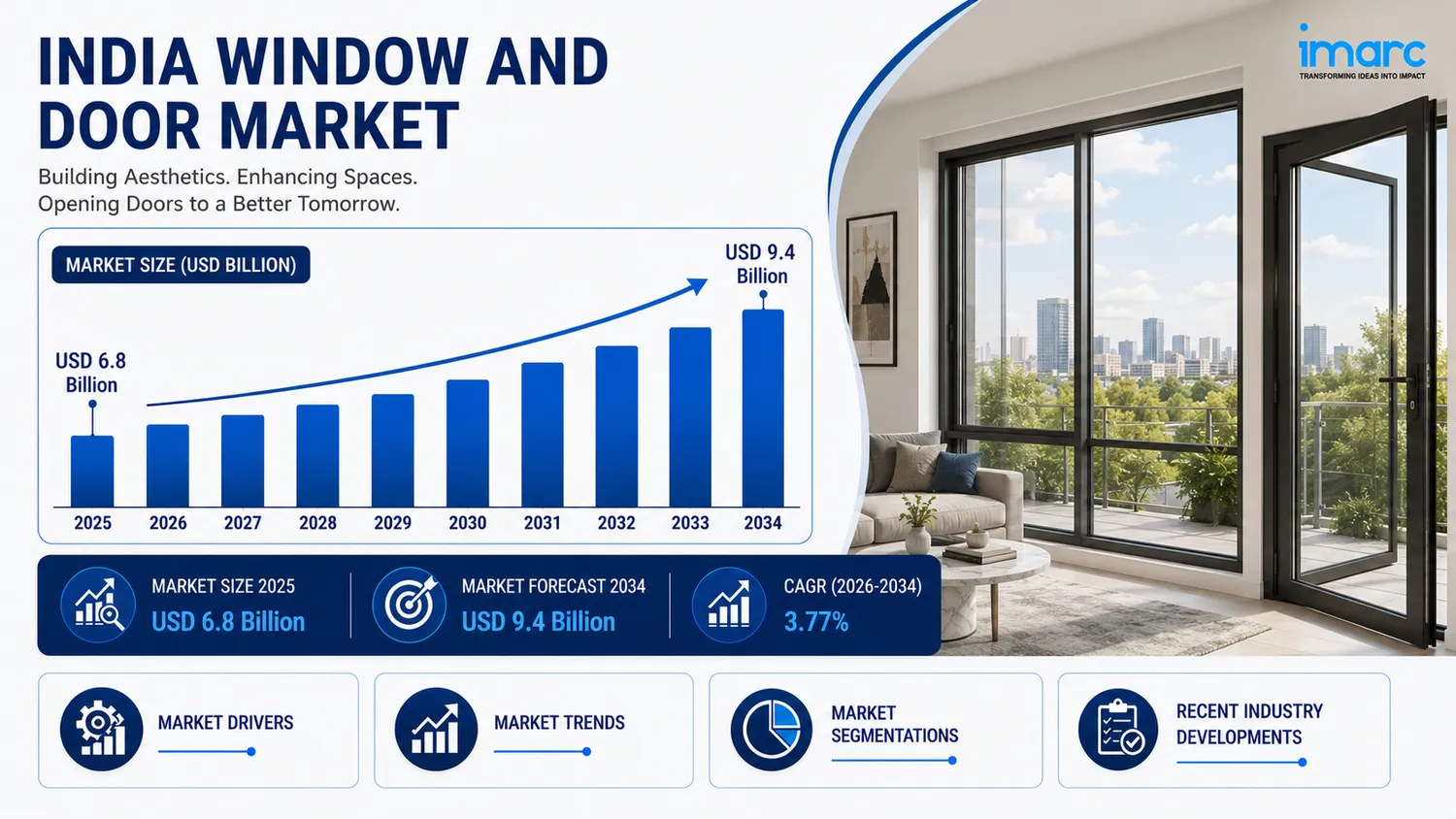
Market Snapshot:
- Market Size (Current Year): USD 6.8 Billion (2025)
- Forecast Market Size (Forecast Year): USD 9.4 Billion (2034)
- CAGR: 3.77% (2026-2034)
- Key Material Types: Metal, Wood, Plastic, Others
- Key End Users: Residential, Commercial
- Key Regions: North India, South India, East India, West India
Why Is the India Window and Door Market Growing?
- Rising Construction of Residential and Commercial Infrastructure
The growing development of residential and commercial buildings is catalyzing the demand for contemporary window and door systems throughout India. Developers are aggressively expanding high-end housing projects, office facilities, and retail centers to meet shifting individual preferences and changing business needs. This massive increase in real estate activity encourages architects and builders to integrate high-performance features that fulfill stringent structural, aesthetic, and ecological standards.
- Focus on Energy Efficiency and Sustainability
Increasing user awareness regarding energy conservation and safety requirements is a primary driver of market expansion. The creation of more sustainable, energy-efficient materials is improving the fundamental design and construction of windows and doors. Advancements like sound insulation, heat-resistant glass, and eco-friendly UPVC materials are becoming highly popular as consumers seek solutions that lower energy consumption and improve indoor comfort.
- Technological Advancements in Manufacturing
The emergence of advanced manufacturing techniques, such as automation and precision engineering, is propelling the market forward. These technological advancements enhance production methods, enabling the mass creation of superior, structurally robust products at competitive costs. This allows manufacturers to provide customized, adaptable window and door solutions appropriate for different high-rise and mixed-use project types.
➤ Request Sample Report (TOC & Charts): https://www.imarcgroup.com/india-window-door-market/requestsample
What Are the Key Trends Shaping the Market?
- Adoption of High-Performance Fenestration Options
Extensive luxury and mixed-use real estate developments—such as Oberoi Realty's 1.8 million square feet project in Mumbai—are boosting the adoption of sophisticated fenestration options. There is a pronounced trend toward installing soundproof windows, secure entrance systems, and climate-proof doors in high-end projects.
- Emphasis on Modular Design and Space Efficiency
With the rapid growth of high-rise and mixed-use buildings in dense urban corridors, structural engineering is increasingly focusing on modular design and the efficient use of space. This trend forces suppliers to innovate and provide space-saving, aesthetically pleasing door and window configurations that seamlessly integrate into modern, compact floor plans.
- Product Innovation and Customizable Solutions
Manufacturers are actively launching new collections designed specifically for modern homes and commercial properties. For instance, in 2024, Jamex UPVC launched a collection emphasizing energy efficiency, durability, and security, featuring highly customizable options and eco-friendly materials. This trend highlights a shift away from standardized products toward bespoke architectural solutions.
What Are the Major Market Challenges?
Raw Material Price Volatility and Skilled Labor Shortages:
The production of modern windows and doors depends on materials like specialized glass, aluminum, and UPVC resins. Fluctuations in global commodity prices can directly impact manufacturing costs. Additionally, the installation of high-performance, soundproof, and climate-proof fenestration systems requires specialized technical skills. A shortage of properly trained installation personnel can lead to suboptimal product performance and customer dissatisfaction, posing a challenge for widespread, flawless execution in rapidly expanding real estate projects.
How Is the Market Segmented?
- By Material Type: Metal, Wood, Plastic, and Others. The market is witnessing a strong shift towards advanced plastics (like UPVC) and treated metals due to their high durability, weather resistance, and low maintenance requirements compared to traditional wood.
- By End User: Residential and Commercial. The residential segment is a massive volume driver due to the sheer scale of national housing projects and the rising demand for premium fenestration in luxury apartments.
- By Region: North India, South India, East India, and West India.
Competitive Landscape & Key Player Positioning:
Covering an in-depth analysis of the competitive landscape, market structure, key player positioning, competitive dashboards, top winning strategies, and detailed profiles of all major industry participants you will gain access to all these exclusive insights within the full research report.
➤ Request Report Customization: https://www.imarcgroup.com/request?type=report&id=31095&flag=E
Frequently Asked Questions (FAQs):
Q1. What is the current size of the India window and door market?
Ans. The window and door market in India was valued at USD 6.8 Billion in 2025.
Q2. What is the expected growth rate of the India window and door market?
Ans. The India window and door market is projected to exhibit a CAGR of 3.77% during 2026-2034, reaching a value of USD 9.4 Billion by 2034.
Q3. What factors are driving the demand for windows and doors in India?
Ans. Demand is driven by the rising construction of residential and commercial infrastructure, the expansion of high-end housing projects, and an increasing focus on energy efficiency and climate-proof designs.
Q4. What role does technology play in this market?
Ans. Technological advancements in automation and precision engineering are enhancing production methods, enabling the creation of superior products like sound-insulated and heat-resistant glass at competitive costs.
Conclusion
The strategic evolution of the India window and door market is securely anchored in the continuous boom of the domestic real estate sector and the structural shift toward energy-efficient, climate-proof architectural designs. As urban developers increasingly demand modular, space-efficient, and sustainable fenestration options for high-rise and mixed-use projects, manufacturers who invest in precision engineering and eco-friendly UPVC/metal solutions are best positioned to capture premium market share. Expanding localized production capacities and offering immersive, customizable retail experiences will remain the definitive pathway for securing sustained growth and long-term profitability through 2034.