India Passenger Car Market Overview
The report titled "India Passenger Car Market Size, Share, Trends and Forecast by Vehicle Type, Fuel Type, Transmission Type, Price Segment, and Region, 2026–2034" comprises the overall market analysis of India, size, growth trends, key drivers, and regional insights of the passenger car market in India and other important aspects related to the sector.
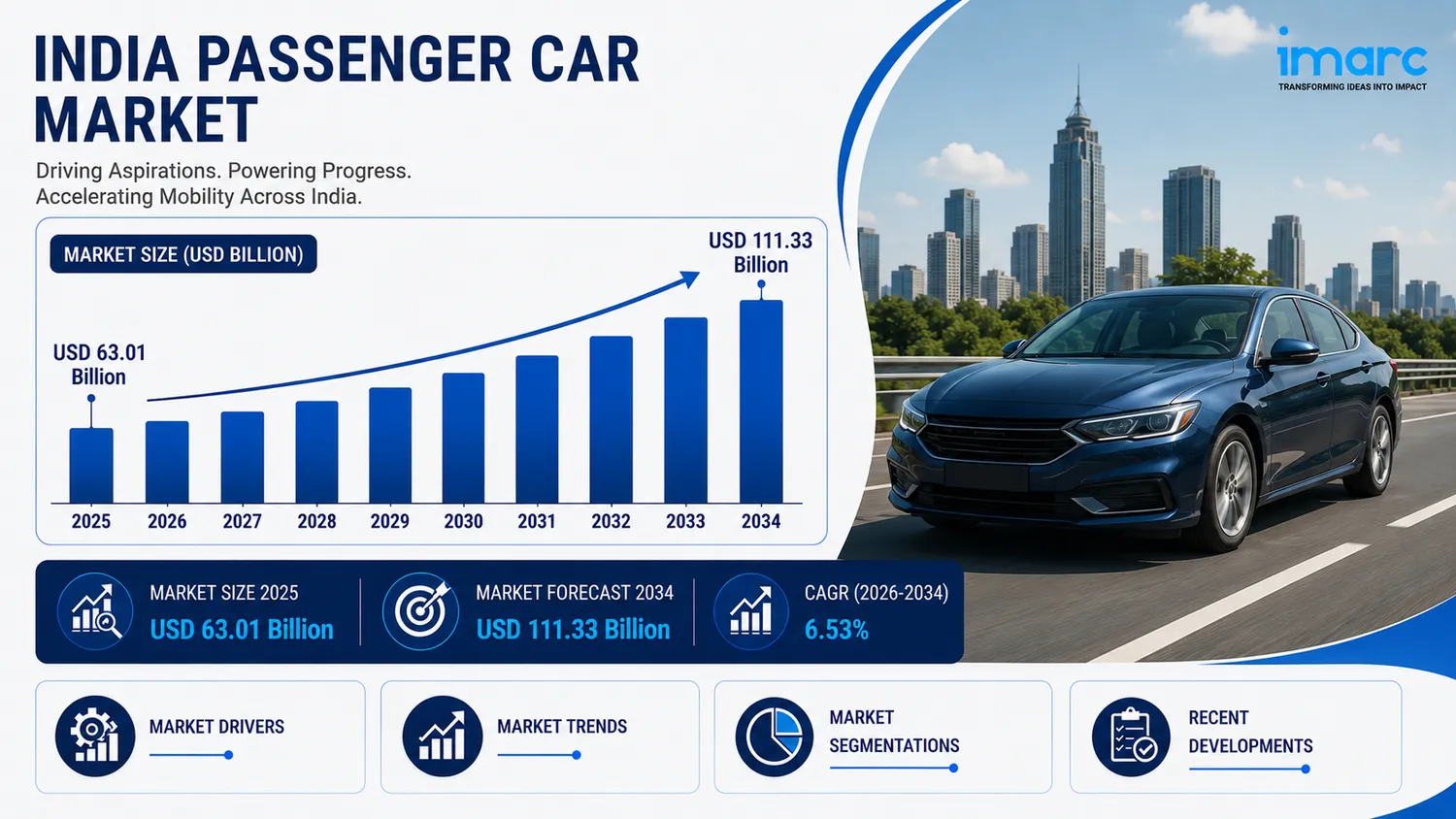
How Big is the India Passenger Car Market?
The India passenger car market size reached USD 63.01 Billion in 2025. Looking forward, IMARC Group expects the market to reach USD 111.33 Billion by 2034, exhibiting a compound annual growth rate (CAGR) of 6.53% during 2026–2034. The market expansion is primarily driven by rising disposable incomes, urban suitability of compact vehicles, growing preference for feature-rich SUVs, and an emerging electric vehicle ecosystem supported by government incentives.
Market Size & Forecast:
- Base Year (2025) Market Size: USD 63.01 Billion
- Projected Market Size (2034): USD 111.33 Billion
- Compound Annual Growth Rate (CAGR): 6.53% (2026–2034)
- Historical Period: 2020–2025
Key Market Trends & Insights:
- By Vehicle Type: Hatchbacks maintain market dominance due to their affordability and urban suitability, though compact SUVs are witnessing rapid adoption.
- By Fuel Type: Petrol remains the most dominant fuel type, while the electric vehicle segment represents the fastest-growing category with an expected CAGR of over 24%.
- Consumer Preferences: There is a visible shift towards feature-rich models equipped with advanced driver assistance systems (ADAS), connected car tech, and enhanced infotainment systems.
- Regional Dominance: North India leads the market, anchored by high income density in Delhi-NCR and strong consumption patterns in Punjab.
Key Market Trends:
- Growing Preference for Compact SUVs and Crossovers
The India passenger car market is undergoing a structural shift in consumer design preferences, moving heavily toward compact SUVs and crossovers. Buyers increasingly seek vehicles that offer higher ground clearance, better road presence, and enhanced safety to navigate diverse road conditions without compromising on fuel efficiency. This trend is encouraging manufacturers to rapidly expand their utility vehicle portfolios to capture the aspirational middle-class demographic.
- Integration of Advanced Connected Technologies and In-Cabin Features
Demand for technologically advanced, feature-rich models is rising sharply across all price segments. Consumers place significant value on smart infotainment systems, connected car technologies, advanced driver assistance features, and improved in-cabin comfort. This shift compels automakers to standardize premium features even in economy and mid-range variants to remain competitive and attract younger, tech-savvy buyers.
- Accelerated Expansion of the Electric Vehicle (EV) Ecosystem
The transition toward sustainable mobility represents a definitive market trend, with electric vehicles emerging as the fastest-growing segment. Supported by favorable policy frameworks like the PM E-DRIVE incentives and expanding charging infrastructure, consumers are increasingly evaluating EVs for their lower total cost of ownership. Concurrently, refined petrol engines and hybrid options are gaining traction among buyers prioritizing fuel efficiency.
➤ Request Sample Report (TOC & Charts): https://www.imarcgroup.com/india-passenger-car-market/requestsample
Strategic Market Dynamics:
Growth Drivers:
- Macroeconomic Expansion and Rising Household Disposable Incomes
India’s steady economic growth and increasing per capita income are primary catalysts expanding the domestic automotive customer base. As middle-class households experience higher discretionary spending power, the transition from two-wheelers to entry-level passenger cars is accelerating rapidly. This economic shift is particularly pronounced in Tier-2 and Tier-3 cities, where expanding dealer networks and rising lifestyle aspirations are driving massive first-time car buyer volume.
- Rapid Urbanization and Shifting Personal Mobility Preferences
Accelerating urban sprawl and expanding metropolitan boundaries have significantly increased daily commuting distances. Coupled with a post-pandemic structural preference for safe, hygienic, and independent travel over crowded public transport, the functional demand for personal vehicles has surged. Passenger cars especially fuel-efficient petrol, CNG, and hybrid models are increasingly viewed as essential daily utility assets rather than luxury items.
- Strong Consumer Inclination Toward Compact SUVs and Premium Features
The Indian passenger car landscape is witnessing a massive structural shift in vehicle design preference, with buyers moving heavily from traditional hatchbacks toward compact SUVs and crossovers. Indian consumers seek vehicles offering higher ground clearance, better visibility, and strong road presence to navigate varied road conditions. Furthermore, the desire for high-value features such as sunroofs, Advanced Driver Assistance Systems (ADAS), connected vehicle tech, and large infotainment displays is driving higher average selling prices (ASPs) and shortening vehicle replacement cycles.
- Favorable Government Policies, EV Schemes, and Accessible Vehicle Financing
Proactive policy support from the central and state governments including the PM E-DRIVE scheme, Production Linked Incentive (PLI) frameworks, and reduced GST rates for electric vehicles is significantly boosting growth, particularly in the EV and green mobility segments. Simultaneously, a deeply entrenched vehicle financing ecosystem characterized by easy loan approvals, flexible EMI schemes, high loan-to-value ratios, and digital processing from banks and NBFCs makes car ownership financially viable for a vastly broader demographic.
Market Restraints:
- Infrastructure Bottlenecks for EVs: While EV adoption is surging, the lack of widespread and uniform charging infrastructure across semi-urban and rural corridors occasionally restrains immediate mass-market penetration for pure electric passenger cars.
- Price Sensitivity and Input Costs: The market remains highly price-sensitive. Fluctuations in raw material costs (like steel and battery minerals) and stringent emission/safety mandates can exert upward pressure on vehicle prices, potentially impacting affordability in the economy segment.
Deep-Dive Segment Insights:
By Vehicle Type
The market by vehicle type is segmented into Hatchback, Sedan, and SUV/MPV. Hatchbacks currently dominate the market with a 48.0% share in 2025. This segment's leadership is structurally driven by high affordability, superior fuel efficiency, and compact dimensions that offer unmatched suitability for dense urban driving and easy parking.
By Fuel Type
The market by fuel type includes Petrol, Diesel, Electric, and Others. Petrol leads the market with a commanding 72.0% share in 2025. The dominance of petrol is sustained by the widespread availability of fuel infrastructure, lower initial acquisition costs compared to diesel or EV counterparts, and continuous improvements in engine refinement.
By Transmission Type
The market is segmented by transmission type into Manual and Automatic. Manual transmissions hold the majority share at 78.0% in 2025. The preference for manual gearboxes is deeply rooted in their cost-effectiveness, lower maintenance expenses, and the traditional driving habits of the vast majority of Indian consumers.
By Price Segment
Categorized into Economy, Mid-Range, and Premium and Luxury, the Economy segment captures the largest share at 54.0% in 2025. This underscores the immense volume driven by first-time car buyers and middle-income households prioritizing budget-friendly, value-oriented mobility options.
By Region
Regionally, the market is analyzed across North India, West India, South India, and East India. North India represents the absolute largest regional market, holding a 31.0% share in 2025. The region's dominant position is anchored by Delhi-NCR's high income density, a highly established dealership network, and strong, above-national-average lifestyle consumption patterns in states like Punjab. West India follows closely (26.8%), supported by wealth in Mumbai's financial sector and industrial growth in Pune.
Competitive Landscape & Key Company Insights
The India passenger car market features a highly consolidated yet intensely competitive landscape characterized by major domestic and international automotive manufacturers. Key corporate participants include Suzuki Motor Corporation, Mahindra Group, Tata Group, and Hyundai Motor Company. Suzuki Motor Corporation (operating as Maruti Suzuki India Limited) retains its position as the undisputed market leader, leveraging an unparalleled distribution depth of over 3,500 dealer outlets and strong brand equity in the hatchback and economy segments. Meanwhile, challengers like the Mahindra Group maintain a robust market position through absolute dominance in the SUV segment and aggressive leadership in scalable EV platforms.
Customization Note: If you require any specific information not covered within this report's scope, we will provide it as part of the customization.
➤ Request Report Customization: https://www.imarcgroup.com/request?type=report&id=31392&flag=E
Frequently Asked Questions (FAQs):
Q1. What is the projected market size and compound annual growth rate (CAGR) for the India passenger car market between 2026 and 2034?
Ans. The market is projected to reach USD 111.33 Billion by 2034, expanding at a CAGR of 6.53% during 2026–2034.
Q2. Which vehicle type holds the dominant market share?
Ans. Hatchbacks command the highest volume share at 48.0% in 2025, primarily driven by their affordability and practical urban suitability.
Q3. Which fuel type is most preferred by consumers in India?
Ans. Petrol represents the dominant fuel type, capturing a 72.0% market share in 2025 due to established infrastructure and cost-effective engine options.
Q4. What is the leading region in the India passenger car market?
Ans. North India leads with a 31.0% share in 2025, heavily supported by high income density in Delhi-NCR and strong consumption in Punjab.
Q5. Which segment is identified as the fastest-growing in the market?
Ans. Electric Vehicles (EVs) represent the fastest-growing segment, expected to exhibit a CAGR of over 24% from 2026 to 2034.
Conclusion
The strategic evolution of the India passenger car market is securely anchored by steady volume growth in the economy hatchback segment, alongside a definitive structural shift toward high-margin compact SUVs and crossovers. Stakeholders and strategic investors must prioritize portfolio diversification, specifically by integrating advanced connected technologies and in-cabin features to meet evolving consumer expectations. Capitalizing on government incentives like PM E-DRIVE to rapidly expand electric vehicle offerings, while simultaneously penetrating Tier-2 and Tier-3 city retail networks, remains the absolute definitive pathway for securing sustained growth and long-term market dominance through 2034.