The Make One (M1) stitch is a commonly used method in knitting to increase the number of stitches in your work. While working with your regular knitting needles you can create a new stitch by picking up the horizontal strand of yarn between two stitches and working it as a regular stitch. The make one stitch (M1) technique works for all projects and all types of knitting needles. Whether you are working back and forth with single-pointed needles or any length of circular needle you can include this stitch increase as when you are working in the round with either a set of double-pointed needles or any length of circular needles. Now when you work flat (back and forth) then mostly knitters assume that there are no requirements for knitting increases but you may need to make shapes before seaming the edges together to shape projects such as sweaters, cardigans, or even hats.
There are several other methods of knitting increases but M1 is commonly used. It is the least visible than other increases. Choosing to work a M1 stitch in your knitting project depends of the pattern you are making. If you are following the instructions of a pattern designer, you get step-by-step instructions on how to work this knitting increase.
Here's how you can do it:
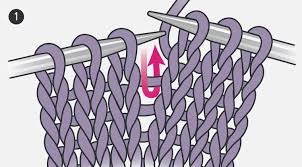
1st Step - Start by identifying the location where you want to make the increase. Look for the horizontal strand of yarn that runs between the stitch on your left needle and the stitch on your right needle.
2nd Step - Insert the tip of the left needle from the front to the back under the horizontal strand of yarn. The left needle should now be positioned behind the right needle.
3rd Step - Knit the picked-up strand as you would knit a regular stitch. If you find it hard to pick up the stitch with the needle tip, then use a crochet hook, smaller in size than the knitting needles used or a repair hook. With time and practice, you can simply work with the tip. Insert the right needle into the front loop of the picked-up strand from left to right.
4th Step - Lift the strand onto the right needle, creating a new stitch.
5th Step - Slip the new stitch from the right needle to the left needle. This completes the M1 increase.
Continue working the rest of your row or round according to your pattern.
The basic M1 described above creates a neutral increase, which does not slant in either direction. It's important to note that there are different variations of the M1 increase, depending on whether you want the increase to be left-leaning (M1L) or right-leaning (M1R). If your pattern specifies an exact type of M1 increase, follow the instructions provided. If not, then the choice is yours whether you would want a left-leaning or right-leaning increase. Many knitters make this choice with the placement of stitch markers, especially when they are knitting in the round.
Besides M1 stitch there are many knitting increases techniques that you can use for projects that require shaping.
M1L
The left-leaning increase in technique is used for multiple projects. Here you pick the loop between the stitches to make an increase. Insert the left-hand needle from front to back, under the bar between the stitches and lifting a new loop onto the left-hand needle making a new stitch A pattern designer will instruct you to balance this one with another stitch. If nothing is instructed you can balance it out with another stitch in the opposite direction.
M1R
The right leaning increase in also commonly used for many knitting patterns. Here too, you insert the left knitting needle into the stitches and pick up a loop but the yarn is wrapped the other way than the left increase.
Remember to consult your knitting pattern for specific instructions on where and how to work the M1 increase, as different patterns may have different requirements. Practice the technique on a small swatch to become comfortable before incorporating it into your larger project.
For all your knitting needs, the Lantern Moon Collection offers premium knitting needles and accessories. The ebony wood used in the tools and accessories are sourced from sustainable forests. Handcrafted by skilled artisans, the needles and hooks display the beauty and charm of the handmade. With the range of interchangeable needle sets you can work with any knitting project. For crochet too, there’s the special Bequest set of interchangeable Tunisian crochet hooks and single-ended crochet hooks in the Radiance Set.
Source by- https://www.apsense.com/article/how-to-knit-make-one-m1-stitch.html