As a parent, you want nothing more than to see your child succeed and enjoy the sport they love. Football is a game that requires a unique set of skills, and with the right training and guidance, your child can develop into a confident and skilled player. In this article, we'll explore some effective ways to help your child improve their football skills through targeted training.
The Importance of Fundamentals
Before we dive into specific training techniques, it's crucial to understand the importance of mastering the fundamentals. Football is a technical game, and players need to excel in multiple skills to compete at a high level. Think about players like Ronaldo and Messi - they have their core abilities nailed in every department, from dribbling and ball control to passing and shooting.
As a parent, it's your job to ensure that your child builds a strong foundation in the basic skills of the game. This includes things like first touch, passing, shooting, and defending. By focusing on these fundamentals early on with programs like CB10 football training in Dubai, you'll set your child up for long-term success and help them develop a deeper appreciation for the sport.
Breaking It Down into Steps
One of the keys to effective football training is breaking down complex skills into smaller, more manageable steps. Kids can feel overwhelmed when trying something new, especially if it seems difficult. By breaking it down, you can help your child feel accomplished and motivated to keep working on it.Let's say you want to teach your child a specific dribbling move, like the Maradona turn. Instead of just showing them the full move and expecting them to pick it up right away, break it down into smaller steps:
- Dribble the ball with control, keeping it close to your feet.
- As you approach the cone, plant your standing foot next to the ball.
- Drag the ball behind your standing foot with the sole of your other foot.
- Pivot your body 180 degrees, keeping your eyes on the ball.
- Accelerate away from the cone, keeping the ball close to your feet.
By breaking it down into these smaller steps and allowing your child to practice each one individually, you'll help them build confidence and mastery of the skill.
Incorporating Variety into Training
While repetition is key to mastering football skills, it's important to keep training sessions varied and engaging. Kids have short attention spans, and they'll quickly get bored if you do the same drills over and over again.Try incorporating a variety of activities into your training sessions, such as small-sided games, skill challenges, and fun warm-up exercises. This will help keep your child engaged and motivated, while also challenging them in different ways.
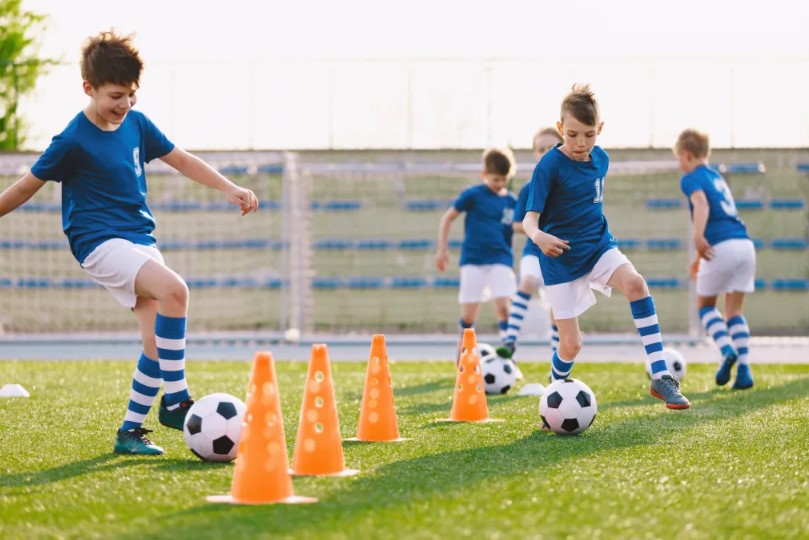
For example, you could set up a dribbling circuit with cones and gates, and challenge your child to dribble through the gates using different parts of their feet. Or you could play a game of "knockout," where players take turns shooting at a goal, and the last one to score is eliminated.By keeping things fresh and exciting, you'll help your child stay engaged and motivated throughout the training session.
Focusing on Physical Development
Football is a physically demanding sport, and it requires players to have a strong foundation in areas like speed, agility, and power. While it's important to focus on technical skills, it's also crucial to incorporate physical development into your child's training.There are a few key ways to do this:
- Incorporate HIIT (High-Intensity Interval Training) to build fast-twitch muscle fibers and improve reaction time.
- Work on physical conditioning exercises that mimic the movements and demands of football, such as sprints, jumps, and change-of-direction drills.
- Encourage your child to participate in other sports and activities that challenge their physical abilities in different ways, such as basketball, handball, or even gymnastics.
By focusing on physical development alongside technical skills, you'll help your child become a more well-rounded and capable player.
Providing Encouragement and Support
One of the most important things you can do as a parent is to provide encouragement and support throughout your child's football journey. Kids thrive on positive reinforcement, and they need to know that you believe in them and are proud of their efforts.
Make sure to praise your child's hard work and progress, no matter how small. Celebrate their achievements, like scoring their first goal or mastering a new skill. And most importantly, make sure they know that you love watching them play and that you're there to support them every step of the way.Remember, football should be a source of joy and excitement for your child, not stress or obligation. By providing a supportive and encouraging environment, you'll help them build confidence and resilience, both on and off the field.
Incorporating Game-Like Situations
While drills and exercises are important for developing specific skills, it's also crucial to incorporate game-like situations into your child's training. This will help them learn how to apply their skills in a real-world context and prepare them for the demands of match play.
One way to do this is by playing small-sided games, such as 3v3 or 4v4. These games are more engaging and less intimidating than full-sided matches, and they allow players to touch the ball more often. They also encourage decision-making and problem-solving skills, as players have to think quickly and react to changing situations.You can also set up specific game scenarios, such as attacking vs. defending drills or set-piece situations. This will help your child learn how to make decisions under pressure and develop a better understanding of the tactical aspects of the game.
Encouraging Creativity and Self-Expression
While it's important to focus on fundamentals and game-like situations, it's also crucial to encourage creativity and self-expression in your child's football training. The best players are often the ones who are willing to take risks and try new things, and it's important to foster this mindset from an early age.
One way to do this is by incorporating skill challenges and trick shots into your training sessions. Challenge your child to dribble through cones without knocking them over, or to score a goal from a difficult angle. Encourage them to experiment with different moves and tricks, and praise their creativity and willingness to try new things.
You can also encourage self-expression by allowing your child to play freely and explore the ball. Set up a large area with plenty of space, and let them dribble, pass, and shoot without any constraints or pressure. This will help them develop a sense of comfort and confidence on the ball, and encourage them to express themselves in a way that feels natural and authentic.
Incorporating Video Analysis
One of the most effective ways to help your child improve their football skills is by incorporating video analysis into their training. Professional football teams hire teams of analysts to watch back footage of games and identify areas of strength and weakness, and you can use a similar approach with your child.
Set up a camera during training sessions and matches, and review the footage together afterwards. Look for specific moments where your child performed well or struggled, and use the footage to provide targeted feedback and guidance. You can also use the footage to help your child visualize and understand complex concepts, such as positioning or decision-making.
By incorporating video analysis into your child's training, you'll help them develop a deeper understanding of the game and provide them with the tools they need to continue improving their skills over time.
Conclusion
Helping your child improve their football skills takes time, dedication, and a commitment to providing high-quality training and support. By focusing on fundamentals, incorporating variety into training sessions, and encouraging creativity and self-expression, you'll help your child develop into a confident and capable player.
Remember, the most important thing is to keep it fun and engaging. Football should be a source of joy and excitement for your child, and by creating a positive and supportive environment, you'll help them develop a lifelong love for the game.