In the race to improve global health outcomes, life science innovation hubs have become powerful engines of progress. These purpose-built ecosystems connect researchers, startups, investors, manufacturers, and healthcare providers in one collaborative space, unlocking the potential to solve complex health challenges faster and more effectively.
As scientific and technological breakthroughs accelerate, so do the expectations placed on these hubs. What began as a novel concept for clustering research and talent has evolved into a global standard for advancing medical science and healthcare technology. But what lies ahead?
From AI-powered discovery and integrated digital platforms to new funding models and specialized infrastructure, the world’s most forward-thinking hubs—like the one at Masdar City—are preparing for the next wave of innovation. Here are the top trends shaping the future of life science innovation hubs:
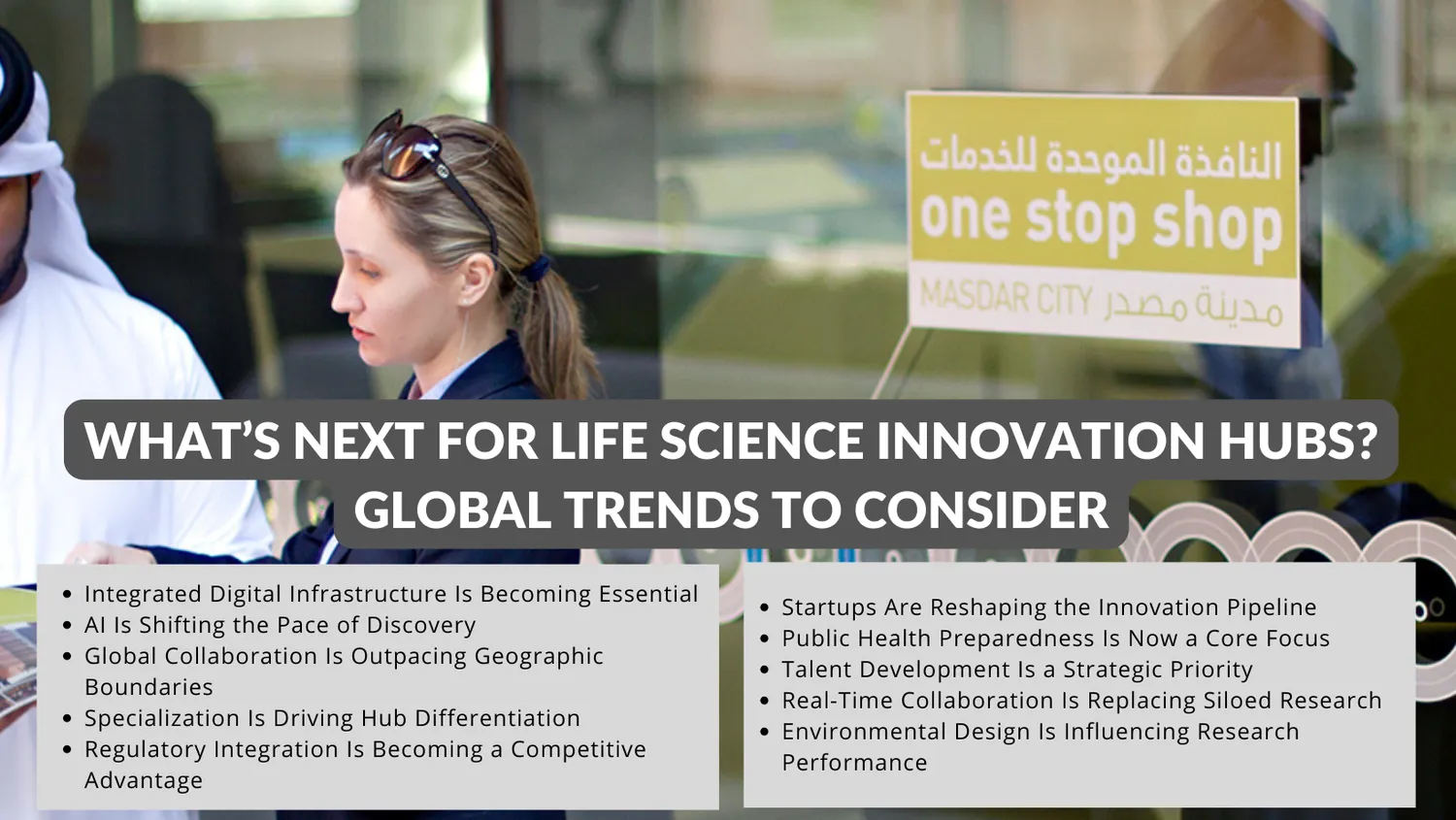
Integrated Digital Infrastructure Is Becoming Essential
Modern research environments demand more than high-end labs—they require smart, connected ecosystems. Cloud-based platforms, secure data exchange, and interoperable digital health records are quickly becoming standard. Life science hubs are transforming into digitally integrated campuses where data flows securely and efficiently across stakeholders. This seamless exchange accelerates clinical research, improves regulatory compliance, and reduces time-to-market for new solutions. Masdar City’s future-ready infrastructure provides its life science community a scalable foundation, positioning it for long-term digital integration.
AI Is Shifting the Pace of Discovery
Artificial intelligence is changing how health research is conducted, enhancing everything from drug development to diagnostics. Life science innovation hubs are increasingly embedding AI into their core processes, democratizing access to advanced tools across startups and research institutions. AI-powered systems can rapidly analyze complex genomic data, model therapeutic responses, and surface novel insights from patient records. As hubs invest in shared AI infrastructure and talent, they enable more organizations to access this transformative capability. Emerging frameworks around ethical AI use are expected to become standard in hub governance.
Global Collaboration Is Outpacing Geographic Boundaries
While geographic proximity still offers benefits, virtual collaboration now plays a critical role in scientific innovation. The most successful hubs foster international partnerships and data-sharing across borders. From virtual labs to cross-regional clinical trials, life science hubs serve as global “connectors.” Hubs offering secure, scalable collaboration platforms will drive the next generation of research impact. Masdar City’s location at the crossroads of Europe, Asia, and Africa—along with its growing international network—makes it an ideal bridge between global research centers.
Specialization Is Driving Hub Differentiation
As more hubs emerge globally, standing out means focusing on niche strengths. Top-performing hubs are no longer one-size-fits-all—they align infrastructure and programming around specific verticals such as digital health, gene therapy, or medical robotics. This strategic focus helps attract specialized talent, research grants, and industry partnerships. Masdar City is positioning itself to support targeted segments in medical innovation, building an ecosystem with specialized capabilities.
Regulatory Integration Is Becoming a Competitive Advantage
Navigating regulatory complexity can be a barrier for medical innovators. The next-generation life science hub addresses this by embedding regulatory expertise into its framework. This includes direct access to approval agencies, clinical trial networks, and dedicated compliance support. Hubs that enable smoother market entry and quicker approvals reduce risk for investors and founders alike. Proactive collaboration with government authorities turns regulation into a growth enabler—Masdar City aligns with this model through partnerships that simplify startup licensing and healthcare compliance.
Startups Are Reshaping the Innovation Pipeline
Startups are leading a wave of innovation in life sciences—from novel therapies to AI diagnostics. Hubs respond with startup-friendly environments that include modular lab space, shared R&D resources, mentorship programs, and venture capital access. This flexible infrastructure lowers entry barriers while promoting agility and growth.
Public Health Preparedness Is Now a Core Focus
Recent global health crises have highlighted the importance of readiness and resilience. Hubs are evolving beyond long-term R&D to support rapid response capabilities. This includes agile vaccine development units, diagnostic test production, and supply chain innovation. Life science hubs that can shift quickly from research to action will play a vital role in global health preparedness. Masdar City integrates logistics, science, and infrastructure to create a responsive environment capable of mobilizing in times of need.
Talent Development Is a Strategic Priority
Scientific innovation hinges on people. Hubs invest in education, research fellowships, and cross-sector training programs to build the workforce of the future. Collaboration between universities, labs, and commercial partners helps create a pipeline of skilled researchers and entrepreneurs. Forward-thinking hubs also prioritize diversity and inclusive leadership in science. Masdar City embeds talent development into its ecosystem through partnerships with local and international academic institutions.
Real-Time Collaboration Is Replacing Siloed Research
Speed is now critical. The most effective research happens in real time, with engineers, clinicians, data scientists, and compliance teams working side by side. Life science hubs design both physical and virtual environments to encourage interdisciplinary collaboration—open lab spaces, co-working zones, and digital interfaces that support instant teamwork. At Masdar City, this collaborative design is matched by robust connectivity, fostering seamless integration between disciplines.
Environmental Design Is Influencing Research Performance
The physical environment of a research hub plays a critical role in innovation. Natural light, green spaces, air quality, and building efficiency contribute to productivity and well-being. Sustainable, human-centered design principles are influencing how hubs are built and managed. Walkable layouts, energy-efficient facilities, and wellness-driven architecture enhance the work environment and help attract and retain top talent. Masdar City’s urban design reflects these principles, offering a high-performance setting for global scientific advancement.
Conclusion: Building the Future of Health Innovation
Life science innovation hubs are no longer just clusters of labs—they are intelligent, adaptive ecosystems driving the next era of healthcare progress. The trends reshaping these hubs reflect a future that is more digital, more specialized, and more collaborative. Hubs like Masdar City are at the forefront of this transformation, creating integrated environments that not only support innovation but actively accelerate it. By aligning physical infrastructure, policy, people, and partnerships, they are redefining how the world addresses its most urgent health challenges.