If you've been thinking about upgrading your home's heating setup, you've probably come across the term direct vent gas fireplace. It's one of the most popular choices for modern homeowners, and for good reason. But with so many options out there, it can be hard to know where to start.
This guide covers everything you need to make a confident decision: how these systems work, what makes them different from other fireplace types, what they cost, and how to pick the right size for your space.
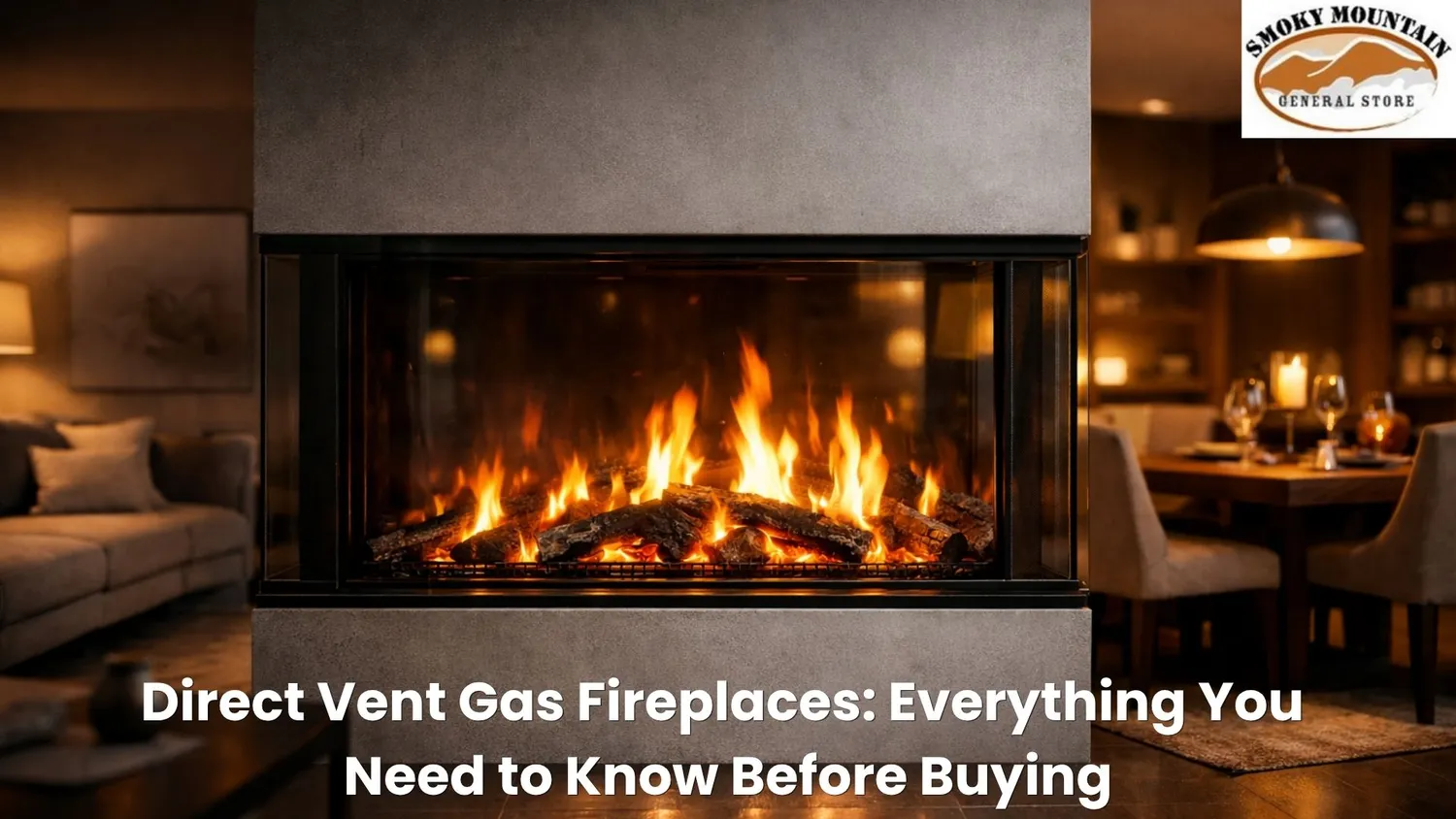
What Is a Direct Vent Gas Fireplace?
A direct vent gas fireplace is a sealed combustion system that pulls fresh air from outdoors for burning and sends exhaust gases back outside through a separate pipe. Because the combustion chamber is completely closed off from your living space, nothing from the burning process ,no smoke, no fumes, no carbon monoxide ,enters your home.
This is fundamentally different from a traditional fireplace, which relies on indoor air and a masonry chimney to function. It's also different from a ventless fireplace, which burns gas inside your living space without any exterior exhaust. We'll get into those comparisons in more detail below.
The result is a system that's cleaner, safer, and more efficient than most alternatives ,which is why it's become the go-to option for new construction and home renovations alike.
How the Dual-Vent System Works
The defining feature of a direct vent fireplace is its coaxial (pipe-within-a-pipe) venting setup. Here's what that looks like in practice:
The inner pipe carries combustion gases from the firebox to the outside. The outer pipe (surrounding the inner one) draws fresh air in from outside to feed the burner. Because both functions happen within the same vent assembly, you only need one penetration through your wall or roof ,making installation relatively straightforward even in homes without a traditional chimney.
The sealed glass front on the firebox completes the picture, keeping your indoor air entirely separate from the combustion process. This is why direct vent fireplaces are approved for installation in tight, well-insulated modern homes where air quality standards are strict.
Key Benefits for Homeowners
Heating Efficiency: Because the combustion chamber is sealed and the glass front retains radiant heat, these units waste very little energy. Most models achieve efficiency ratings well above traditional open-hearth fireplaces, making them a practical supplemental heating source for living rooms, bedrooms, or open-plan spaces.
Indoor Air Quality: Since combustion air comes entirely from outside, your indoor oxygen levels and air quality are unaffected ,even during extended use. This makes them a much better option for people with respiratory sensitivities or for use in bedrooms and tightly sealed homes.
Installation Flexibility: No chimney? No problem. Direct vent fireplaces for sale come in configurations that can vent horizontally through an exterior wall or vertically through the roof. That means you can install one in a basement, a room addition, or anywhere else a traditional fireplace simply couldn't go.
Low Maintenance: There's no ash to clean up, no creosote buildup in the flue, and no need to store or haul firewood. Routine upkeep mainly involves keeping the glass clean and scheduling an annual professional inspection.
Realistic Flame Appearance: Modern units ,especially sleek linear styles ,offer impressively lifelike flame effects. Many homeowners can't tell the difference between these and a traditional wood fire at first glance.
Direct Vent vs. Ventless: Which Is Safer?
This is one of the most common questions we get, and it's worth answering carefully.
Ventless fireplaces burn gas inside your home without routing exhaust outdoors. They're highly efficient in terms of heat output because no warmth escapes through a vent ,but all combustion byproducts, including water vapor and trace gases, remain in your living space. Most are designed with oxygen-depletion sensors that shut the unit off if air quality drops below a safe threshold.
Direct vent systems, by contrast, keep the entire combustion process isolated from your indoor air. For households with children, pets, elderly residents, or anyone with respiratory conditions, this is a meaningful safety advantage. They're also permitted in more jurisdictions ,some states and municipalities have restricted or banned ventless fireplaces in certain applications.
For a deeper look at this topic, we've written a full comparison: Direct Vent vs. Ventless Gas Fireplaces: Key Differences in Safety, Cost & Installation.
Bottom line: For most homeowners who want long-term, worry-free use ,especially in a primary living area ,a direct vent system is the safer and more versatile choice.
Gas vs. Wood-Burning: A Practical Comparison
Wood-burning fireplaces carry a certain romantic appeal, and many homeowners love the crackling sound and smell of a real wood fire. That said, it's worth being clear-eyed about the tradeoffs.
Wood fires require you to source, store, and haul firewood. They produce ash that needs regular removal, and the flue needs annual cleaning to prevent creosote buildup ,a fire hazard if neglected. Heat output is also harder to control, and traditional open fireplaces can actually lose more heat than they produce when drafts pull warm indoor air up the chimney.
Direct vent gas fireplaces offer consistent, adjustable heat at the push of a button. There's no prep work, no cleanup, and no need to tend the fire. Many models include remote controls, thermostat functionality, and programmable timers that make operation completely effortless.
How to Choose the Right Size
Sizing is one of the most important decisions you'll make, and it's often overlooked. A fireplace that's too small won't heat the space effectively; one that's too large can overheat a small room.
The key metric to look at is BTU output (British Thermal Units per hour). As a general rule:
- Small rooms (up to 400 sq ft): 10,000–20,000 BTU
- Medium rooms (400–800 sq ft): 20,000–35,000 BTU
- Large open-plan spaces (800+ sq ft): 35,000+ BTU
Physical dimensions matter too. A 33" firebox suits a standard living room wall neatly, while a 60" or 72" linear model makes a dramatic statement in a large great room. We carry units ranging from compact 32" models to wide 72" linear designs to fit virtually any room. For a thorough breakdown of how room dimensions should influence your choice, see our Direct Vent Fireplace Size Guide.
Natural Gas vs. Propane
Most models are available in both natural gas and liquid propane configurations. Your choice will largely depend on what's available at your home.
Natural gas is typically less expensive per BTU and is the more convenient option if your home is already connected to a municipal gas line ,no tanks to manage or refill.
If you live in a rural area without gas line access, a direct vent propane fireplace ,also called a direct vent LP fireplace ,is the practical solution. LP delivers slightly higher heat output per cubic foot, though the fuel itself tends to cost more than natural gas over time.
Many manufacturers offer conversion kits so a unit can be switched from one fuel type to the other if your situation changes down the road.
What About Fireplace Inserts?
If you already have a masonry or factory-built fireplace that's drafty, inefficient, or cosmetically outdated, a direct vent fireplace insert might be the most cost-effective upgrade available to you.
A direct vent gas fireplace insert slides into your existing firebox opening and connects to a new liner that runs through your old chimney or vents through the wall. You get all the efficiency and safety benefits of a modern gas system without tearing out your existing hearth ,often at a lower total cost than a full new installation. Direct vent fireplace inserts gas models are particularly popular as retrofits for wood-burning fireplaces whose owners want the convenience of gas without a major renovation.
Installation and Maintenance
Installation: While the venting flexibility of these systems makes installation simpler than a traditional masonry fireplace, it's still a job for a licensed professional. Proper gas line connection, venting configuration, and clearances to combustibles all need to meet local building codes. A poor installation can create safety hazards or void your warranty. Installation costs vary by region and complexity but typically run between $500 and $2,000 for labor, on top of the unit itself.
Maintenance: These systems are low-maintenance by nature, but a few habits will keep yours running safely for years. A technician should check the burner, ignition system, and venting once a year. The sealed front glass can fog over time ,use a cleaner designed specifically for fireplace glass. Inspect the exterior termination cap periodically for debris or ice buildup, and verify the ignition system is functioning cleanly at the start of each heating season. A well-maintained unit should last 15 to 25 years with no major issues.
Frequently Asked Questions
Do these fireplaces require electricity to operate? Many models can operate without electricity using a millivolt ignition system ,useful during power outages. However, units with electronic ignition, blowers, or smart controls will need power for those features.
Can I install one in any room? Generally yes, as long as there's a viable path for the vent to reach an exterior wall or the roof. A qualified installer can assess your specific situation before committing to a location.
Is the glass front hot to the touch? The sealed glass does get warm during use, but many newer models include a protective inner screen that reduces surface temperatures ,an important safety feature in homes with young children or pets.
How long does installation take? Most installations are completed in a single day. More complex setups ,like venting through multiple floors ,may take longer.
Are these fireplaces energy-efficient? Yes. Most achieve efficiency ratings between 70% and 90%, compared to roughly 10–20% for a traditional open wood fireplace. They're best used for zone heating rather than whole-home heating, which is where the efficiency benefit really shows up on your energy bill.
Ready to Find the Right Fireplace?
Choosing a fireplace is a long-term decision ,most quality units last two decades or more. Taking the time to match the right size, fuel type, and style to your space will pay off in comfort and efficiency for years to come.
At Smoky Mountain General Store, we carry a curated selection of direct vent fireplaces, inserts, and accessories from trusted brands including Superior, Majestic, Monessen, and more. Browse our full Best Direct Vent Gas Fireplace collection or reach out directly ,we're happy to help you find the right fit.