Robotics brings together machines, electronics, sensors, control systems and software. This combination often creates an important question for students who want to become robotics engineers: should they begin with mechanical engineering or electronics? Both routes provide useful foundations, but they prepare students for different parts of a robotic system. Students interested in circuits, sensors and communication technologies might consider a bachelor of electronics and communication engineering.
What Does a Robotics Engineer Actually Do?
A robotics engineer works on systems that sense their surroundings and perform physical actions. The exact responsibilities depend on the project and the engineer's area of expertise.
Some engineers design robotic structures, joints and mechanisms. Others work on sensors, controllers, embedded systems and communication between different components.
Students who are more interested in machines, motion and product design might find a bachelor of technology in mechanical engineering closer to their interests.
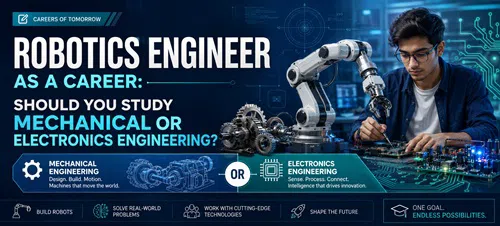
How Does Mechanical Engineering Connect With Robotics?
Every robot needs a physical structure that moves reliably.
Mechanical engineers contribute to areas such as mechanism design, material selection, manufacturing and motion. They also study forces and how different components behave when a machine operates.
Knowledge of CAD and engineering design becomes useful when developing robotic arms, mobile robots and automated equipment.
Mechanical engineering may therefore suit students who enjoy understanding how things move and how physical products are designed.
How Does Electronics Engineering Connect With Robotics?
A robot needs more than a mechanical body. It also needs systems that sense and respond.
Electronics engineers work with sensors, circuits, microcontrollers and embedded systems. These technologies help a robot collect information about its surroundings and control its actions.
Communication knowledge also becomes relevant when robots exchange information with computers, networks or other machines.
This route may appeal to students who enjoy working with circuits and intelligent electronic systems.
Which Branch Is Better for Robotics?
There is no single engineering branch that suits every robotics career.
Mechanical engineering provides a stronger foundation for areas involving physical design, mechanisms and manufacturing. Electronics and communication engineering provides useful knowledge for sensors, control hardware, embedded systems and connectivity.
Your choice should depend on the part of robotics that interests you most.
A student interested in designing robotic mechanisms might prefer mechanical engineering. Someone interested in making a robot sense, communicate and respond might prefer electronics.
What Additional Skills Should You Build?
Robotics is multidisciplinary, so your degree is only one part of the learning journey.
Programming is valuable for students from both branches. Languages such as Python and C++ are commonly associated with robotics and automation.
Students should also gradually understand:
Control systems and automation
Sensors and actuators
Embedded systems
Robotics programming
Computer vision
Artificial intelligence
CAD and 3D modelling
Projects provide an effective way to connect these skills. Building a small robot or automated system helps students understand how mechanical and electronic components work together.
What Robotics Careers Could You Explore?
Robotics skills are relevant across manufacturing, automotive systems, industrial automation, healthcare technology and other engineering sectors.
Students might eventually explore roles such as robotics engineer, automation engineer, embedded systems engineer, mechanical design engineer or control systems engineer.
The exact path depends on the technical skills developed alongside the core engineering degree.
Conclusion
Mechanical and electronics engineering can both lead towards robotics, but they build different strengths. Mechanical engineering develops understanding of design, manufacturing, thermal systems and physical mechanisms, while electronics and telecommunication engineering builds knowledge across circuits, microcontrollers, control systems, communication, signal processing and intelligent electronic systems.
At Somaiya Vidyavihar University, K J Somaiya School of Engineering offers both B.Tech. Mechanical Engineering and B.Tech. Electronics & Telecommunication Engineering with interdisciplinary options relevant to robotics. Electronics & Telecommunication students can choose minors such as Robotics & AI, Mechatronics, Robotics and Automation, Electric Vehicle and Drone Technology, while the curriculum also includes control systems, machine learning, IoT, AI and computer vision.
Mechanical Engineering students can similarly explore minors in Robotics and Automation, AI & Machine Learning, IoT & Real-Time Embedded Systems, Electric Vehicle and Drone Technology, while building core strengths in design, manufacturing and thermal engineering. Robotics Engineer is also listed among the programme’s career paths.
This flexibility allows students to start with the engineering discipline that best matches their interests and then add robotics-focused skills through interdisciplinary learning, projects and specialised minors.