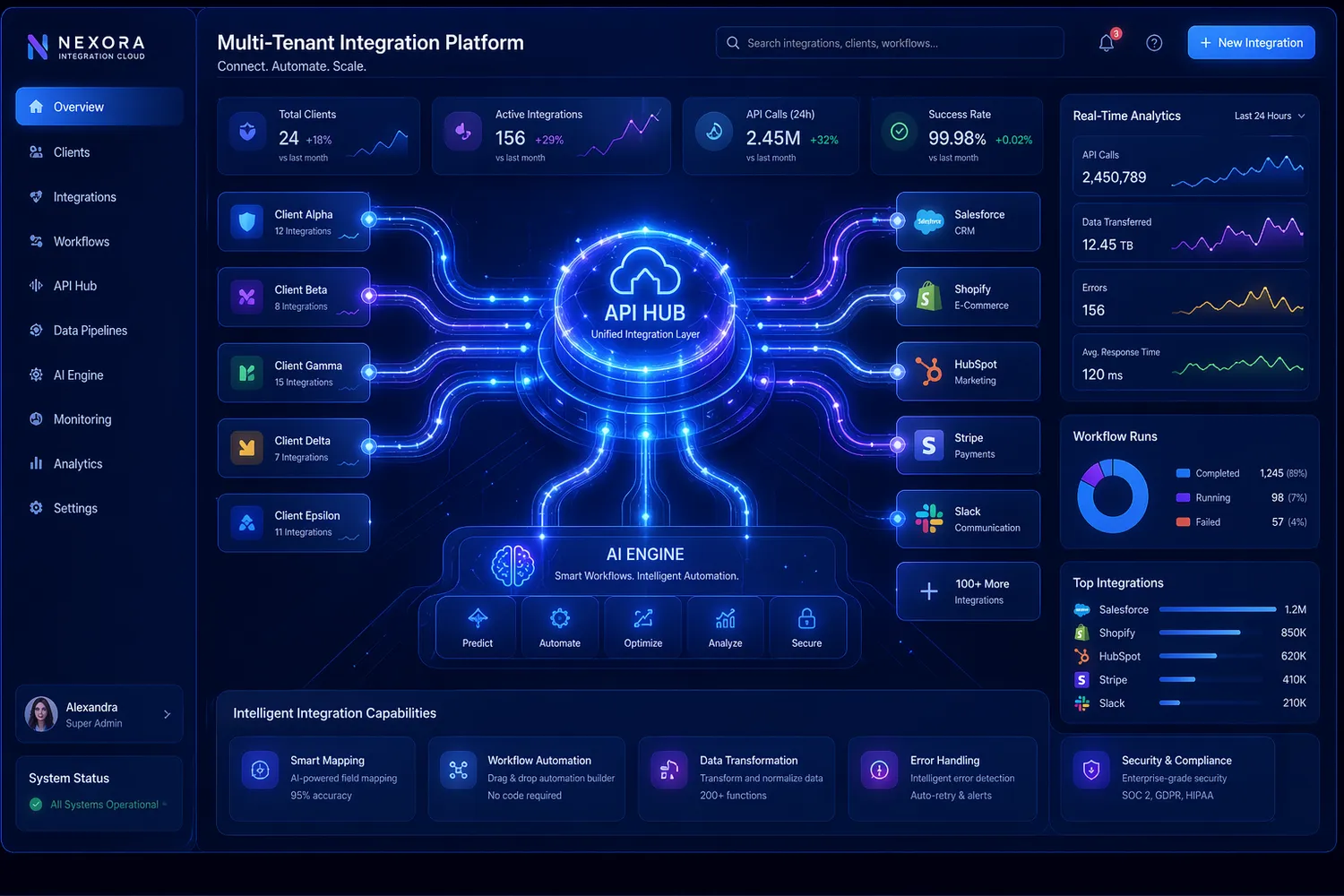
Introduction: Multi-Tenant Integration Is the Real Differentiator
If you’re building a SaaS product, integration is no longer a backend concern—it’s a customer-facing capability.
And that capability must scale across hundreds or thousands of tenants, not just one environment.
This is where the difference between:
- Workato (workflow automation)
- and ConnectorHub (embedded integration platform)
becomes architectural—not just functional.
1. What Multi-Tenant Integration Actually Requires
Before comparing platforms, let’s define the requirement properly.
A true multi-tenant integration platform must support:
- Single integration deployed across multiple customers
- Tenant-level data isolation
- Custom workflows per tenant without duplication
- Centralized updates with distributed impact
This aligns with how modern SaaS systems work:
A single application instance serves multiple tenants while keeping their data isolated and secure
2. Workato Embedded: Workflow Layer, Not Architecture Layer
How Workato Handles Multi-Tenancy
Workato approaches multi-tenant integrations through:
- Recipe-based workflows
- Environment-level configurations
- API triggers and connectors
What This Means in Practice:
- Integrations are often duplicated per customer
- Customizations require separate workflow versions
- Scaling across tenants introduces:Operational overhead
Version management complexity
Limitation: Tenant Scaling is Operational, Not Native
Workato can support multiple customers—but:
- It’s not inherently multi-tenant-native
- It’s workflow-centric, not platform-centric
Result:
You can scale—but with increasing complexity.
3. ConnectorHub: Multi-Tenant by Architecture, Not Configuration
ConnectorHub is built as a cloud-based integration platform where multi-tenancy is foundational.
🔹 Core Principle: Build Once, Deploy Across Tenants
Instead of creating integrations per customer:
- You define:APIs
Workflows
Data mappings
And then:
- Deploy across multiple tenants with configuration layers
🔹 Tenant Isolation + Shared Infrastructure
ConnectorHub follows modern SaaS principles:
- Shared infrastructure
- Logical tenant isolation
- Configurable workflows per tenant
This is exactly how scalable SaaS systems operate:
Multiple tenants share infrastructure while maintaining isolated data and configurations
🔹 Tenant-Aware Workflow Execution
Each workflow is:
- Context-aware (tenant ID, config, permissions)
- Dynamically executed per tenant
- Not duplicated unnecessarily
This eliminates:
- Workflow sprawl
- Maintenance overhead
4. API-Based Integration: Where ConnectorHub Wins
Workato Approach:
- Connector-driven workflows
- API usage embedded in recipes
ConnectorHub Approach:
A true API-first integration platform:
- OpenAPI / Swagger-based connector creation
- Reusable API services
- Workflow chaining across systems
Why This Matters:
- APIs become platform assets, not workflow components
- Easier to:Scale integrations
Reuse logic
Extend across tenants
5. AI Integration Platform Capabilities
ConnectorHub aligns more naturally with emerging AI-driven integration models:
ConnectorHub Enables:
- Intelligent workflow orchestration
- Data transformation across systems
- Event-driven automation
Because it is:
- API-first
- Workflow-extensible
- Multi-tenant aware
Workato Limitation:
- AI sits on top of workflows
- Not deeply integrated into multi-tenant execution layer
6. PropTech Integration: A Real-World Comparison
Use Case: CRM + ERP + CMMS Integration
Systems:
- CRM (Salesforce)
- ERP (SAP / Yardi)
- CMMS (Corrigo)
With Workato:
- Integration per client
- Workflow duplication
- Custom logic per deployment
With ConnectorHub:
- Prebuilt integration templates
- Tenant-level configuration:Field mappings
Workflow rules
- Shared core logic
7. Tenant Experience Platform Integration
ConnectorHub enables a tenant experience layer:
- White-labeled integration UI
- Embedded workflow builders
- Tenant-specific dashboards
👉 This is critical for SaaS vendors who want:
- Customers to manage integrations themselves
Workato Embedded:
- Offers embedding
- But still relies on:External workflow logic
Limited tenant-level abstraction
8. Final Comparison: ConnectorHub vs Workato Embedded
Final Verdict
ConnectorHub doesn’t just “handle” multi-tenant integrations—it is architected around them.
- Workato
→ Best for workflow automation across tools - ConnectorHub
→ Best for scalable, embedded, multi-tenant integration platforms
Strategic Takeaway
If you're a SaaS vendor, the decision comes down to this:
Do you want to manage integrations as workflows…
or deliver them as a core product capability?