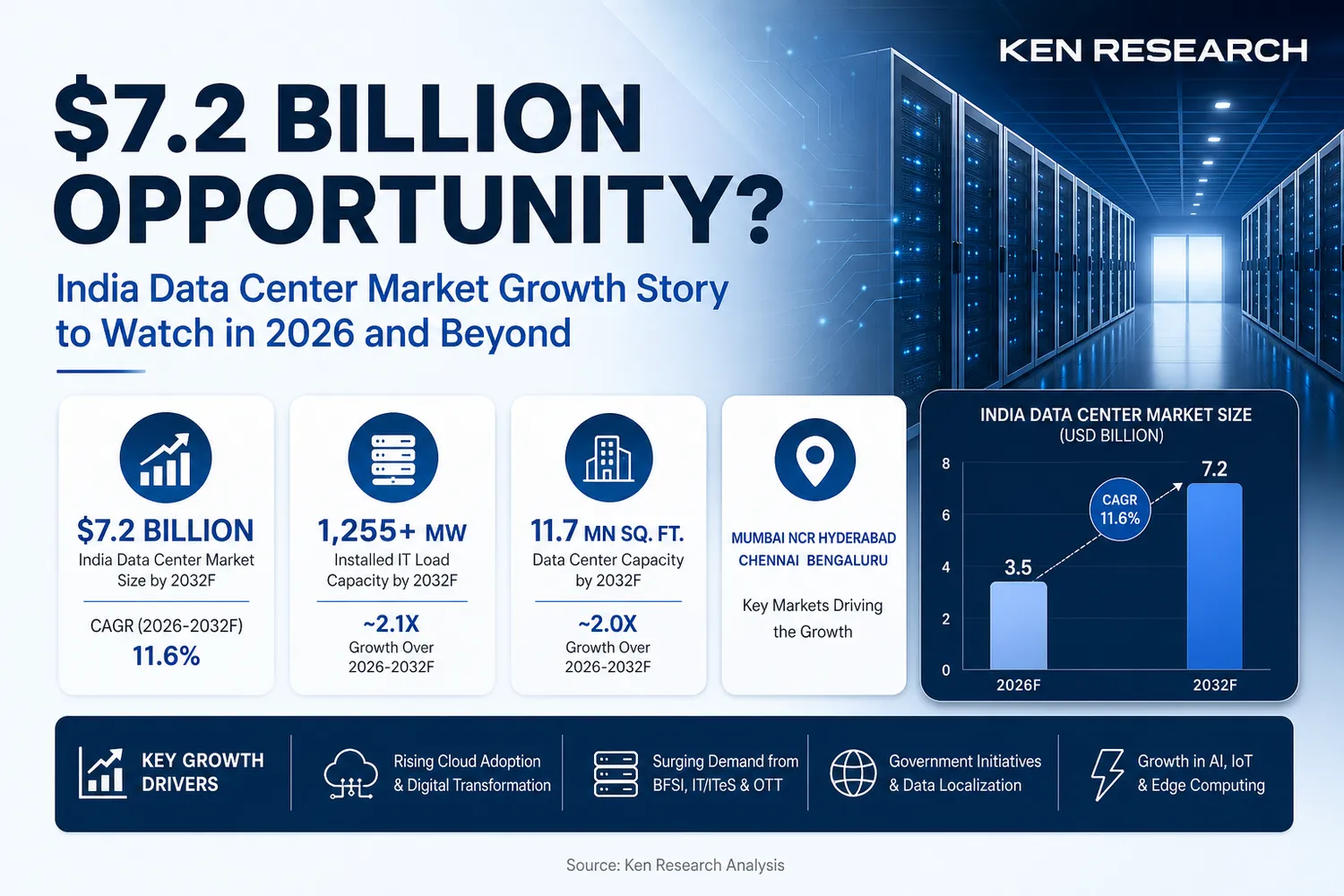
The India data center market is valued at USD 7.2 billion based on a five-year historical analysis, with growth trajectory projections through 2032 among the strongest in Asia. This is not a speculative market opportunity. It is a structurally anchored expansion driven by 850+ million internet users, escalating AI infrastructure demand, financial services data localization mandates, and hyperscaler capital deployment at scale. Based on market research insights, the India data center market size is expected to grow significantly from its current base as enterprise digital transformation accelerates and India's regulatory environment increasingly favors domestic data sovereignty. For investors and operators, 2026 represents a strategic entry window before market concentration intensifies further.
What is the India Data Center Market Size and Its Baseline Metrics?
Historical market size: USD 7.2 billion (five-year historical analysis base). Total installed capacity is expected to more than double by 2032. Mumbai accounts for the largest share of operational capacity. Hyderabad and Chennai are the second and third largest city-level markets. Tier-2 cities including Noida, Kolkata, Ahmedabad, and Pune are the fastest-growing geographic sub-markets. Power density requirements are rising from 5-10 kW per rack (traditional) toward 30+ kW per rack (AI/GPU-dense configurations). The India data center market report from Ken Research provides the foundational market intelligence for this assessment.
Four Structural Demand Pillars Sustaining Market Growth Through 2032
Independent industry evaluation identifies four non-discretionary demand drivers that make the India data center market's growth trajectory structurally resilient.
- Digital volume: India's 850+ million internet users generate over 25 exabytes of data monthly, with mobile video, AI-driven services, and financial transactions representing the fastest-growing data categories. This volume creates non-negotiable demand for compute and storage infrastructure at scale.
- Regulatory data localization: RBI mandates on payment system data storage, SEBI electronic records requirements, and IRDAI data governance frameworks collectively mandate domestic data center capacity for India's large and growing regulated financial services sector. This demand is independent of technology spending cycles.
- Hyperscaler infrastructure investment: Global cloud providers including AWS, Microsoft Azure, and Google Cloud are in active expansion mode across Indian metro clusters. Their greenfield campus development absorbs colocation capacity and drives ecosystem investment across power, cooling, and connectivity supply chains.
- AI and high-performance computing: Generative AI inference and training workloads require GPU-dense facilities with power densities exceeding 30 kW per rack. This is driving a greenfield facility development cycle specifically engineered for AI compute requirements that differs substantially from conventional data center construction.
Market Segmentation by Facility Type, Geography, and Customer Tier
The India data center market trends reveal a market segmented across three primary facility types. Hyperscale data centers are concentrated in Mumbai, Hyderabad, and Chennai, absorbing the largest share of new capacity investment. Colocation facilities serve enterprise customers requiring carrier-neutral infrastructure without ownership commitments this segment is growing across both Tier-1 metros and Tier-2 cities.
Edge data centers are an emerging category, positioned at network periphery locations to serve 5G-enabled latency-sensitive applications including autonomous systems, real-time analytics, and connected device management.
By customer tier: financial services and IT/ITeS sectors drive the largest demand volumes; healthcare data infrastructure is growing fastest in percentage terms from a lower base.
Competitive Landscape: Who Operates India's Data Center Market?
The India data center market competitors are structured across distinct competitive tiers. Global hyperscalers (AWS, Microsoft Azure, Google Cloud) dominate the hyperscale segment through owned campuses and long-term colocation absorption. Domestic colocation leaders include NTT India (Netmagic), Nxtra Data (Bharti Airtel), STT GDC India, CtrlS Datacenters, and Yotta Infrastructure. New entrant operators with significant capital backing include Adani Enterprises and Hiranandani's Yotta. Competitive differentiation parameters include: power reliability certifications (Tier III+), renewable energy procurement agreements, carrier-neutral interconnection environments, geographic footprint across metro and Tier-2 locations, and AI-optimized facility design specifications.
Key Challenges Facing India's Data Center Market Through 2032
Based on sector assessment, the following structural challenges temper the pace of market expansion despite strong underlying demand.
- Power reliability gaps: Data centers require 99.999% uptime power assurance. Grid infrastructure in many Indian non-metro locations does not reliably meet this standard, requiring significant captive generation and UPS investment that substantially increases facility operating costs.
- High greenfield development costs: Typical greenfield data center development costs range from USD 8 to USD 15 million per megawatt of installed IT load, creating high capital barriers for new market entrants and limiting supply-side response speed.
- Regulatory complexity: Data localization requirements, cross-border data transfer restrictions, and environmental clearance processes for large campuses add project development time and compliance cost.
- Talent scarcity: Critical facilities engineering, data center operations, and cybersecurity specialist talent is scarce, particularly outside Tier-1 cities where operational staff pipelines are thinner.
- ESG pressure: Data centers are energy and water-intensive facilities. Institutional investor ESG requirements are pushing operators toward renewable energy procurement agreements and water-efficient cooling system investments that add to capex requirements.
India Data Center Market Forecast 2025-2032: What the Numbers Indicate
The India data center market forecast from independent analysis points to total installed capacity more than doubling between 2025 and 2032. Growth is projected to be strongest in the hyperscale and AI infrastructure segments. Tier-2 city development is accelerating as operators seek cost-competitive greenfield locations ahead of Tier-1 metro land and power cost escalation. India is expected to emerge as one of Asia's top five data center markets by installed capacity before the end of the decade. The 2026-2028 period is identified as the highest-intensity investment phase as multiple concurrent greenfield campuses reach operational status across major metro clusters.
Conclusion: The 2026 Entry Window and Long-Term Investment Case
The India data center market's trajectory from its USD 7.2 billion historical base to projected 2032 scale represents one of Asia's most compelling infrastructure investment opportunities. The India data center market growth is underpinned by forces that are regulatory, demographic, and technological simultaneously. Competitors who secure strategic land positions, renewable energy agreements, and hyperscaler anchor tenancy in the 2025-2026 window are expected to command premium market positions through the decade. The industry outlook for this sector is decisively positive, with investment case strength derived from structural demand certainty rather than speculative market positioning.