Contact relays, also called a relay, can be defined as electromagnetic switches. This kind of switch allows the flow of electric current through a coil that closes or opens a switch. Control relays offer protection to the circuit current. This means that users don't have to run the switch on manually to change or isolate the electric circuit state. Control relays have a big role to play in electronic devices today. There are parts capable of powering electronic parts like transistors, power supply systems, power plants, and motors, among others.
Types of relay controllers
Control relays come in different types, usually depending on the structural features and operating principle. They include:
- Solid state relays: this relay controller utilizes components that are solid state to complete switching operations. This is done without any part moving.
- Contractor: this type of control relay is large, and it switches large electrical power amounts through the contacts
- Electromagnetic relays: electromagnetic relays are usually constructed with magnetic, mechanical, and electrical components. They also have mechanical contacts and operating coils. On coil activation, it closes or opens the mechanical contact. In a supply system, there are two AC and DC types.
- Thermal overload protection relay: this control relay works on the thermal effect principle of electrical energy. When there is excessive current flow in the circuit, it opens because of the bimetallic strip that is experiencing the temperature increase.
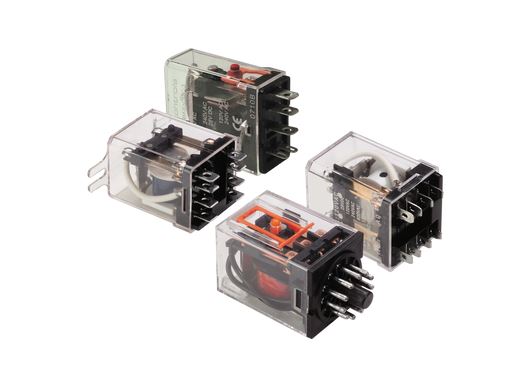
Control relay and contact type
Each control relay comes with a contact type like SPST-NO. It helps to understand what that means. Poles usually represent the circuits that are controlled by one switch. Throws are a representation of the positions that a switch can adopt.
- Single pole single throw SPST: this comes with 2 terminals that may be disconnected or connected. They also include 2 meant for the coil. This kind of relay bears 4 terminals. The single pole double throw SPDT usually has common terminals that connect one of the others. When we include the two meant for the coil, the relay comes with 5 terminals. Whether a coil is inactive o active, either A or B rests. The other should be the coil to be powered.
- Double pole single throw, DPST: this is the same as two SPST activated by one coil. It also includes 2 for the coil. The terminals are 6 in total. The double pole double throw DPDT equals 2 SPDTs activated by one coil. When the 2 for the coil are included, the relay has eight terminals.
Understanding normally closed NC and normally open NO contacts
Normally open contacts can allow current once a relay gets energized. If voltage is present, the contact will close and let the current flow. Normally closed contacts let current flow if the relay is not energized. This is the NO opposite. The NC contact usually interrupts the current flow.
Is there a difference between contactors and control relays?
The two mentioned are electrical devices whose main task is to switch circuits. Contactors are large relays. However, the two cannot be used one in place of the other. This is because of a few things:
- Load capacitor: normally, the classification of control relays is in terms of carrying loads, usually a maximum of 10 amperes or more. On the other hand, contactors can handle more than 10 amperes loads. Contactors are designed to handle NO contacts, while the control relays can handle the NC and NO.
- Auxiliary contacts: usually, contactors are fitted with auxiliary contacts. These are often used for performing some additional functions. This is not true for control relays.
- Safety features: contactors are designed to handle high loads. For this reason, sometimes they come with some safety features like spring-loaded contacts, overloads, and arc suppression.
- Applications: contactors are normally built for use in three-phase applications. However, relays are usually used in single-phase applications.
It is, therefore, important to determine whether you should get a contactor or a control relay. This should be based on the amperes, the voltage, and the number of phases they can handle.
Summary
It should not be hard to understand control relays, especially once you grasp the fact that they have switches that need electricity to switch. The more complicated part is understanding the normally closed and normally open concepts and how that works. Control relays are important in electrical circuits, and they cannot be ignored.