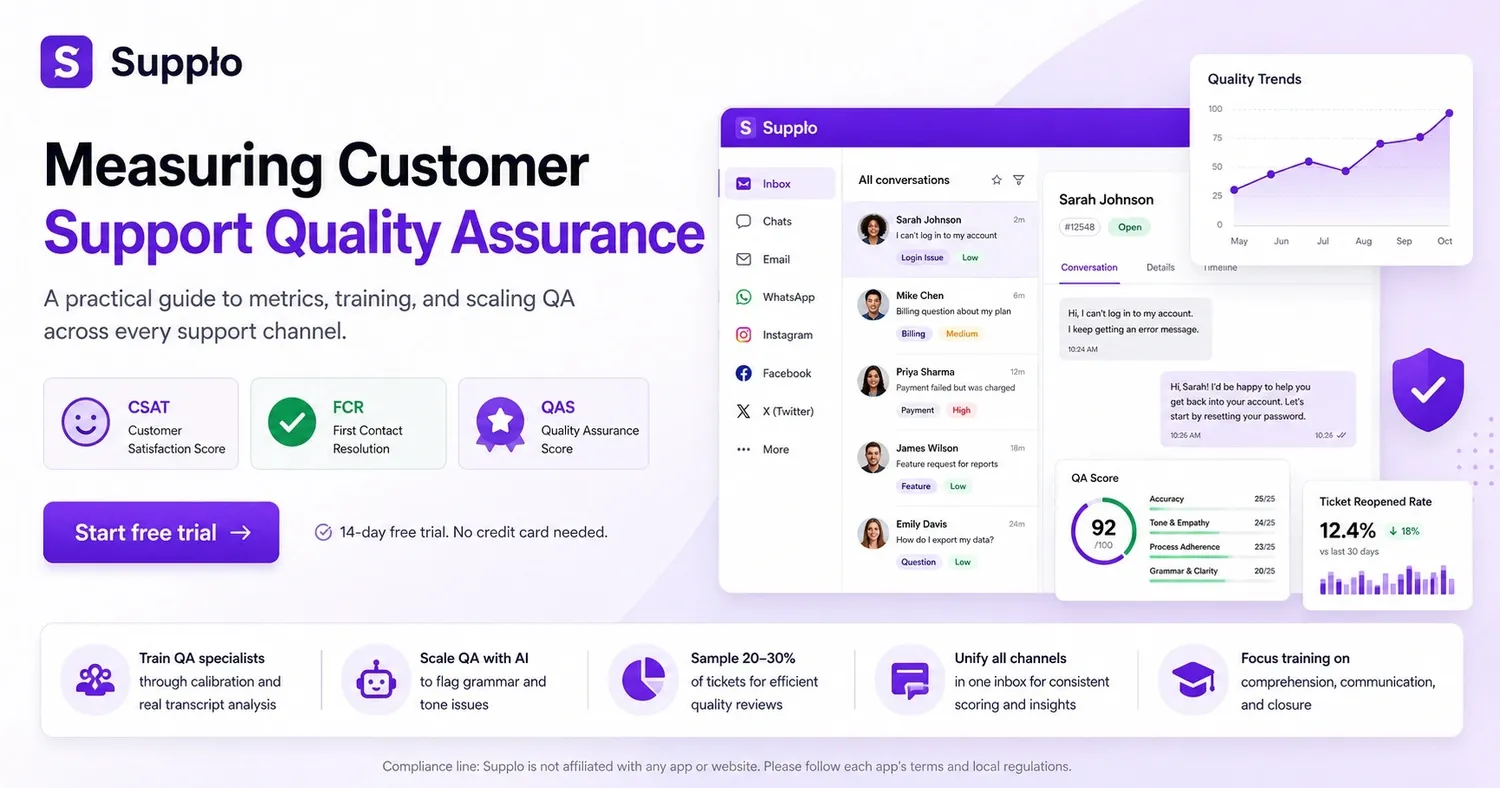
Customer support quality assurance (QA) ensures every customer interaction—be it a chat, email, call, or social media message—meets your exacting standards for precision, tone, and issue resolution. Consistently measuring support quality helps you prevent small issues from escalating into major reputation problems. In today's world of AI-powered solutions and multi-channel support, QA isn't just an option; it's essential for maintaining customer trust as your operations grow.
Many teams often wait for a flood of complaints before they properly address QA. By then, the damage is already done. A robust QA process, however, catches minor issues early, stopping them from developing into widespread poor habits that annoy customers and hurt retention rates. Maintaining service excellence is paramount.
Quick Answers
- You can measure support quality effectively using CSAT (Customer Satisfaction Score), FCR (First Contact Resolution), and a dedicated QA score.
- Train your QA specialists through regular calibration sessions and by analyzing actual conversation transcripts.
- To scale QA, sample 20-30% of tickets and use AI to identify grammar or tone issues automatically.
- Use a unified platform like Supplo to centralize scoring across all communication channels, including email, chat, WhatsApp, and social DMs.
What's Customer Support Quality Assurance, and Why Is It So Important Now?
Here’s the straightforward truth: customer support QA is a systematic way to evaluate interactions, ensuring they consistently meet your standards for accuracy, tone, and successful resolution. It answers two crucial questions: Was the customer’s problem solved? And was it handled in a way that builds lasting loyalty?
Traditional QA often involved randomly listening to phone calls, scoring them, and hoping they were representative. Modern QA, however, covers all digital touchpoints—email, WhatsApp, Instagram, and live chat—all managed from a single inbox. This is where a real transformation happens. When you consistently measure customer support quality across every channel your customers use, you can identify problems before they become established patterns.
The old method was reactive; you'd only notice a drop in CSAT scores months later and then begin investigating. The new approach is proactive; you catch isolated mistakes and fix them quickly, preventing them from spreading. With AI managing routine inquiries and multi-channel support becoming standard, QA is no longer a luxury. It's the essential safeguard that keeps your brand reliable and trustworthy as you expand, ensuring consistent service.
How to Precisely Measure Support Quality
You need three fundamental metrics, and I'll explain why each one is vital for service excellence. The Customer Satisfaction Score (CSAT) reflects how the customer felt about the interaction. First Contact Resolution (FCR) tells you if they had to repeat their issue, which is one of the quickest ways to annoy a paying customer. The Quality Assurance Score (QAS) confirms whether your agent actually followed your established process.
Without these three metrics, you're operating blindly, making informed decisions difficult. A single positive survey won't reveal a broken escalation process. A high CSAT score might hide the fact that your agents are skipping crucial steps. And FCR without the context of QA? You might think you're resolving tickets quickly, but customers could still be left frustrated.
- CSAT is a transactional metric; send a survey after each ticket for instant feedback.
- FCR helps reduce repeat contacts, which often represents a significant hidden cost in support operations.
- QAS combines objective criteria like accuracy, grammar, tone, and adherence to process into one comprehensive score.
- Avoid vanity metrics like "average handle time"; prioritizing speed without quality will quickly erode trust.
- Track trends weekly, not annually; a single poor quarter can quickly show up in CSAT scores.
Ready to start tracking? Sign up for Supplo’s free 14-day trial—no credit card required. You can set up your QA dashboard in less than 10 minutes and begin scoring your first 50 tickets today. → Start free trial
Essential Customer Service QA Metrics for Every Team
Beyond the foundational three, there’s a whole category of metrics that can reveal hidden issues in your support operations. A Response Quality Score, for instance, along with assessments of grammar, empathy, and completeness, tells you if your agents sound genuinely human or more like chatbots. The Escalation Rate indicates whether agents are truly resolving issues or just passing them along. And the Ticket Reopening Rate? That's a clear sign of incomplete resolutions.
Here’s the key insight: CSAT alone can’t pinpoint process gaps. I’ve seen teams with impressive 4.8 CSAT scores but also a 30% ticket reopening rate. Customers were happy initially, but their satisfaction quickly dropped when they had to contact support again the next day. These additional metrics help catch those unnoticed problems, ensuring service excellence.
- An escalation rate exceeding 20% often suggests that your agents lack autonomy or that your knowledge base is insufficient.
- A ticket reopening rate above 15% frequently indicates that the initial resolution was either partial or inaccurate.
- Response Quality Score can be automated using AI tools that identify grammar and tone issues in real-time.
- Track these metrics weekly and review them in a quick 30-minute meeting; don't let valuable data sit unread on a dashboard.
Evaluating Customer Support Performance: The Human Aspect of the Scorecard
Let's be direct: a scorecard is only as effective as the people who use it. Even with the most detailed rubric, if two QA analysts score the same ticket vastly differently, your data becomes useless. This is where calibration becomes critical.
Calibration involves having multiple QA analysts independently score the same ticket and then comparing their results. Without it, one agent might receive a 95 from reviewer A and a 72 from reviewer B. This destroys confidence in the process, and rightly so. Agents can spot inconsistent scoring from a mile away.
- Conduct monthly calibration sessions using 3–5 sample tickets, and use a shared rubric covering accuracy, tone, and process adherence.
- Include both customer-facing and internal-only tickets to identify all potential blind spots.
- Address discrepancies immediately: "Why did you rate the tone a 5 when I gave it a 3?" This reveals underlying assumptions.
- Document all calibration decisions to create a living rubric, updating it quarterly as processes evolve.
Discover what an effectively calibrated scorecard looks like within a modern shared inbox. → What a modern QA inbox looks like
Customer Support Quality Assurance Training: Building an Effective Program
Here's an unfiltered opinion: most QA training is ineffective and dull. Why? Because it relies on artificial role-plays that don't reflect real-world interactions. If you want your QA specialists to genuinely improve, use actual anonymized transcripts. Show them genuine mistakes, difficult customers, and real problems.
Structure your training around three core areas: comprehension (did the agent understand the issue?), communication (did the customer feel heard?), and closure (was the issue fully resolved?). A structured 4-week onboarding program is far more effective than a one-day workshop, ensuring consistent service quality.
- Week 1: Participate in shadow scoring with a senior QA specialist, scoring alongside them and then comparing results.
- Week 2: Score independently with a weekly audit; a manager blinds reviews every fifth ticket.
- Week 3: Engage in calibration training, actively participating in group scoring sessions.
- Week 4: Operate with full autonomy, supported by random spot checks.
- Incorporate "bad ticket" analysis: study interactions with the lowest scores to help develop pattern recognition skills.
Training for Support QA Specialists: From New Hire to Calibration Expert
Not everyone is suited to be a QA specialist. This role demands specific skills: identifying patterns (recognizing a recurring error across numerous tickets), providing constructive feedback (scoring is easy; coaching is challenging), and interpreting rubrics (applying consistent standards across various channels). Don't assign individuals to QA without proper training.
Pair new specialists with a mentor for their first 100 scored tickets. The mentor should review every score and highlight inconsistencies, not to penalize, but to educate. The primary goal is consistency, not perfection.
- Teach the "feedback sandwich" method for delivering scores: start with a positive observation, address an area for growth, and end with an encouraging statement.
- Conduct mock calibration sessions where specialists present and defend their scores to a panel, building confidence and fostering consistency.
- Maintain a shared QA library of example tickets (categorized as excellent, acceptable, or poor) for quick reference.
- Assess specialists quarterly by auditing 10 of their scored tickets against a master reviewer’s evaluation.
Using QA Training to Improve Support Agent Performance Without Micromanagement
Here’s the key rule of quality assurance: if it feels like punishment, agents will resist it. If it feels like coaching, they’ll embrace it. Frame QA training as a way to enhance performance. The message should be: "Here's what you're doing well, and here's one area to refine."
Use QA scores to create customized coaching plans. An agent struggling with tone, for example, receives empathy exercises. One who misses a resolution step gets playbook drills. When training is tailored to specific gaps, agents improve much faster—sometimes 30% quicker than those who only see a score.
- Assign each agent a QA specialist for monthly one-on-one reviews focused on 2–3 specific areas for improvement.
- Develop "mini-modules" based on common errors; for instance, a 15-minute video on effectively handling upset customers.
- Gamify improvement: publish anonymized team scores (never individual ones) and celebrate weekly progress.
- Never use QA scores as the sole performance metric; combine them with CSAT and FCR for a comprehensive evaluation.
Using QA data for coaching, not disciplinary action, is crucial. → See how Supplo's AI agent resolves up to 80% of tickets
How to Expand Support QA Processes for a Growing Team
The challenge with scaling QA is that manual processes don't scale efficiently. When your team grows from 5 to 50 agents, your QA team simply can’t review every ticket. You need clear rules, automation, and a tiered review system.
Start by defining sampling rules. Review 100% of interactions from new hires during their initial 30 days. For experienced agents, reduce this to 20%. However, always review 100% of escalated tickets, as these are where costly mistakes typically occur. Then, integrate automation to flag tickets with low grammar scores or unusually long handle times.
- Establish sampling tiers: 100% of tickets for agents in their first 30 days, 50% during their first 90 days, then 20% thereafter.
- Automate flagging: set triggers so that a "tone score below 3" or a "ticket reopened within 24 hours" automatically initiates a QA review.
- Utilize a shared QA dashboard (like Supplo's inbox) where all team members can view their scoring history.
- Rotate QA specialists across different channels (chat, email, social DMs) quarterly to prevent channel-specific bias.
Streamlining QA for High-Volume Support: Automation, Sampling, and AI
Let’s focus on high-volume support environments, where each agent handles 200+ tickets daily. At this scale, reviewing every interaction is physically impossible. However, you can be strategic about what you review.
Employ stratified random sampling: select tickets from various channels, at different times of day, and from agents with varying experience levels. This provides a representative overview without requiring a review of everything. Then, integrate AI tools to automatically identify low-quality responses, missing greetings, grammatical errors, and incomplete answers. Human QA specialists can then concentrate on complex cases, rather than routine checks.
- Sample 10–15 tickets per agent per week, chosen randomly but with a bias toward complex or escalated tickets.
- Use AI to pre-score basic elements: grammar, tone, greeting usage, and adherence to closure protocols; human QA specialists then review only those tickets flagged by AI.
- Track QA efficiency: measure how many tickets each QA specialist reviews per hour, aiming for 8–12.
- Supplo's AI agent can automatically handle up to 80% of tickets, allowing your human team to focus on nuanced interactions that require thorough QA and expert oversight.
Scaling Customer Support Quality Assurance Without Increasing Headcount
Here's what many teams overlook: you don't necessarily need to hire more QA specialists to scale. Instead, you need automation, optimized workflows, and a centralized inbox. Leverage AI to pre-screen tickets for quality issues. Then, use a system that automatically assigns flagged tickets for human review.
With this hybrid strategy, your current team can manage three times the volume. No new hires, no ballooning headcount. Plus, a flat pricing model means no per-seat costs escalating as you grow. (Yes, that’s a Supplo feature; it's core to our philosophy.)
- Use Supplo's AI agent to automatically score responses for tone and accuracy before a human agent sends the reply.
- Set up automated workflows: for instance, if a ticket is reopened within four hours, automatically route it to QA.
- Integrate your knowledge base with QA processes: if an agent consistently deviates from a knowledge base article, flag it for retraining.
- Acknowledge that 100% QA coverage is impractical at scale; a 20–30% sampling rate combined with automated triggers will catch most issues.
If your QA process feels cumbersome or inconsistent, Supplo's inbox unifies all channels into a single, thread-based view. You can flag tickets for QA, auto-assign scores, and conduct calibration sessions. Try it for free. → Free trial
Key Takeaways
- Measure support quality using a combination of CSAT, FCR, and QA scores instead of relying on just one metric.
- Train QA specialists through hands-on calibration sessions and analysis of real transcripts, moving beyond theoretical knowledge.
- Scale your QA efforts by sampling 20-30% of tickets and using AI to automatically identify grammar or tone issues.
- Utilize a shared inbox like Supplo to centralize scoring across email, chat, WhatsApp, and social media DMs.
- QA training should prioritize comprehension, communication, and effective resolution.
- Automate as many tasks as possible to reduce the manual workload for reviews.
- Regularly update your QA rubrics to ensure they remain aligned with evolving processes and customer expectations.
FAQ
What's the difference between CSAT and QA scoring?
CSAT measures the customer's feeling after an interaction, making it subjective. QA scoring, conversely, assesses how well the agent adhered to your established process, making it objective. Both are important, but they provide different insights.
How many tickets should each agent have reviewed by QA weekly?
For most teams, reviewing 8–12 tickets per agent per week is sufficient to identify patterns. If an agent is new or on a performance improvement plan, increase this to 20. For high-volume teams, leverage automated flags to reduce manual effort.
Can AI completely replace QA specialists?
Not entirely. While AI can flag grammar, tone, and process errors, it cannot fully assess empathy or critical thinking in problem-solving. Use AI for initial screening, allowing human specialists to focus on more complex cases. Supplo's AI agent handles the majority of routine inquiries, freeing your QA team to concentrate on ensuring overall quality.
How can I get agents to buy into a QA program?
Position it as coaching, not punishment. Share anonymized team benchmarks and celebrate collective improvements. When agents see that QA data helps them achieve higher CSAT scores, they will be more likely to embrace it.
Which metrics should I disregard in QA?
Average handle time (AHT) and first response time are operational metrics, not indicators of quality. Prioritizing speed over quality often leads to customer frustration. Instead, focus on CSAT, FCR, and the QA score.
How often should QA rubrics be updated?
Update them quarterly, or whenever there's a significant process change (e.g., adding a new channel or launching a new product). Rubrics can quickly become outdated, and outdated rubrics lead to inconsistent scoring.
What if QA scores are consistently low across the entire team?
This typically points to a training or process issue, rather than a problem with individual agents. Review your knowledge base, ensure agents have the necessary tools, and evaluate whether your rubrics are realistic. If all agents are struggling, address the underlying system first.
Compliance line: Supplo is not affiliated with any app or website. Please follow each app's terms and local regulations.