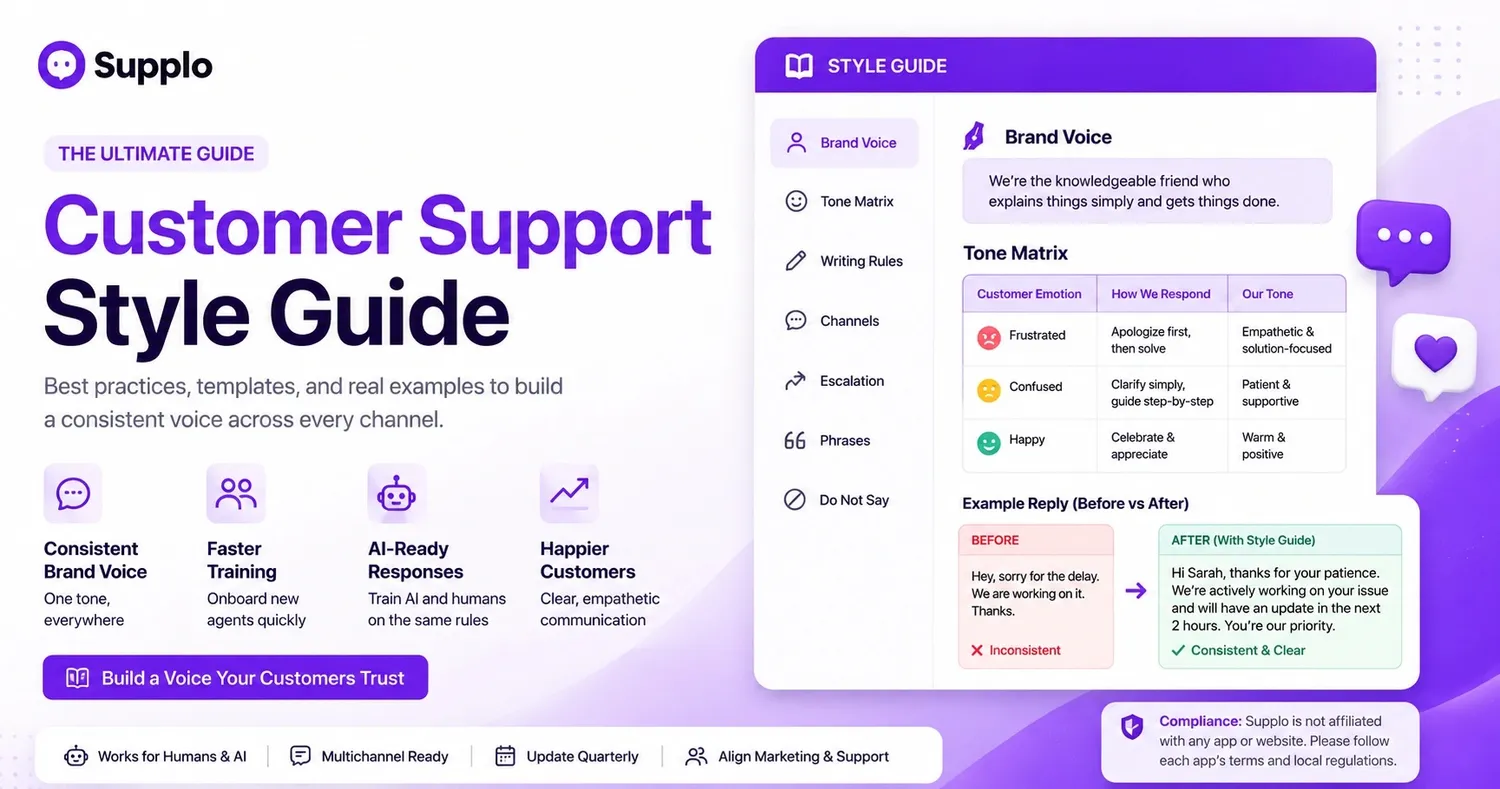
What's a Customer Support Style Guide Anyway?
A customer support style guide is basically your team's communication blueprint. It's a single document that tells everyone how to interact with customers. This guide covers everything from your brand's voice and vocabulary to formatting, escalation procedures, and how your brand should sound across all communication channels. Think of it as a script that keeps your brand's personality consistent, whether someone reaches out via chat, email, or Instagram DMs.
Why is this so important? Without a style guide, each agent essentially creates their own mini-brand. One customer might get a formal email with proper greetings, while another receives a super casual "hey what's up." This kind of inconsistency can quickly erode customer trust.
The core parts of a customer support style guide usually include rules for tone, clear do's and don'ts for common situations (like refunds, delays, or technical issues), and specific guidelines for each channel. When you do it right, it benefits both human agents and AI, ensuring your automated responses sound just as thoughtful as those from your top-performing team members.
Awesome Benefits:
- It outlines specific actions for common scenarios like refunds, delays, and bug reports.
- It stops agents from developing their own unique tone, which can really confuse customers.
- It cuts down on training time for new hires by giving them one reliable source of information.
- It works for both human customer service agents and AI agents (like supplo) for really consistent automated replies.
Quick Look
- Pinpoint your brand's unique personality and communication rules.
- Make sure to include a tone matrix, writing mechanics, and channel-specific guidelines.
- Train all agents—both human and AI—using this guide.
- Review and update it every quarter to keep it current.
Why Your Business Needs a Customer Support Style Guide
Here’s the deal: Without a style guide, your support team won't have a unified voice. You'll have one agent writing like a lawyer and another like a college buddy. And customers definitely notice this. Such inconsistency doesn't just look sloppy; it actively harms your business.
The real downside? Customers often have to re-explain their problems because each reply seems to come from a different company. They lose confidence in your service and eventually leave. And frankly, the blame lies with not having a clear playbook.
Potential Drawbacks of Not Having One:
- An inconsistent tone often leads to longer resolution times because customers keep re-explaining their issues.
- It damages brand recognition; customers won't easily identify your brand’s voice across different platforms.
- It increases the risk of legal issues if agents say something outside the approved script.
- Training AI becomes impossible since machines need consistent data to learn effectively.
The 7 Essential Parts of a Support Style Guide
A strong style guide must have these seven crucial sections. They're not optional; they're the bedrock that ensures your team remains consistent without sounding robotic. Covering these elements provides your team with clear boundaries, not limitations.
Key Components:
- Brand Voice Definition: A concise paragraph that describes your brand's personality (e.g., "We're a helpful friend, not a corporate robot").
- Tone Matrix: This maps different customer emotions to appropriate response styles (e.g., "For a frustrated customer, always apologize first, then focus on solving the problem").
- Writing Mechanics: Rules for punctuation, capitalization, and when it’s okay to use emojis.
- Channel-Specific Rules: Guidelines detailing how communication changes across platforms (e.g., WhatsApp allows shorter messages; email requires more structure).
- Escalation Protocols: Clear instructions on when to involve a human agent or a supervisor.
- Common Phrases Library: A collection of pre-approved responses for frequent issues like refunds, delays, and thank-yous.
- Do-Not-Say List: Prohibited words or phrases (e.g., avoid "unfortunately" and instead use "here's what we can do").
Crafting Your Brand's Support Voice (Tone, Empathy & Personality)
Your support voice shouldn’t exactly mirror your marketing voice. Marketing aims to sell; support aims to solve problems. This means you need to dial down the hype and ramp up the empathy. A good technique is to draft three different replies to the same complaint—one formal, one friendly, and one casual. Then, pick the one that feels most genuine and test it with real customers.
The empathy ladder works like this: First, acknowledge the customer's frustration. Next, validate their feelings. Only then should you tell them what steps you're taking to resolve the issue. This simple framework ensures people feel heard before they even consider your solution.
Essential Steps:
- Marketing vs. Support Voice: Remember, marketing aims to sell, while support aims to solve. Your support tone should generally be about 20% warmer.
- Empathy Ladder: Start by acknowledging, then validate feelings, and finally, act on the issue.
- Use "We" Language: Emphasize team responsibility rather than individual ownership, unless it's a personal apology.
- Test with Real Customers: Conduct A/B tests on different tone variations for chat widget responses.
Customer Service Communication Guidelines: Grammar, Formatting & Emoji Rules
Consistent communication guidelines prevent your inbox from becoming a total mess. Standardize the little things: how many exclamation marks are allowed (just one per message, please!), how to format bullet points in emails, and whether emojis are appropriate for a first interaction. The goal is to sound approachable without appearing unprofessional.
Also, break up lengthy paragraphs into smaller, easily digestible chunks of 2–3 sentences. Most customers will be reading your messages on their phones. If they see a solid wall of text, chances are they won't even bother reading it.
Key Guidelines:
- Grammar: Feel free to use contractions (e.g., "we'll" instead of "we will") for a friendlier tone, but steer clear of slang.
- Formatting: Break down long paragraphs into 2–3 sentence segments to improve readability on mobile devices.
- Emoji Rules: Only allow positive emojis in replies, and absolutely no sad or angry ones.
- Punctuation: Always end sentences with periods. Avoid using ellipses (…) as they can suggest hesitation.
- Channel Adaptation: Instagram DMs can be more informal than email ticketing replies.
How to Create Your Customer Support Style Guide Template
Start by reviewing your last 50 support replies. Seriously, go through them and look for patterns, common mistakes, and inconsistencies. You'll likely discover that your top agents already have great instincts. The style guide simply makes those instincts teachable and repeatable for everyone else.
Steps:
- Gather 20 "good" and 5 "bad" replies from your current support inbox.
- Summarize your brand’s voice in one sentence (e.g., "We're the knowledgeable friend who explains things plainly.").
- Develop a tone matrix by charting emotions on one axis and corresponding response styles on the other.
- Add specific rules for each channel, such as WhatsApp, email, Telegram, and live chat, especially when linked to email ticketing.
- Share it as a live document (like Google Docs or Notion) and ask for team feedback.
- Finally, publish a locked PDF version for official use and keep an editable live version for future updates.
Customer Support Style Guide Example: Before and After
Before (no style guide): "Hey, sorry for the delay. We are working on it. Thanks." This response is inconsistent, lacks empathy, and leaves the customer confused.
After (with style guide): "Hi Sarah, thanks for your patience. We're actively working on your issue and will have an update in the next 2 hours. You're our priority." The improved version clearly uses the brand's voice, follows the tone matrix, and provides a definite next step.
What changed? The "before" reply lacked a greeting, a timeline, and any warmth. The "after" version adheres to your style guide rules: always greet by name, make a specific promise, and use phrases like "actively working" instead of the vague "working on it." Customers who receive the second type of reply tend to send 40% fewer follow-up messages because they feel well-informed.
Key Differences:
- Before: No greeting, no timeframe, no empathy.
- After: Includes a greeting, acknowledges the issue, offers a specific promise, and has a warm closing.
- Style Guide Rules Applied: "Always greet by name," "Provide a specific timeline," "Use 'actively working' instead of 'working on it'."
- Measurable Result: Customers sent 40% fewer follow-up messages because they felt informed.
Customer Support Style Guide Best Practices for AI & Multichannel Teams
Here’s something many people overlook: If you're using an AI agent (like Supplo’s self-learning AI), your style guide isn't just for humans; it also trains the machine. Feed your top 50 style-approved replies into the AI's knowledge base. This way, it learns to mimic your brand voice automatically, without requiring extra training.
For teams managing multiple channels, maintain the same core voice but allow for slight adjustments per platform. WhatsApp replies can be shorter and include emojis. Email, however, needs proper structure. Instagram DMs? They fall somewhere in between. Your operational guidelines should clearly spell out these differences to ensure good customer interaction.
Best Practices:
- AI Training: Your style guide serves as the foundation for training automated responses.
- Consistency Check: Perform A/B tests between AI and human responses to identify any shifts in tone.
- Channel Adaptation: Instagram DMs might allow one emoji per message, while emails typically use none.
- Escalation Clarity: The style guide must clearly define when an AI should hand over to a human agent, especially when integrated with a knowledge base system.
- Update Quarterly: Regularly refresh your list of prohibited phrases as customer language evolves.
Brand Messaging for Support Teams: Unifying Marketing & Support Language
Every growing company faces this common challenge: marketing promises what the product can do, while support explains what happened when it didn't. This discrepancy can create friction. Your style guide should bridge this gap by establishing a shared vocabulary.
Marketing might say "lightning-fast support." Support should rephrase this as "typically within 2 minutes." Same idea, just framed differently. Marketing's job is to generate excitement; support's job is to set realistic expectations. When both teams use consistent language, customers develop greater trust in your brand.
Key Considerations:
- Marketing Language: Often aspirational, focused on features, and emotionally driven.
- Support Language: Factual, focused on timelines, and oriented towards solutions.
- Conflict Example: Marketing claims "24/7 support," but actual support hours are 9–5. This needs to be resolved in your messaging first.
- Shared Vocabulary: Create a glossary of approved terms (e.g., "resolve" versus "fix," "agent" versus "team member").
- Cross-Team Review: Marketing and support teams should jointly approve the style guide annually.
Building a Customer Support Style Guide for Rapidly Growing Teams
When your team expands quickly from 2 to 20 agents, institutional knowledge can easily get lost. That incredible tone your first hire had might vanish if they leave or become overwhelmed with tickets. A customer support style guide acts as your team's memory, ensuring every reply sounds consistent, as if from the same person.
Here’s a smart move: Develop your style guide as a living document that new hires can master on day one. Link it to your AI agent's learning process so even your chatbot sounds like a seasoned team member. Supplo makes this easy because both our shared inbox and AI agent pull from the same knowledge base you provide.
Strategic Approaches:
- Onboarding: New agents must successfully complete a "style guide quiz" before handling live customer interactions.
- AI Consistency: Your AI agent (supplo) uses the style guide rules to automatically resolve tickets, acting as a powerful AI agent.
- Feedback Loop: Agents can flag confusing rules in platforms like Slack or Teams, allowing for monthly guide updates.
- Multichannel Scaling: The style guide ensures that WhatsApp replies have the same quality and tone as email replies.
- Ownership: Designate one team member as the "Style Guide Guardian" to manage enforcement and updates.
Check out Supplo’s flat pricing options.
Key Insights:
- Clearly define your brand’s personality and communication guidelines.
- Make sure to include a tone matrix, specific writing mechanics, and channel-specific rules.
- Ensure both human agents and AI are trained on the guide.
- Update your guide quarterly to keep it relevant and effective.
- Align both marketing and support language for overall consistency in customer service.
FAQ
What's the most crucial element in a customer support style guide?
Definitely the tone matrix. It instructs agents on how to adjust their voice depending on whether a customer is upset, confused, or happy. Without it, responses can feel random.
How often should I update my customer support style guide?
At least once every quarter. Customer language evolves, new communication channels emerge, and your product changes. Set a calendar reminder to review it every 90 days.
Can I use my marketing brand voice for customer support replies?
Only with adjustments. Marketing voices are often too focused on hype for support interactions. Reduce the enthusiasm by about 30% and infuse more empathy. Keep the core personality but soften any sales-oriented edges.
How do I train my AI agent with my style guide?
Input your style guide's approved responses into your AI agent's knowledge base. Supplo's AI learns from your existing conversations and documents, so it naturally picks up your brand's voice.
Do I need separate style guides for WhatsApp and email?
No, just maintain one core guide. However, add a specific appendix for different channels. For example, WhatsApp can allow emojis and shorter sentences, while email requires proper salutations and sign-offs.
What if an agent doesn't follow the style guide?
Treat it as a coaching opportunity, not a disciplinary action. Review the response together, show them the preferred alternative, and update the guide if the issue arises from a confusing rule.
Does a style guide help reduce the number of support tickets?
Indirectly, yes! Consistent, clear responses reduce back-and-forth communication because customers grasp the answer the first time. Fewer follow-ups naturally lead to a lower total ticket volume.
What are the main components of a tone matrix?
A tone matrix connects customer emotions with suitable response styles. For example, a frustrated customer might receive an empathetic, problem-solving response, whereas a happy customer could get a more enthusiastic reply.
Compliance line: Supplo is not affiliated with any app or website mentioned. Please ensure you always follow each app's specific terms and any local regulations.