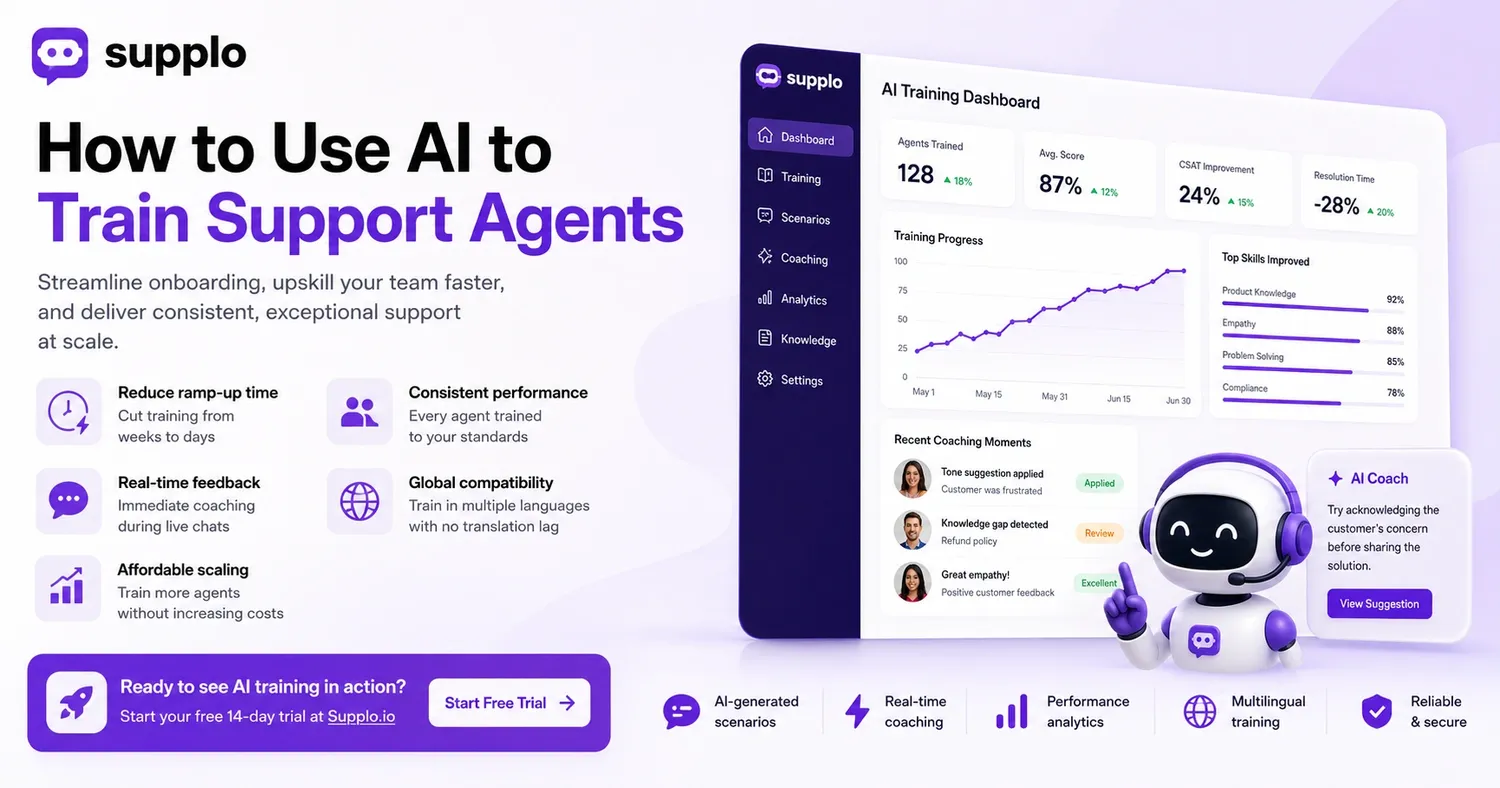
Let's be honest for a second. Training customer support agents the traditional way is a real headache. It takes ages, costs a fortune, and the results are often hit-or-miss. You usually end up pulling experienced agents away from their duties to mentor new hires, and even then, how much new folks learn really differs.
But guess what? Using AI for training support agents isn't some far-off dream anymore. It's a practical solution that's readily available and genuinely effective. This guide is for customer service leaders and managers eager to simplify onboarding, boost their team's skills quicker, and stop wasting resources on outdated training methods that just don't scale.
Quick Glimpse
- Faster Onboarding: Slash training times from weeks to mere days with AI.
- Consistent Quality: Ensure every agent receives the same high-quality instruction.
- Instant Feedback: Get live coaching directly within ongoing chats.
- Global Reach: Train agents in various languages without translation delays.
- Cost-Effective Growth: Expand your team without breaking the bank.
Why Old-School Agent Training Drains Your Time and Budget
Let's address the big issue. Traditional training—like shadowing, role-playing, and those massive PDF manuals—consumes an incredible amount of time. Your top performers spend hours coaching new recruits. And the outcome? It's inconsistent at best.
Here's a closer look at the actual impact:
- The Hidden Cost of "Buddy Training": You lose productivity from both the mentor and the learner.
- Why Static Knowledge Bases Fall Short: They can't adapt to the complex, unpredictable nature of real customer questions.
- Compliance Risks: Untrained agents handling sensitive financial or account information can lead to serious legal issues.
- Knowledge Silos: Manual training creates isolated information pockets that break down as your team grows.
The numbers simply don't add up when you're trying to scale your operations. This is precisely where AI changes everything.
What's AI Training for Customer Support All About?
Here's the deal: AI training for customer service isn't about replacing your human agents. Instead, think of it as providing them with an incredibly smart, always-on assistant.
It's a system that learns from your existing knowledge base and past customer interactions. This intelligence helps it provide the right answers, highlight gaps in your documentation, and simulate real customer scenarios for practice. It's not a black box making decisions on its own; it's a tool designed to make your team faster and more consistent in their support efforts.
- AI Agent vs. AI Coach: One handles tickets, while the other develops your staff.
- Self-Learning AI: It becomes more effective with continued use, requiring minimal manual updates.
- Not a Replacement: AI can't replicate human empathy or complex judgment.
- Beyond E-Learning: AI training provides an interactive and dynamic experience, adapting to how agents actually perform.
Key Strategies: Automating New Hire Training with AI
This is where things get truly practical! Automating agent training with AI means cutting ramp-up time from weeks to just a few days. Seriously, no exaggeration!
Start by feeding your AI your 50 most frequent support tickets and your updated knowledge base articles. Then, watch your new hires gain confidence quickly.
- Method 1: AI-Generated Scenarios: These are directly pulled from your actual ticket history.
- Method 2: Real-time Answer Suggestions: This helps reduce hesitation during live customer chats.
- Method 3: Automated Feedback Loops: These flag when a new hire's response deviates from the knowledge base.
- Method 4: Performance Dashboards: Get insights into knowledge retention without manual grading.
- Method 5: Multilingual Simulations: Train global teams by translating scenarios, not just answers.
The core idea behind using AI to train support agents is simple: practice with real data, get immediate feedback, and learn by doing.
AI-Powered Agent Development: Moving Beyond Outdated Practices
Forget handing agents a thick policy manual! AI-assisted development empowers your team to learn by doing.
Your AI can role-play as a difficult customer, guide agents through refund processes, and even detect their tone. This isn't just for initial onboarding; it's an ongoing development tool that helps even your most experienced agents improve.
- Advanced Scenarios for Veterans: Tackling challenging escalation situations they rarely encounter.
- Identifying Training Needs: AI can pinpoint knowledge gaps you didn't even know existed.
- Linking Outcomes to Metrics: Connect AI training directly to Quality Assurance (QA) scores and Customer Satisfaction (CSAT).
- Cross-Training Across Channels: Cover email, chat, and social media all within one system.
Crafting Personalized AI Training Modules for Your Support Agents
Building custom training modules begins with your own company data. Upload your top 100 resolved tickets, your brand's style guide, and any compliance requirements. The AI then generates modules that assess your agents on your specific products and policies, not generic examples.
The best part? Update a single item in your knowledge base, and the training modules automatically refresh. No more outdated training materials!
- Step 1: Collect your "gold standard" tickets—the best examples of correct resolutions.
- Step 2: Define your scoring criteria (accuracy, empathy, speed, whatever's important to you).
- Step 3: Let the AI create multiple-choice, open-ended, and role-playing modules.
- Step 4: Run a test group and refine based on their feedback.
- Step 5: Schedule regular module updates (e.g., after every new product launch).
AI Coaching for Your Customer Service Team
Here's where AI coaching becomes incredibly intriguing. Instead of waiting until after an interaction to review performance, the AI provides coaching during the live conversation.
Your AI agent can discreetly suggest an answer, recommend a softer phrase, or alert you to a compliance risk while the agent is typing. It's like having a senior support lead overseeing every chat, but without the awkward hovering. This enhances agent development and ensures consistent service quality.
- Establish "Guardrails": Agents must acknowledge suggestions before using them.
- Coaching vs. Automation: Coaching offers advice; automation executes tasks.
- Sentiment Alerts: "This customer seems upset; try apologizing first."
- Post-Chat Summaries: These create a valuable "coaching moment" for both the agent and the AI.
Ready to experience AI training firsthand? Start a free 14-day trial at Supplo.io. Connect your knowledge base, and watch as the AI generates training modules for your team in minutes. No credit card is required. It's the most practical way to see if AI-assisted onboarding fits your workflow.
Boosting Support Agent Skills Through AI Simulated Conversations
Simulated conversations are the quickest way to build agent confidence without risking actual customer relationships. This is crucial for agent proficiency.
Your AI can imitate a challenging customer, follow a specific script, and even push back if the agent provides an incorrect answer. Consider it a flight simulator for support: consistent practice leads to mastery, but only if you're practicing the right things. Effective skill development relies on realistic simulations.
- Practice Ticket Queue: Using AI-generated customer personas.
- Fire Drill Scenarios: Handling difficult situations like payment issues or account disputes.
- Measure Response Time and Tone: Under pressure, in real-time.
- "Fail Forward" Approach: Let agents make mistakes and review them constructively.
Automating Agent Training with AI
Here's the proven workflow:
- Step 1: Data Ingestion: Feed the AI your tickets, knowledge bases, and chat logs.
- Step 2: Module Generation: The AI creates scenarios and quizzes from your data.
- Step 3: Adaptive Assignment: The AI identifies weaknesses and assigns relevant modules.
- Step 4: Live Coaching: The AI provides suggestions during real-time chats.
- Step 5: Analytics & Iteration: The AI suggests training content updates based on performance.
When done correctly, this loop runs continuously. Every resolved ticket becomes a future training lesson, ensuring your agent education never becomes outdated.
AI for Enhanced Agent Performance
AI tracking offers detailed data without feeling like micromanagement. You'll see which agents excel at quick resolutions and who might need more coaching on empathetic responses. This data is key for performance metrics.
The main idea: use AI analytics as a diagnostic tool, not for punitive measures. Track trends over time and watch your team naturally improve.
- Metrics to Track: Resolution time, CSAT, knowledge base usage, and sentiment shifts.
- Spotting the "AI Crutch": Identify agents who rely too heavily on suggestions versus those who adapt.
- Benchmark Against History: Focus on individual improvement rather than comparing agents.
- Flag Common Knowledge Gaps: Address issues in your knowledge base directly, fixing the source rather than just the symptom.
AI-Driven Skill Development for Remote and Global Teams
When your team spans multiple time zones, AI training acts as a great equalizer. This is vital for remote agent support.
Everyone receives the same scenarios, coaching, and knowledge base, all in their native language. No more "the training was different for the Manila office" excuses. AI translates and standardizes, ensuring your agent in Nairobi learns exactly what your agent in New York does. This promotes consistent training across diverse teams.
- Real-time Translations: For both training modules and live coaching.
- Asynchronous Training: Effectively manage teams working across 24/7 shifts.
- Compliance Advantage: Ensure a consistent understanding of policies worldwide.
- Equal Support for Remote Agents: Avoid the feeling of being a "second-class citizen."
Don't settle for high costs per resolution. If you're concerned about AI reliability or training expenses, see the difference with Supplo's $0.04-per-resolution model. Our AI learns from your team and improves over time—offering consistent, affordable training that scales. Start your free trial now.
Why Reliability Outweighs Speed in AI Training
A fast AI that provides incorrect information is worse than having no AI at all. Poor data can severely impact agent effectiveness.
Reliability means your AI has been meticulously trained on your specific company data, not just generic public models. It also knows when to admit "I don't know" and hand off to a human. The most critical feature in AI training isn't flashy automation; it's the certainty that the suggestions your agents learn from are accurate.
- Hallucinations: Can quickly teach detrimental habits.
- Solid Knowledge Base: This is the bedrock for reliable AI.
- Self-Learning Model: Improves over time through team corrections.
- Pilot Testing: Always test thoroughly before full deployment.
How Supplo's AI Agent Empowers You to Train and Scale Your Team
Supplo's AI agent doesn't just resolve 80% of tickets automatically; it learns from those resolutions to train your team effectively. This creates a powerful feedback loop for agent enablement.
Every correctly answered query becomes a new training module. Every time it hands off to a human, it becomes a valuable coaching opportunity. And because Supplo costs just $0.04 per resolution (unlike legacy tools at $0.99), you can afford to train and scale simultaneously. This makes scalable training incredibly affordable.
What's more, it integrates email, chat, WhatsApp, Telegram, Instagram DMs, and Facebook Messenger into one unified inbox, so your team masters one system instead of juggling six.
Here's how it works:
- AI learns from your knowledge base and past conversations.
- Training features include AI-generated answer suggestions, performance analytics, and live coaching.
- Flat pricing means no per-seat costs, so your bill won't unexpectedly balloon.
- Quick start: Connect your data, and it begins learning in minutes.
- Global payments: Supports crypto, Binance Pay, GCash, and more.
Supplo is an independent platform and is not affiliated with any specific app or website. Users should always adhere to each app's terms and local regulations.
Keep your team learning without overspending. With Supplo's flat-per-workspace pricing, you can train your entire support staff—from new hires to veterans—without per-seat fees inflating your budget. Plus, it accepts global payments via crypto, Binance Pay, Skrill, and others. Try Supplo free for 14 days and discover why teams are making the switch from older tools.
Key Learning Points
- Faster Onboarding: Cut training duration from weeks to days with AI.
- Consistent Performance: Every agent is trained to your exact standards.
- Real-time Feedback: Get immediate coaching during live interactions.
- Global Compatibility: Train in multiple languages without translation delays.
- Cost-Effective Scaling: Train more agents without increasing expenses.
- Reliability Over Speed: Prioritize AI that accurately identifies its limitations and hands off to humans when necessary.
FAQ
Is it safe to let an AI train my support agents?
Yes, absolutely, as long as you provide it with reliable data (your own knowledge base and past tickets). A well-trained AI often delivers more consistent results than human-only training. Just remember to review the training modules it generates, especially for sensitive topics like payment disputes or account security issues.
Will AI training replace the need for human managers?
No, not at all! Think of AI as a powerful tool that handles the repetitive aspects of training, like scoring quizzes, suggesting answers, and simulating customer interactions. Your human managers remain crucial for reviewing nuanced performance, fostering team culture, and making critical judgment calls in complex scenarios.
How can I tell if my AI training modules are actually effective?
Track the right metrics! Focus on things like the time-to-first-resolution for new hires, how often agents utilize the knowledge base, and overall CSAT scores. If these metrics improve, your training is working. Most AI tools, including Supplo, offer clear dashboards that display this vital data.
Can I use AI training for agents who speak different languages?
Definitely! AI tools like Supplo translate messages and training modules in real-time. This ensures that your Spanish-speaking agent receives the same high-quality coaching as your English-speaking counterpart, without any translation delays or loss of context.
What happens if the AI provides an incorrect answer during training?
That's precisely why you need a system that allows agents to flag incorrect suggestions. Reliable AI tools log every suggestion, enabling you to audit and correct them. Over time, the AI learns what's effective and what isn't — that's the "self-learning" aspect at play.
How long does it take to set up AI-powered agent training?
If you already have a knowledge base and a history of resolved tickets, setup can be surprisingly fast—less than an hour. The AI needs this data to learn your specific policies and desired tone. Supplo, for instance, connects to your existing systems in a matter of minutes.
Does AI training work for temporary or seasonal staff?
Yes, it's actually ideal for seasonal hires! AI training is perfectly repeatable and doesn't demand a senior agent's precious time. You can put a seasonal agent through a condensed training module in a single day, getting them ready to handle basic queries almost immediately.
Compliance line: Supplo is not affiliated with any app or website. Users must always adhere to each app's terms and local regulations.