
What is an MSc Zoology Degree?
An MSc Zoology degree is a two-year postgraduate program focused on advanced animal sciences. The curriculum integrates classroom theory, laboratory experimentation, field studies, and dissertation research. Students develop expertise in animal physiology, genetics, ecology, biodiversity, behaviour, and evolutionary biology.
Unlike broader interdisciplinary programs, zoology provides a specialised understanding of animal systems and their interactions with ecosystems. When comparing MSc Zoology vs other life science courses, the distinction becomes clear. Zoology emphasises animal diversity and ecological relationships, whereas biotechnology focuses more on molecular applications, and microbiology concentrates on microorganisms.
At institutions such as Shoolini University, the program is structured around research exposure, laboratory immersion, and mentorship within the School of Biological and Environmental Sciences. The university emphasises innovation, publications, and hands-on scientific training, which strengthens graduate readiness for research and employment.
Understanding the Admission Process for MSc Zoology
The admission process for MSc Zoology generally includes:
- A bachelor’s degree in Zoology or a related life science discipline
- Minimum qualifying marks as specified by the institution
- Entrance examinations such as CUET-PG or university-level tests
- Personal interviews in some universities
At Shoolini University, eligibility criteria include academic performance and entrance qualifications, with an emphasis on selecting candidates interested in research and scientific advancement. Prospective students should review the university's official guidelines to ensure timely and accurate application submission.
Skills MSc Zoology Students Require
Success in this program depends on specific competencies. The skills required for MSc Zoology students include:
- Analytical and logical reasoning
- Laboratory precision and technical proficiency
- Field observation and ecological assessment
- Scientific writing and research documentation
- Data interpretation and statistical analysis
Developing these skills enhances your ability to perform well in both academic and applied scientific roles.
Is MSc Zoology a Good Career Choice?
A frequent concern among students is: is MSc Zoology a good career choice? The answer depends on your career vision. India is one of the world’s biodiversity hotspots, hosting nearly 8 per cent of global biodiversity according to reports from the Ministry of Environment, Forest and Climate Change. This biodiversity creates consistent demand for professionals trained in wildlife research, conservation, and ecological management.
The future scope of MSc Zoology in India is supported by expanding environmental regulations, climate research initiatives, biodiversity documentation projects, and wildlife conservation programs. Graduates contribute to sustainable development strategies and scientific research.
If your interests lie in ecological systems, animal behaviour, and research-based careers, then MSc Zoology offers a strong professional foundation.
Career Options After MSc Zoology
There are diverse career options after an MSc in Zoology, spanning the academic, government, and private sectors. Graduates commonly pursue roles such as:
- Wildlife Biologist
- Ecologist
- Environmental Consultant
- Research Associate
- Lecturer or Assistant Professor (after qualifying NET)
- Biodiversity Specialist
These positions exist within forest departments, research institutions, conservation NGOs, universities, and environmental consultancies.
Job opportunities after MSc Zoology
The range of job opportunities after MSc Zoology continues to expand as ecological awareness grows. Employment avenues include:
- Zoological research laboratories
- Environmental impact assessment firms
- Wildlife conservation organisations
- Marine biology research centres
- Government ecological projects
Specialised roles in behavioural ecology, genetics, and biodiversity analytics are increasingly valued in research ecosystems.
MSc Zoology Salary in India
Financial expectations are important in academic planning. The typical MSc Zoology salary in India ranges between ₹3 lakh and ₹8 lakh per annum for entry- to mid-level roles, depending on experience and sector. Academic and research positions often see gradual growth in compensation, especially after doctoral studies or eligibility tests.
Although salaries may initially be moderate compared to some corporate sectors, long-term growth prospects improve with expertise, publications, and professional specialisation.
Research Opportunities in MSc Zoology
A major advantage is the research opportunities in MSc Zoology. Students may specialise in:
- Animal genetics
- Entomology
- Marine biology
- Wildlife ecology
- Parasitology
- Conservation biology
Research training builds analytical depth and prepares graduates for advanced scientific inquiry. At Shoolini University, students benefit from modern laboratories and faculty mentorship that encourage participation in funded research projects and publications.
Higher studies after MSc Zoology
Many students pursue higher studies after MSc Zoology to enhance expertise and career mobility. Options include:
- PhD in Zoology or Environmental Biology
- Postgraduate diplomas in wildlife management
- UGC-NET or CSIR-NET qualification for academic roles
- Interdisciplinary doctoral programs
Advanced qualifications significantly increase research responsibilities, leadership opportunities, and earning potential.
MSc Zoology vs Other Life Science Courses
When evaluating MSc Zoology vs other life science courses, consider the following distinctions:
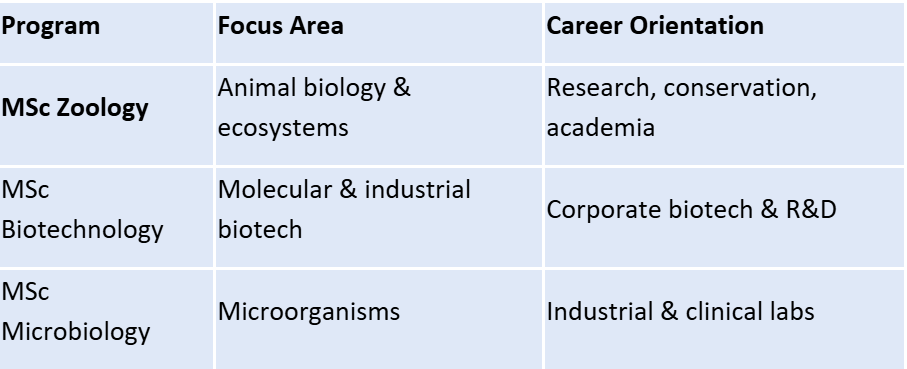
Your choice should reflect long-term interests rather than short-term trends.
Beyond professional prospects, pursuing an MSc Zoology also cultivates intellectual maturity and scientific responsibility. The discipline encourages evidence-based reasoning, ethical research conduct, and ecological sensitivity. Students gain exposure to interdisciplinary collaboration, working alongside environmental scientists, geneticists, and policy researchers. This broader perspective strengthens adaptability in a rapidly evolving scientific landscape.
Moreover, structured laboratory training and field immersion enhance applied competence, which employers increasingly value. When evaluating the future scope of MSc Zoology in India, it is important to recognise that environmental sustainability, biodiversity documentation, and climate research will continue to shape national scientific priorities, ensuring sustained relevance for trained zoologists.
Is MSc Zoology Worth Pursuing?
Ultimately, students ask: is MSc Zoology worth pursuing? If you value scientific inquiry, environmental responsibility, and animal research, the answer is affirmative. The degree offers structured intellectual growth, multiple career options after MSc Zoology, expanding job opportunities after MSc Zoology, and measurable future scope of MSc Zoology in India.
Carefully assess your interests, strengths, and professional aspirations. If they align with research, biodiversity, and ecological sciences, then MSc Zoology can become a fulfilling academic and professional pathway.