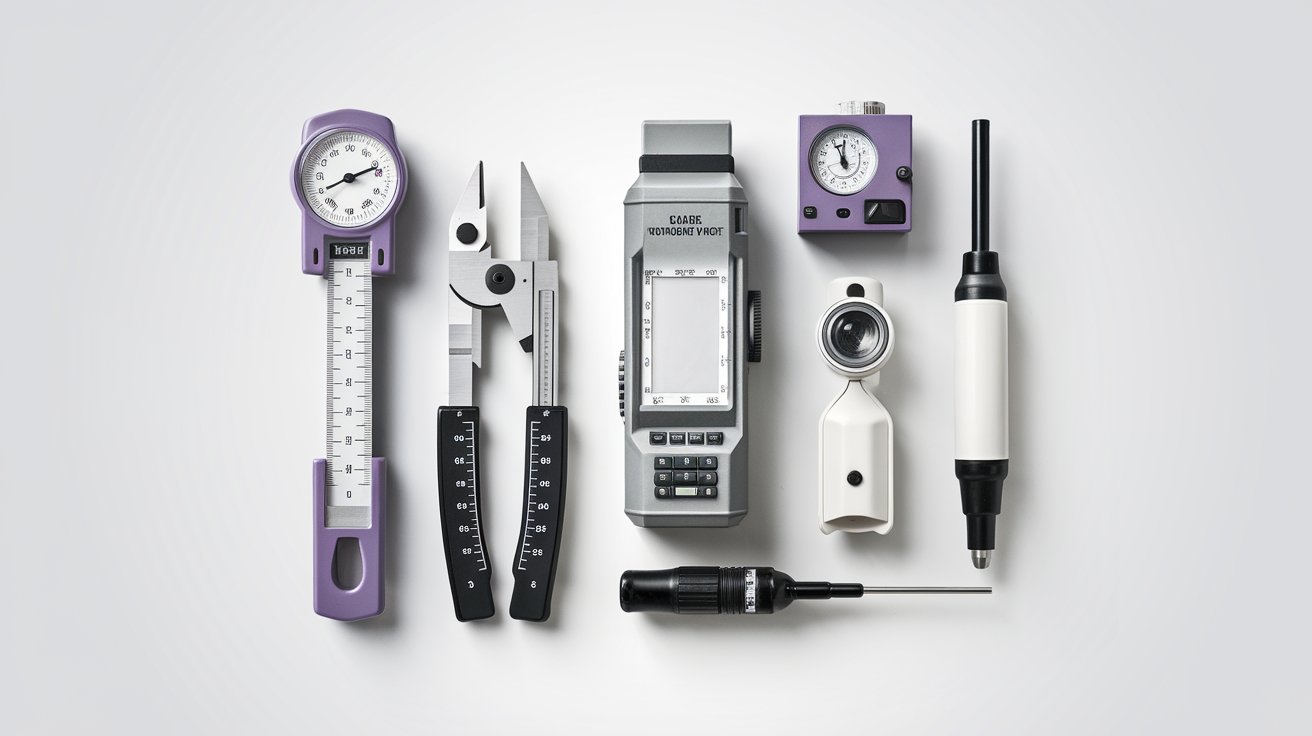
Quality inspection instruments are central to ensuring that goods conform to the required standards, do not have defects, and are in conformity with regulation requirements. These instruments facilitate the detection of minute inconsistencies that human eyes may otherwise miss, thereby making sure products are reliable and safe for use.
Key Benefits of Quality Inspection Instruments
- Improved Accuracy: Instruments like micrometers and calipers take measurements to the highest precision.
- Time Management: Automated systems reduce inspection time, thereby speeding up production cycle time.
- Uniformity: Automated and digital measurement tools provide equalities across lots.
- Compliance: Fulfill industry standards without costly non-conformance penalties.
- Data Collection and Reporting: Advanced tools provide detailed data with reports for analysis and future reference.
Quality inspection instruments are essential parts of quality control processes in many industries, including manufacturing, automotive, pharmaceutical, and food production. Let's discuss the various types of instruments and how they play a role in quality assurance.
Types of Quality Inspection Instruments
1. Calipers and Micrometers: The Precision Tools
Calipers and micrometers are commonly used in measuring the dimensions of components or finished products. These tools are highly accurate and precise, and therefore are indispensable in quality control. Digital calipers can read very quickly and easily, while micrometers are usually used for smaller and more delicate measurements.
The applications of micrometers could be seen in the measurements of the thickness of components of a car, wherein such parts must meet severe technical specifications to ensure safety as well as performance.
2. Visual Inspection Tools: Measuring Beyond the Surface End
Even though human eyes can detect imperfections, inspection tools like borescopes and magnifying lenses enhance the capabilities of the inspector. Borescopes are used, for instance, in aerospace and automotive industries to inspect parts in an engine or other inaccessible regions for signs of wear, corrosion, or damage.
These devices give clearer images and may be attached to cameras or monitors for better visualization.
3. Coordinate Measuring Machines (CMM): The High-Tech Precision Giants
CMMs are high-tech tools that allow for the measurement of an object's physical geometrical characteristics. A CMM can be operated manually or computerized with software to perform the measurements automatically. It employs a probe to touch the object's surface and acquire data points, which are further used to generate a precise 3D model of the component.
Industries like aerospace and auto depend on CMM to inspect complex parts with the utmost accuracy and ensure they fit together correctly.
4. Force and Torque Testers: Testing Strength and Sustainability
For construction or electronics-related industries, testing the strength or sustainability of materials is crucial. Force and torque testers calculate the amount of force or rotational pressure needed to deform or break a product.
For instance, within the electronics industry, force testers can be used to assess the strength of connectors or the durability of components that are capable of withstanding daily use.
5. Spectrometers: Material Analysis on a Molecular Level
These machines measure how materials absorb, emit, or scatter light to obtain the composition. Such equipment is very critical in such industries as drugs and foodstuffs industries where chemicals involved must ensure safety requirements are met in terms of their chemical make-up.
The pharmaceutical firms apply the use of these machines to confirm that the chemical used as raw material during the preparation of drugs lacks impurities.
Take It for a Test Drive: https://axonator.com/request-for-demo
Quality Control Instruments Ensure Efficiency and Precision
Quality inspection tools are fundamental in every industry that desires perfection when manufacturing products. Some of the biggest benefits they can provide are the higher degree of accuracy and measurement provided by these automated tools rather than the subjective measures associated with manual inspection tools, where human errors create inaccuracies and defects which human eyes cannot easily pick up on.
For example, micrometers and calipers enable inspectors to measure product dimensions with extreme precision, so that every product falls within the tolerance range. In aerospace, automotive, and medical device manufacturing, this level of accuracy is critical. A slight deviation can compromise safety or performance, making these instruments indispensable.
Time efficiency is another critical feature. Quality inspections using conventional methods tend to be quite time consuming, especially in cases involving extensive human intervention. Equipment such as Coordinate Measuring Machines (CMMs) and digital measuring devices can, however, automate many inspection activities. This automation has significantly decreased inspection time and improved production cycles without compromising the quality aspect. The quicker you diagnose defects or mismatches, the faster your product advances to the subsequent stages of production, increasing overall productivity.
Modern quality control also includes data capture and reporting. The inspection instruments of today are usually equipped with data logging, which automatically records measurements and test results. This minimizes the possibility of errors resulting from manual data entry while ensuring an audit trail that can be followed for regulatory compliance. For industries such as pharmaceuticals or food production, which are highly regulated, maintaining accurate records is a necessity.
Read More: https://axonator.com/blog/quality-inspection-instruments/
In the automobile sector, for instance, accuracy is critical to ensuring parts fit together perfectly and operate under extreme conditions. By using force testers, engineers are able to measure torque or forces applied to various parts in checking whether they meet the requirements for durability. Spectrometers similarly ensure that materials applied in the automobile manufacturing industry are of the highest quality. This reduces the likelihood of defects that may lead to compromised safety in automobiles.
Quality inspection instruments, most specifically CMMs and borescopes, are applied extensively in the aerospace sector in terms of checking out for defects in high-valued parts such as the aircraft wings, engines, and turbines. Catastrophic results may occur, thus these components' integrity should be non-negotiable.
Quality inspection tools for pharmaceutical companies go beyond just the physical measurement. The chemical makeup of medications and medical devices has to be exact to guarantee safety and effectiveness. Common lab instruments include spectrometers and chromatography systems that analyze raw materials and finished products to ensure purity and quality. Failure to comply with these regulations results in costly product recalls.
Finally, visual inspection tools are still very much a part of the inspection process, especially in industries where human judgment is required to evaluate the overall appearance or function of a product. Tools such as magnifying lenses, digital microscopes, and borescopes allow inspectors to detect even the smallest defects that might affect product performance or aesthetic appeal.
In conclusion, quality inspection instruments are more than tools; they are the vital components of the modern production and manufacturing process. Whether it's a car part meeting safety standards, pharmaceutical ingredients being pure, or electronics functioning, these instruments ensure the highest quality, safety, and efficiency. As the industries evolve, so does the technology behind these instruments, driving greater accuracy and speed in inspections.
About Axonator Inc:
At Axonator, our vision is simple yet powerful: to enable the world on mobile. We envision a future where every aspect of business and society is seamlessly connected through mobile devices. Our mission is to empower businesses worldwide to leverage the full potential of mobile technology, transforming the way they operate, communicate, and collaborate.
Contact:
Axonator Inc. (The World On Mobile)
Austin, TX, USA
USA: +1-716-274-8885
India: +91-8600-032-635
Email: support@axonator.com
Website: https://axonator.com/