
You have a clear vision. Budget secured. Roadmap drafted. Here comes the critical point at which you can either make or break your product:
Whom to rely upon?
An incorrect choice of software development partner is not only about financial losses but also about wasting precious time, losing momentum and, very often, even the product itself. The worst-case scenarios related to failed outsourcing deals represent some of the biggest expenses within the history of IT. But even despite this, dozens and dozens of CTOs, entrepreneurs and product managers decide upon this on daily basis, usually without proper information.
The total size of the global market for IT outsourcing solutions is expected to amount to one trillion one hundred billion USD by 2030. In other words, there are going to be more vendors, more options, and, consequently, more risks.
But this guide is here to help. From evaluating to choosing the best solution, we'll show how it's done.
Why This Decision Is More Critical Than Ever
Remote-first team creation and talent sourcing have simplified the process of choosing a development partner. However, ease of access hasn't brought ease of decision-making.
What makes the search more challenging isn't the availability of companies that can create software but the ability of such companies to understand the client's environment, maintain transparency, and deliver a software solution that addresses their needs within scope and deadline.
According to a study by the Standish Group, 31 percent of software projects are successful in terms of deadlines and budgeting. The remaining 69 percent of all software projects are either delayed, exceed the budget, or abandoned before completion. Vendor selection plays an important role here.
Why software development product choices should be as thorough as a vice president of engineering and co-founder recruitment.
Also Read: Complete Guide to Software Development Services A Must-Read!
Steps to steps for choosing a right software Partner
Step 1: Define What You Actually Need Before You Search
The biggest mistake businesses make is approaching vendors without clarity on their own requirements. Before you send a single inquiry, get aligned internally on four things:
Define Your Project Scope
- What are you building? (New product, feature addition, platform migration, API integration?)
- What is the expected timeline and budget range?
- What does success look like at 90 days, 6 months, and 12 months?
Identify Your Technical Requirements
- Do you have an existing tech stack that must be extended?
- Do you need frontend, backend, full-stack, mobile, or all of the above?
- Are there compliance, security, or infrastructure requirements (HIPAA, SOC 2, GDPR)?
Know Your Engagement Model Preference
- Do you want a dedicated team embedded in your workflow?
- Are you outsourcing a fixed-scope project?
- Do you need ongoing software consulting and development services post-launch?
Answering these questions before reaching out will save you weeks of misaligned conversations and help you evaluate vendors against a clear standard.
Step 2: Know the Different Types of Software Development Companies
Not all development firms are built the same. Understanding the landscape helps you shortlist faster.
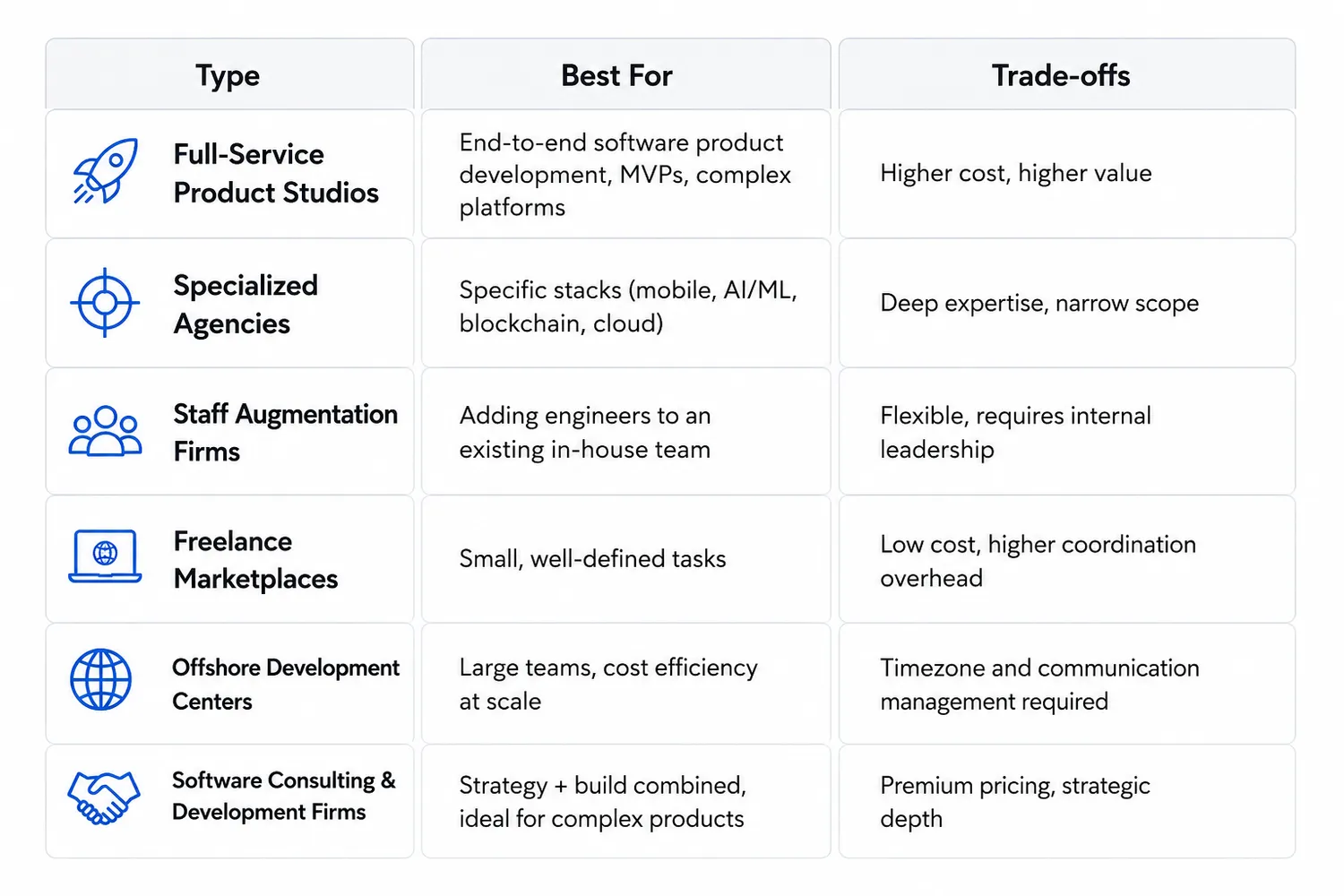
For founders building from scratch or scaling a product, a full-service studio or software consulting development service typically delivers the best return they bring both strategic thinking and execution capability under one roof.
Step 3: Evaluate Technical Capability But Dig Deeper Than the Portfolio
Every development company will show you their best work. Your job is to look beyond the showcase.
Review Case Studies Critically
Ask for case studies that match your industry, product type, or technical complexity. A portfolio full of marketing websites tells you nothing about their ability to build a scalable SaaS backend or a real-time mobile application.
Look for evidence of:
- Measurable outcomes (not just screenshots)
- Complex technical problem-solving
- Products that are still live and growing
Ask the Right Technical Questions
When speaking with their team, probe with specifics:
- "How do you handle database architecture for applications expected to scale to 1M+ users?"
- "Walk me through your approach to API design and versioning."
- "What's your testing strategy unit, integration, end-to-end?"
- "How do you manage technical debt across long-term engagements?"
The quality of their answers reveals the depth of their engineering culture far more than any sales deck.
Assess Their Tech Stack Alignment
You don't need a company that only works in the exact stack you've chosen great engineers can adapt. But you do need demonstrated expertise in the technologies most critical to your product's success.
Step 4: Evaluate the Process, Not Just the People
Great engineers working inside a broken process still ship bad software. When evaluating a software development service, their delivery methodology matters as much as their technical skill.
Look for Agile Fluency Not Just Agile Claims
Most companies will say they "work agile." What you want to know is how they practice it:
- How are sprints structured and how often are demos delivered?
- How is the backlog managed and prioritized?
- How are scope changes handled mid-project?
Assess Communication Protocols
Communication failure is the #1 cause of outsourcing project failure. Establish expectations early:
- Who is your primary point of contact?
- What project management tools do they use? (Jira, Linear, Notion, Asana?)
- How frequently do they provide progress updates?
- What's the response time SLA for critical issues?
Understand Their QA and Testing Philosophy
A professional software product development company treats QA as a continuous discipline, not an afterthought before delivery. Ask specifically:
- Do they have dedicated QA engineers or does development self-test?
- Is automated testing part of their standard workflow?
- How are regression tests managed across releases?
Step 5: Vet Culture Fit and Communication Style
A technically excellent team that communicates poorly will frustrate you at every milestone. Culture alignment is underrated in vendor evaluation and it directly impacts project outcomes.
Real-World Scenario: The Hidden Cost of Poor Culture Fit
A Series A startup hired an offshore development company with an impressive portfolio and competitive pricing. Six months in, the team was 40% over budget. The root cause wasn't technical it was communication. The vendor team rarely surfaced blockers proactively, estimated timelines optimistically to avoid conflict, and shipped features without validating requirements.
The lesson: a vendor's willingness to say "no" or "we're not sure" is a green flag, not a red one. Honest communication is more valuable than agreeable answers.
Green Flags to Look For
- They ask more questions than they answer in early conversations
- They push back on unrealistic timelines with data-backed reasoning
- They have a defined onboarding process for new clients
- Their team members speak directly not just the salesperson
Red Flags to Watch
- Vague answers about team composition ("we have many developers available")
- No fixed point of contact post-sale
- Reluctance to provide client references
- Promises of unusually fast delivery without scoping questions
Step 6: Understand Pricing Models and What They Really Mean
Price is important. But the cheapest option is almost never the most cost-effective one in software development.
Common Pricing Structures
Fixed Price: Best for well-defined, limited-scope projects. Provides budget certainty but leaves little room for discovery or iteration. Any scope change triggers a change order and costs.
Time & Materials (T&M): Best for evolving products where requirements will shift. You pay for actual hours worked. Requires trust and strong project management from both sides.
Dedicated Team / Retainer: Best for ongoing software product development, where you need consistent velocity and deep product context. A monthly retainer for a dedicated team combines predictability with flexibility.
Value-Based Pricing: Some premium software consulting service firms price based on the business value delivered, not just hours. This aligns incentives but requires a mature vendor-client relationship.
What "Cheap" Actually Costs
A $30/hour developer who requires 3x the hours, produces rework-heavy code, and requires constant supervision isn't cheaper than a $80/hour developer who ships clean, documented, production-ready code the first time.
Always evaluate total cost of ownership including rework, delays, and post-launch maintenance burden.
Also Read: Why Custom Software Development Saves Enterprises Millions in the Long Run
Benefits of Choosing the Right Software Development Partner
- Faster time to market — experienced teams have reusable frameworks and established processes that accelerate delivery
- Reduced technical debt — quality-focused teams write code that scales, reducing costly rewrites later
- Strategic input — the best software consulting development service firms act as thought partners, not just executors
- Risk mitigation — proven processes for testing, security, and deployment reduce launch risk
- Scalability — the right partner grows with you, adding or reducing capacity as your roadmap evolves
Challenges to Anticipate
- Timezone management — offshore partners require deliberate overlap planning
- Context transfer — getting a new team up to speed on your product vision takes time and documentation
- Scope creep — without disciplined change management, projects expand beyond original budgets
- Dependency risk — over-reliance on one vendor without knowledge transfer creates long-term vulnerability
Best Practices for a Successful Vendor Relationship
1. Always run a paid discovery phase first: Before committing to a full project, engage the company for a 2–4 week discovery sprint. This tests their process, communication, and thinking with real stakes but limited exposure.
2. Insist on a dedicated team, not a shared one: Shared teams juggle multiple clients. Dedicated teams build context and move faster on your product. Clarify this upfront.
3. Own your IP and codebase from day one: Ensure your contract specifies that all code, designs, and documentation produced are your intellectual property. Never accept a vendor who retains ownership of deliverables.
4. Build in knowledge transfer from the start: Require documentation, code comments, and periodic knowledge transfer sessions. This protects you if the relationship ends and you need to hand off to an internal team or new vendor.
5. Establish a clear escalation path: Know exactly who to contact and at what level when things go wrong. Having this defined before problems arise prevents them from becoming crises.
Conclusion
Choosing a software development company is not a procurement decision. It's a product decision.
The partner you select will shape the quality of your code, the speed of your delivery, the confidence of your investors, and ultimately the experience of your users.
The key takeaways:
- Define your scope, stack, and success metrics before you begin outreach
- Evaluate process and communication as rigorously as technical skill
- Run a paid discovery engagement before committing to full development
- Understand total cost of ownership not just hourly rates
- Look for a software consulting development service that thinks strategically, not just executes tasks
The best software development relationships feel like partnerships. The team understands your business. They challenge assumptions, surface risks early, and celebrate product wins alongside you. That's the standard worth holding out for.
Frequently Asked Questions
Q1: How do I know if a software development company is legitimate?
Look for verifiable client references, a portfolio of live products, transparent team profiles (LinkedIn-verifiable), clear contracts with IP ownership clauses, and established communication processes. Legitimate firms welcome due diligence they don't rush you past it.
Q2: Should I choose a local or offshore software development company?
Both can work well, depending on your priorities. Local firms offer easier collaboration, timezone alignment, and cultural familiarity at a premium. Offshore firms offer cost efficiency and scale, but require stronger communication infrastructure. A hybrid model (nearshore or mixed team) often delivers the best balance of cost and coordination.
Q3: What's the difference between a software development service and a software consulting development service?
A software development service primarily executes they build what you specify. A software consulting and development service combines strategic advisory with execution. They help you define what to build and why, then build it. For early-stage or complex products, the consulting layer is often worth the premium.
Q4: How long does it take to build a software product with an external team?
Timelines vary widely based on complexity. A focused MVP can be delivered in 8–14 weeks. A full-featured platform may take 6–18 months. Any company that gives you a precise timeline without a thorough discovery and scoping session should be viewed with skepticism.