Starting a Salesforce career without professional project experience can make it difficult to demonstrate practical abilities to employers. A thoughtfully created portfolio can help bridge this gap by presenting projects that simulate realistic business requirements. Freshers can use practice environments to build CRM solutions involving data management, automation, security, reporting, and workflow configuration. Instead of focusing only on completed features, a useful portfolio should explain the business problem, the solution developed, and the Salesforce concepts applied. This approach can give recruiters a better understanding of a candidate’s practical knowledge and willingness to learn. Salesforce Training in Chennai helps learners develop practical skills in CRM, sales automation, customer management, and Salesforce platform tools.

Select a Realistic Business Scenario
Choose a project based on a situation that businesses commonly encounter, such as managing leads, tracking customer service requests, monitoring sales activities, or organizing customer information. Define the company scenario, users, business requirements, data structure, and expected outcomes before starting the configuration. A project built around a specific business challenge can demonstrate that you understand how Salesforce capabilities fit into actual business processes. It also gives you an opportunity to explain your technical decisions during interviews instead of simply listing Salesforce features on your resume.
Showcase Salesforce Capabilities
Configure standard and custom objects.
Create fields and establish object relationships.
Set up profiles, roles, and permission controls.
Apply validation rules for reliable data.
Design useful page layouts and record types.
Build automated processes with Flow.
Create reports and interactive dashboards.
Configure relevant sales or service functionality.
Create Useful Automations
Automation can demonstrate your ability to turn business requirements into efficient Salesforce processes. Build practical flows that handle activities such as assigning new records, updating information, generating follow-up tasks, sending notifications, or supporting approval processes. Each automation should have a clear purpose and should solve a specific problem within your project scenario. Document the trigger, conditions, actions, and expected result so that someone reviewing your portfolio can understand how the automation works and why you designed it that way. Enrolling in Salesforce Training in Bangalore enables professionals to gain hands-on knowledge of Salesforce administration, configuration, workflows, and reporting.
Add Reporting and Analytics
Reports and dashboards can show how Salesforce information can be converted into useful business insights. Create reports around areas such as lead activity, sales performance, customer service cases, conversion trends, or task completion. Develop dashboards that present important information in an easy-to-understand format and explain the purpose of the metrics selected. Including analytical components in your portfolio can demonstrate that you understand not only how to configure Salesforce but also how organizations can use CRM data to monitor performance and support everyday decisions. Professionals can strengthen their CRM and Salesforce skills through industry-focused Salesforce Training in Hyderabad.
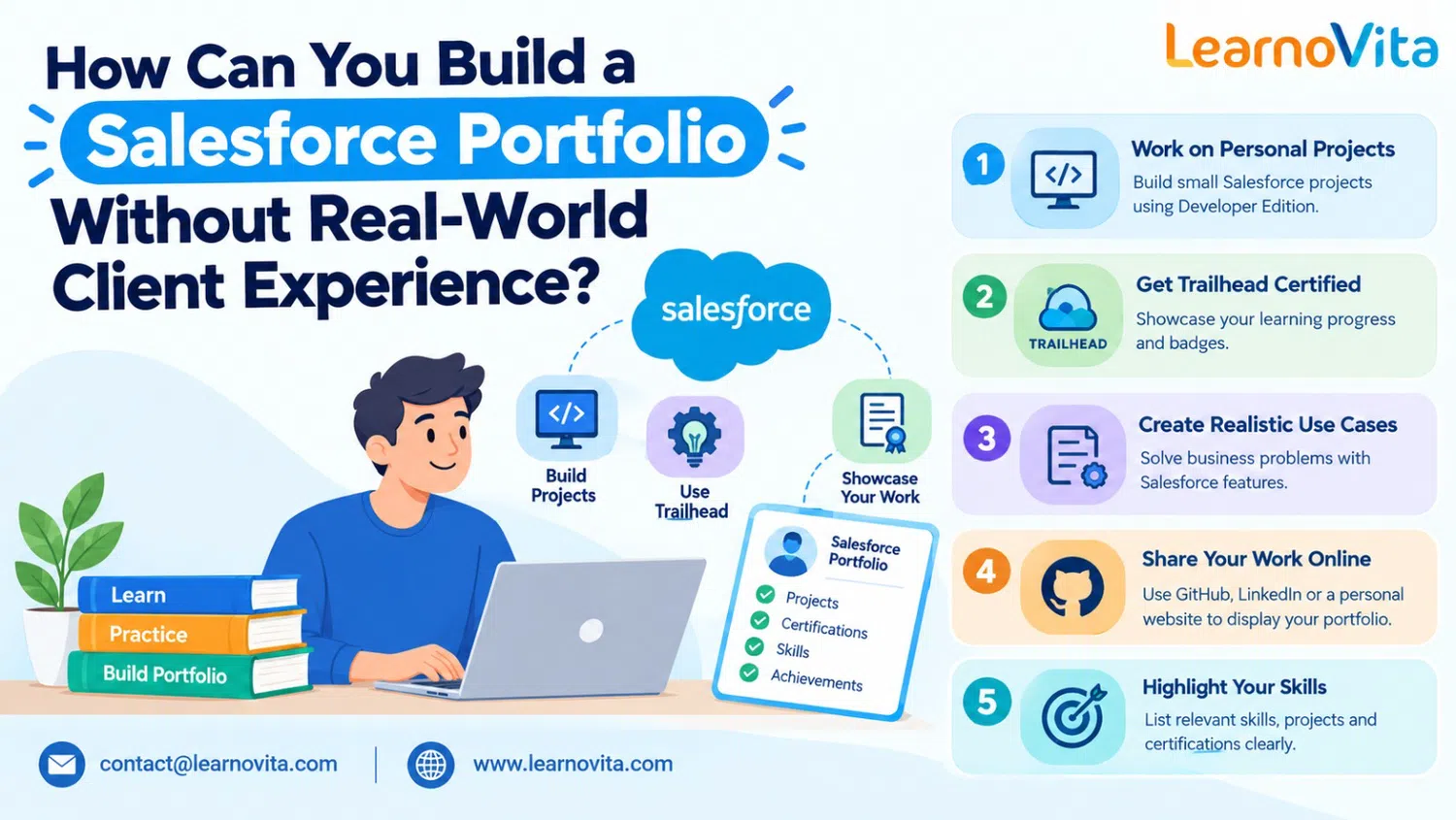
Document Your Work
Provide a clear title and objective for each project.
Describe the business challenge being addressed.
Explain the Salesforce solution you created.
Include screenshots of important configurations.
Document objects, fields, workflows, and automation.
Add relevant reports and dashboard examples.
Explain testing and troubleshooting performed.
Mention the skills demonstrated through the project.
Explain Your Technical Decisions
A strong portfolio should reveal the thinking behind your implementation. Explain why you selected particular objects, fields, automation methods, security settings, or reporting approaches. If you faced configuration problems, describe how you investigated and resolved them. You can also include examples of testing scenarios and changes made after testing. This type of documentation gives recruiters a better opportunity to evaluate your problem-solving approach and shows that your knowledge extends beyond following tutorials or reproducing basic Salesforce configurations. A Salesforce Online Course enables professionals to gain flexible, hands-on knowledge of Salesforce administration, configuration, workflows, and reporting.
Build a Professional Portfolio
Keep the portfolio focused on a small collection of well-developed projects rather than filling it with incomplete demonstrations. Organize every project using a consistent structure that covers the scenario, requirements, implementation, Salesforce features, testing, and results. Use clear screenshots and concise explanations so recruiters can quickly understand what you built. Connect your portfolio with your resume and professional profiles, and update the projects as you learn additional Salesforce technologies. A polished presentation can make your practical work easier to evaluate during the hiring process.
Conclusion
Freshers can create a credible Salesforce portfolio even when they have not worked on client projects. Realistic practice scenarios can provide opportunities to demonstrate platform configuration, CRM processes, automation, security, reporting, and problem-solving abilities. The value of a portfolio comes from showing how you approached a business requirement and transformed it into a working Salesforce solution. By developing practical projects, documenting technical decisions, and presenting the work professionally, aspiring Salesforce professionals can give employers concrete examples of their capabilities while preparing for their first industry opportunity.