Hair loss affects millions of men and women worldwide. While it is often seen as a cosmetic concern, it can also have a significant impact on confidence, self-image, and overall quality of life. Thanks to modern hair restoration procedures, hair transplantation has become one of the most effective long-term solutions for pattern baldness.
However, many people focus only on finding a clinic or comparing prices. They often overlook one of the most important decisions, the hair transplant technique itself. Choosing the wrong technique may affect your appearance, recovery, donor hair preservation, and long-term satisfaction.
If you're considering a hair transplant, understanding why the right technique matters can help you make a smarter and more informed decision.
Hair Transplant Success Depends on More Than Just Surgery
A successful hair transplant is not simply about moving hair from one part of the scalp to another. Every patient has different hair characteristics, scalp condition, age, pattern of hair loss, and future expectations.
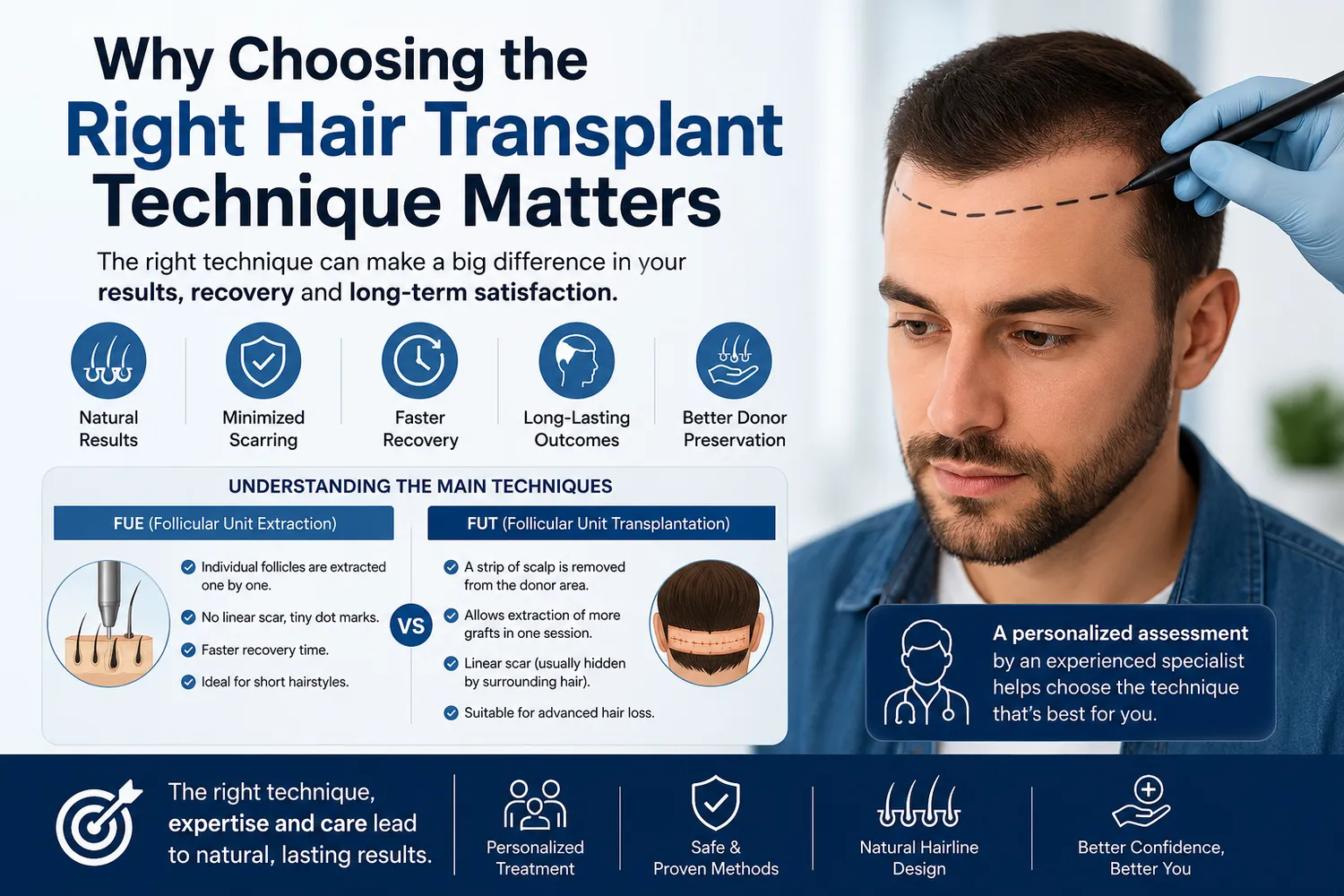
The technique selected by your surgeon plays a major role in:
- Creating a natural-looking hairline
- Preserving healthy donor hair
- Minimizing visible scarring
- Reducing recovery time
- Achieving long-lasting density
- Planning for future hair loss
This is why experienced specialists evaluate each patient carefully before recommending a treatment plan instead of offering the same procedure to everyone.
Understanding the Main Hair Transplant Techniques
Today, the two most recognized techniques are:
Follicular Unit Extraction (FUE)
FUE involves removing individual hair follicles directly from the donor area and transplanting them into areas affected by hair loss. Because follicles are extracted one by one, there is no long linear scar, and recovery is generally faster.
FUE is often preferred by people who:
- Keep short hairstyles
- Want minimal visible scarring
- Need a quicker return to daily activities
- Have mild to moderate hair loss
Modern FUE techniques also allow surgeons to create highly natural hairlines when performed by experienced professionals.
Follicular Unit Transplantation (FUT)
FUT, commonly known as the strip method, involves removing a thin strip of scalp from the donor area. Individual follicular units are then separated under a microscope before transplantation.
FUT may still be suitable for selected patients, especially those requiring a large number of grafts in one session or those with specific donor characteristics.
The most appropriate technique depends entirely on individual assessment rather than personal preference alone.
Why the Right Technique Makes a Big Difference
1. Natural Appearance
Everyone wants results that look completely natural.
Hair direction, angle, density, and hairline design all contribute to the final appearance. The selected transplant technique should allow the surgeon to place follicles according to your natural hair growth pattern.
When performed correctly, people should notice your improved appearance—not your surgery.
2. Better Donor Hair Preservation
Your donor hair is limited. Once it has been transplanted, it cannot be replaced.
A carefully selected technique helps preserve donor follicles for possible future procedures if hair loss continues over time.
This is especially important for younger patients whose hair loss may progress with age.
3. Reduced Scarring
Scarring is one of the biggest concerns among patients.
FUE generally leaves tiny dot-like scars that become difficult to notice after healing, while FUT results in a linear scar hidden beneath surrounding hair.
Your hairstyle preferences and lifestyle should be considered before choosing either option.
4. Faster Recovery
Recovery time varies depending on the procedure performed.
Many patients choosing FUE experience less post-operative discomfort and return to work sooner. However, healing also depends on following post-procedure instructions carefully.
Regardless of the technique, proper aftercare plays an important role in achieving successful results.
5. Long-Term Planning
Hair transplantation should never be viewed as a quick cosmetic fix.
Pattern baldness often continues over time. Choosing the correct technique helps preserve future treatment options while maintaining a balanced and natural appearance for years to come.
An experienced surgeon plans not only for your current hair loss but also for your future needs.
Why Personalized Assessment Matters
No two cases of hair loss are exactly the same.
Factors that influence technique selection include:
- Age
- Degree of hair loss
- Hair texture
- Donor hair quality
- Scalp flexibility
- Family history
- Future hair loss progression
- Personal expectations
This is why a proper consultation is essential before deciding on surgery.
According to the Mayo Clinic, patients should undergo a thorough evaluation to determine the cause of hair loss and whether hair transplantation is the most appropriate treatment option. Hair restoration surgery works best for carefully selected candidates with stable donor hair.
The Importance of Choosing an Experienced Clinic
Even the most advanced technique cannot compensate for poor surgical planning or lack of experience.
When researching clinics, consider:
- Experience of the surgical team
- Before-and-after patient results
- Individual treatment planning
- Modern surgical equipment
- Transparent consultation process
- Post-operative follow-up care
Rather than searching only for the cheapest option, focus on overall quality, patient safety, and proven expertise.
Looking for Hair Restoration in Faisalabad?
If you've reached the point where medications are no longer providing satisfactory improvement, it may be time to explore surgical options.
Many people begin by researching Health360's Hair Transplant Clinics in Faisalabad, where advanced FUE hair transplant procedures are offered with personalized treatment planning, experienced specialists, and comprehensive follow-up care. Learn more about the procedure here: https://health360.pk/fue-hair-transplant-pakistan/
Choosing a clinic that evaluates your individual needs instead of recommending the same treatment for everyone can significantly improve both your experience and your final results.
Trusted Resources to Learn More
Before making any decision, it's helpful to review information from reputable medical organizations:
- Mayo Clinic – Hair Loss Diagnosis & Treatment: https://www.mayoclinic.org/diseases-conditions/hair-loss/diagnosis-treatment/drc-20372932
- American Academy of Dermatology – Hair Loss Information: https://www.aad.org
- International Society of Hair Restoration Surgery (ISHRS): https://ishrs.org
These resources provide evidence-based guidance about hair loss, treatment options, and what to expect from hair restoration procedures.
Final Thoughts
Choosing a hair transplant is an important decision, but choosing the right technique is equally important.
The best procedure is not necessarily the newest or the most popular. Instead, it is the one that matches your hair type, degree of hair loss, donor availability, and long-term goals. A personalized treatment plan developed by an experienced specialist offers the greatest chance of achieving natural-looking, lasting results.
Expert Tip
Don't ask a clinic, "Which hair transplant technique is better?" Instead, ask, "Which technique is best for my pattern of hair loss, and why?" The answer to that question often determines the quality of your results for years to come.