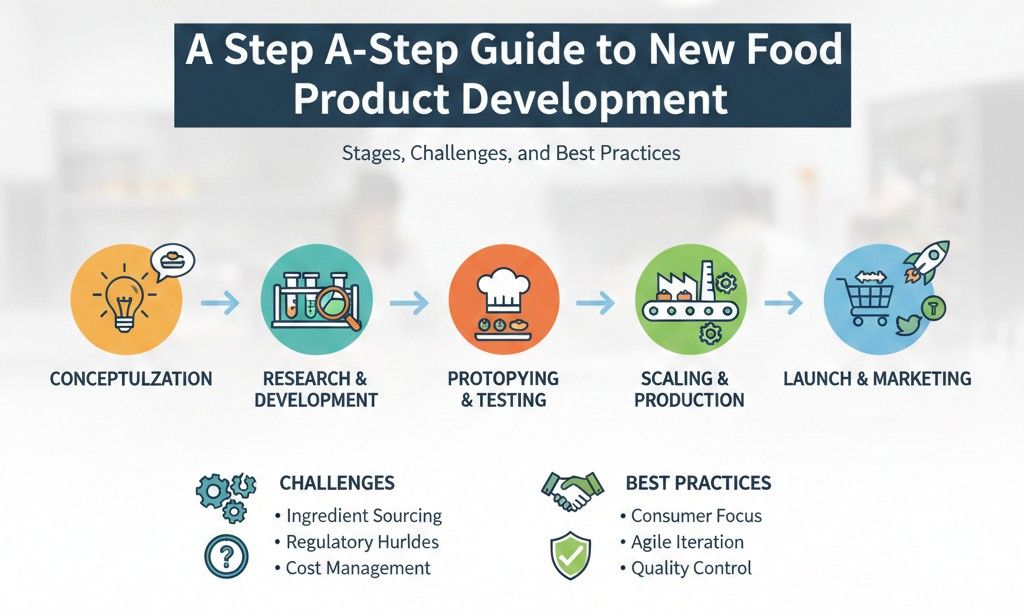
In the competitive and ever-changing food industry, new food product development is vital for companies to stay ahead and satisfy evolving consumer preferences. The process of food product development involves multiple stages that take an idea from concept to shelf-ready product. Understanding these stages—and common pitfalls—can help businesses innovate efficiently and successfully. This guide explains the key steps of product development in food industry with insights on food formulation, the role of food consultants, and how new product development servicesadd value.
1. Idea Generation and Market Research
Every successful product begins with a strong idea. Companies identify opportunities by analyzing consumer trends, gaps in the market, and emerging health or lifestyle demands. This research phase is critical to direct the new food product development process and reduce risks.
Market research often involves gathering consumer feedback and competitor analysis. Many firms collaborate with food consultantsduring this stage to validate ideas and align them with market needs.
2. Concept Development and Screening
In this stage, ideas are transformed into clear concepts defining the target audience, product benefits, and potential challenges. Multiple concepts are generated, but only the most viable proceed.
Concept screening weighs factors like feasibility, cost, and alignment with consumer preferences. Companies may engage new product development services to leverage expertise and ensure that concepts are both innovative and practical.
3. Food Formulation and Prototype Creation
A central phase of product development in food industry is food formulation—designing the recipe and process to create a prototype that delivers the desired taste, texture, and nutritional profile.
This stage requires careful balancing of ingredients, considering cost, sensory appeal, shelf life, and compliance with food safety regulations. Iterations are common to optimize the formula before moving forward.
4. Testing and Sensory Evaluation
Prototypes undergo rigorous testing, including sensory evaluations where taste panels assess flavor, texture, aroma, and appearance. Consumer testing may also be conducted to ensure the product resonates with the target market.
Feedback at this stage often leads to adjustments in formulation or packaging. Experienced food consultants can provide valuable insight to interpret test results and suggest improvements.
5. Process Optimization and Scale-Up
Moving from small batches to mass production requires adjusting the process to maintain quality and efficiency. This involves selecting appropriate equipment, streamlining workflows, and ensuring consistent product performance.
Scale-up challenges are common, and collaboration with manufacturing specialists or new product development services is crucial to a smooth transition.
6. Packaging and Labeling Development
Packaging protects the product and communicates key information to consumers. It must meet regulatory standards, including ingredient disclosure, allergen warnings, and nutrition facts.
Packaging choices also impact shelf life and consumer appeal. Sustainable packaging options are increasingly important in modern product development in food industry.
7. Regulatory Compliance and Safety Assurance
Ensuring the product complies with food safety laws and labeling regulations is non-negotiable. This stage involves detailed documentation, safety testing, and sometimes certifications like organic or non-GMO.
Working with food consultants specialized in regulatory affairs helps companies avoid costly compliance errors and market delays.
8. Market Testing and Launch
Before a full-scale launch, companies may conduct market testing or pilot releases to gather consumer reactions in real-world settings. This data informs final refinements and marketing strategies.
A coordinated launch involves marketing, sales, and supply chain teams to maximize product success.
Common Mistakes to Avoid in New Food Product Development
- Skipping - detailed market research, leading to products that miss consumer needs.
- Inadequate - food formulation testing, resulting in poor taste or quality.
- Ignoring - scale-up challenges, causing production delays or inconsistencies.
- Overlooking - regulatory requirements, risking recalls or fines.
- Choosing - inappropriate packaging, which can reduce shelf life or consumer appeal.
Conclusion
New food product development is a complex, multi-stage process that requires careful planning, technical expertise, and market understanding. From ideation through food formulation, testing, scaling, and launch, every step plays a crucial role in product success. Leveraging new product development services and consulting with experienced food consultants can help businesses navigate challenges and deliver innovative, high-quality food products that meet consumer demands.
By mastering these stages, companies can effectively innovate and thrive in the dynamic food product development landscape.