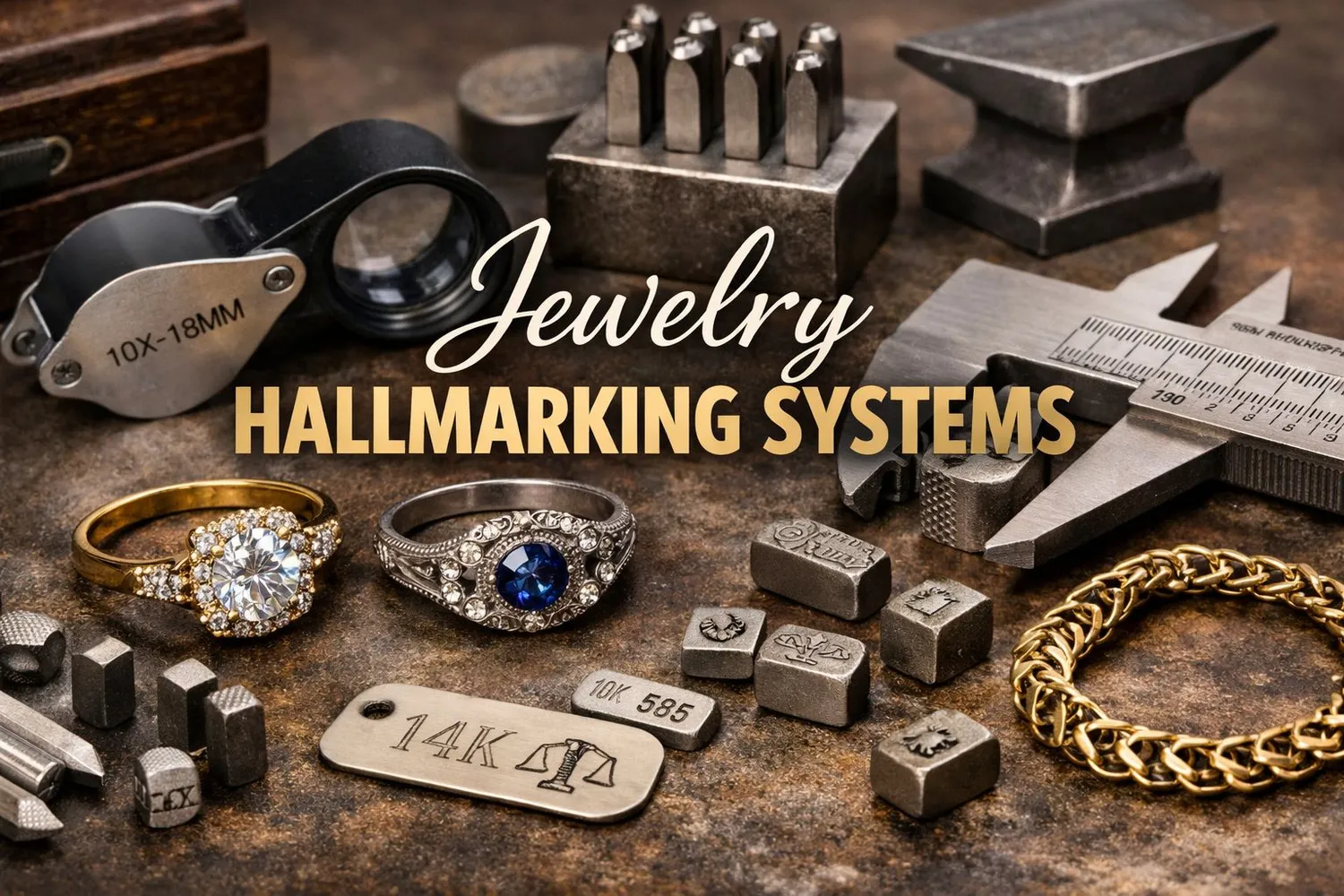
When people talk about jewelry value in the U.S., the conversation usually starts with carats, gemstones, or brand names. But there’s another factor that quietly shapes what a piece is worth — whether it’s hallmarked.
Hallmarks aren’t decorative. They’re small, often overlooked stamps that verify metal purity and sometimes origin. In practical terms, they answer a simple question: Can someone trust what this piece is made of?
That trust — or lack of it — affects resale, insurance, pawn value, collectibility, and long-term worth in ways many buyers don’t fully realize at the time of purchase.
Let’s break down how.
The Consumer Trust Factor
A hallmark signals that a piece’s metal content has been formally verified or declared according to recognized standards.
In the U.S., hallmarking isn’t mandated in the same way it is in some other countries, but purity stamps like:
- 10K, 14K, 18K (for gold)
- 925 (for sterling silver)
- PT or 950 (for platinum)
still function as trust markers.
When a piece carries a clear stamp, buyers — whether retail customers, dealers, or future purchasers — have a starting point for evaluation.
Without that stamp, everything becomes uncertain.
Even if a non-hallmarked piece is genuinely 14K gold, a buyer has no immediate reason to assume that. Verification then requires testing. Testing adds friction. Friction lowers confidence. Lower confidence usually lowers what someone is willing to pay.
This matters most in secondary markets, not during the emotional purchase moment.
A buyer in a retail setting might fall in love with a design. A buyer in a resale or inheritance situation is thinking about liquidation value.
And that’s where hallmarks start making a measurable difference.
Resale Implications
When jewelry enters resale channels — estate sales, private sales, or dealer trade-ins — its story changes from beautyto proof.
Hallmarked pieces:
- Can be evaluated quickly
- Require less destructive testing
- Are easier to price
Non-hallmarked pieces:
- Often need acid testing or electronic verification
- May be partially discounted to account for uncertainty
- Can be treated as “probable” rather than “confirmed” purity
Even when testing confirms purity, resale offers may still be lower.
Why?
Because liquidity matters.
A dealer who buys hallmarked jewelry can resell it faster with less explanation. A dealer buying unstamped metal takes on additional responsibility — and risk — when passing it along.
That risk gets priced in.
A simple way to think about it:
Two identical gold chains enter the resale market.
- One is stamped 14K.
- One has no marking but tests as 14K.
The second may still sell for less — not because it’s less real, but because it’s less immediately provable.
Insurance Impact
Insurance companies care about documentation.
A hallmarked piece supports:
- Appraisal accuracy
- Replacement clarity
- Claims processing
When jewelry lacks a hallmark, insurers may rely more heavily on appraisals and testing documentation. That’s workable — but not ideal.
In claims situations, especially for theft or loss, verification becomes critical.
If a hallmarked piece is lost, its declared purity provides a benchmark for replacement.
If a non-hallmarked piece is lost, insurers may depend entirely on:
- Purchase records
- Appraisal descriptions
- Photographic evidence
That can create ambiguity.
Ambiguity often slows claims or complicates valuation.
This doesn’t mean non-hallmarked jewelry can’t be insured. It absolutely can.
But it often requires:
- A more detailed appraisal
- Testing confirmation
- Sometimes periodic re-verification
In practical terms, hallmarks reduce administrative friction over the lifetime of ownership.
Pawn & Resale Markets
Pawn shops and gold buyers operate under time pressure.
They make rapid assessments — sometimes in minutes.
Hallmarks act as shorthand.
A visible 18K or 925 stamp allows a buyer to:
- Move faster
- Offer closer to intrinsic value
- Reduce testing time
Unstamped jewelry typically goes through:
- Scratch testing
- Electronic analysis
- Visual inspection
Even when it passes all tests, the initial absence of a stamp often leads to a conservative offer.
This is partly operational. Testing takes time. Time costs money.
It’s also behavioral.
Pawn markets operate on risk buffers. If something lacks immediate proof, they build in margin.
That’s why sellers sometimes feel frustrated when:
“It's real gold — why am I getting less?”
The answer isn’t always about authenticity. It’s about efficiency and resale certainty.
Estate Jewelry Issues
Estate jewelry frequently lacks hallmarks.
Older pieces may have:
- Worn stamps
- Obsolete marking systems
- No markings at all
This creates complications for heirs.
Without a hallmark, establishing value requires:
- Professional testing
- Historical assessment
- Metal analysis
Even then, resale buyers may treat the piece cautiously.
There’s another layer: estate pieces often rely on storytelling.
“He bought this in the 1960s.”
“She wore this every day.”
Sentimental history doesn’t translate into market confidence.
A visible hallmark bridges that gap.
When absent, value becomes more negotiable.
It doesn’t erase worth — but it introduces variability.
Some estate pieces gain value through craftsmanship or design despite lacking stamps. Others lose resale strength simply because buyers must rely on testing rather than immediate verification.
Collector Preference
Collectors tend to care about hallmarks for a different reason: traceability.
In certain types of collectible jewelry, markings may indicate:
- Period authenticity
- Workshop origin
- Metal standards of a specific era
For collectors, hallmarks can function like signatures.
A clearly marked piece is easier to:
- Authenticate
- Categorize
- Resell within collector circles
Non-hallmarked items may still be desirable — especially if design or provenance is strong — but they often require deeper scrutiny.
Some collectors even view the absence of expected markings as a red flag.
Not always a dealbreaker.
But always a question mark.
Long-Term Worth Comparison
Over decades, hallmarked jewelry tends to maintain more stable resale positioning.
Here’s why:
1. Easier Re-Evaluation
Future owners — whether heirs or buyers — won’t need to rely solely on testing.
2. Greater Market Confidence
Clear purity signals reduce negotiation friction.
3. Lower Transaction Costs
Fewer verification steps often translate into better offers.
4. Documentation Alignment
Appraisals, insurance records, and resale listings align more easily with marked pieces.
Non-hallmarked jewelry doesn’t inherently lose value.
But its value often becomes:
- More dependent on context
- More sensitive to buyer skepticism
- More variable across markets
Over time, that variability can matter more than purity itself.
Common Mistakes Buyers Make
Assuming all stamps guarantee quality.
A hallmark confirms metal content — not craftsmanship or gemstone authenticity.
Ignoring worn or partial markings.
Sometimes stamps fade. Buyers may overlook faint hallmarks that still matter.
Relying on verbal assurances.
Statements like “It’s definitely 18K” carry little weight in resale markets without markings or documentation.
Skipping independent appraisal.
Especially important for non-hallmarked pieces intended as long-term assets.
Edge Cases Worth Noting
- Handmade jewelry may lack formal stamps but still be high purity.
- Antique pieces sometimes follow older marking conventions.
- Custom designs may omit marks due to size or aesthetics.
In these cases, documentation becomes critical.
A professional appraisal can substitute for a hallmark — but it requires upkeep.
FAQs
Does a missing hallmark mean fake metal?
No. It means unverified metal. Testing can confirm authenticity.
Can hallmarks be faked?
Yes. That’s why testing still matters in high-value transactions.
Do hallmarks affect melt value?
Indirectly. Melt value depends on purity, but hallmarks make that purity easier to trust.
Will insurance refuse non-hallmarked jewelry?
Not typically, but they may require stronger documentation.
Are estate pieces always disadvantaged without hallmarks?
Not always. Design, age, and craftsmanship can offset this — but verification becomes essential.
A Practical Takeaway
Hallmarks don’t create value by themselves.
They support value by making it:
- Easier to trust
- Easier to verify
- Easier to transfer
In markets driven by proof rather than sentiment, that support can influence outcomes — sometimes subtly, sometimes significantly.
Safety Note
Jewelry valuation affects financial decisions including resale, insurance coverage, and estate planning. If you’re making decisions involving significant monetary value, consult a qualified appraiser or insurance professional for guidance.
What Buyers Should Remember
A hallmark is less about today’s purchase and more about tomorrow’s clarity.
When jewelry changes hands — through resale, inheritance, or liquidation — the smallest stamp can shape how smoothly that transition happens.
And smooth transitions tend to protect value.