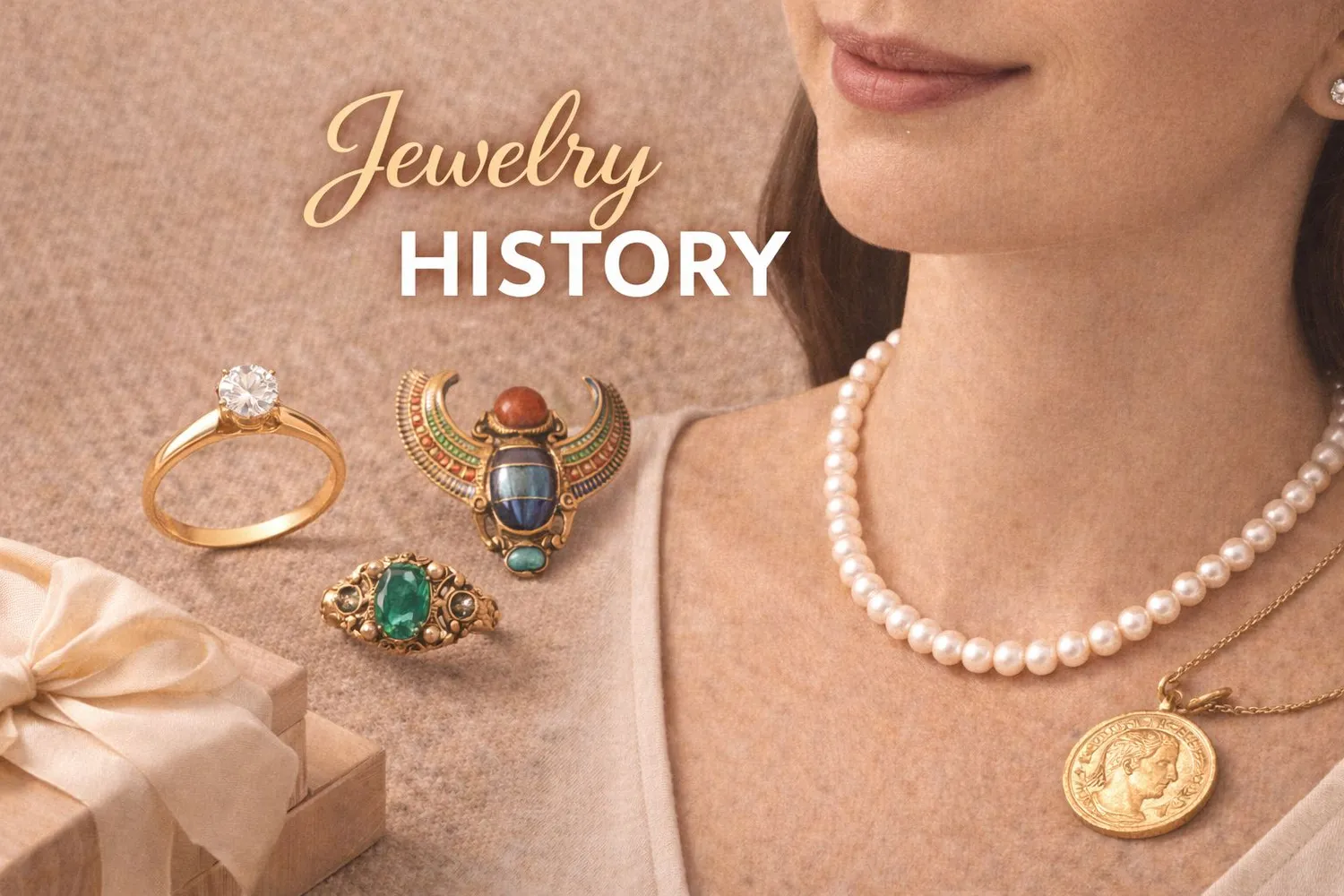
If you ask most Americans what an engagement ring looks like, they’ll picture a diamond solitaire. Round stone. White metal. One center diamond doing all the talking.
What’s interesting is how recent that image really is.
The engagement ring didn’t start as a diamond tradition in America. It evolved—slowly at first, then very quickly in the 20th century—shaped by economics, marketing, cultural shifts, and changing ideas about marriage.
Understanding that history doesn’t just satisfy curiosity. It helps you see which parts of the tradition are ancient… and which were built by advertising.
Let’s walk through how engagement rings became what they are today.
Before America: The Early Ring Exchange Tradition
Long before the United States existed, rings were already symbols of commitment in Europe.
Ancient Romans used rings as a sign of betrothal. In medieval Europe, rings symbolized binding contracts. By the time European settlers arrived in North America, the idea of exchanging rings as a promise of marriage was already established.
But early American colonists didn’t always use diamond rings.
In 17th-century colonial America, engagement rings were not universal. In fact, many Puritans considered jewelry excessive. Some couples exchanged simple gold bands. Others used more symbolic tokens.
One example was the “posy ring,” a simple gold band engraved with a short romantic phrase inside. These were practical, modest, and meaningful.
Diamonds were rare and expensive. They weren’t yet the expected centerpiece of a proposal.
The 19th Century: Sentiment Before Sparkle
During the 1800s, especially in the Victorian era, engagement jewelry became more sentimental and symbolic.
Instead of single diamonds, rings often included:
- Clusters of small stones
- Colored gemstones
- Hearts, bows, or floral motifs
- Hidden compartments
Gemstones were sometimes chosen for meaning. For example, acrostic rings spelled out words with the first letters of each stone—like ruby, emerald, garnet, amethyst, ruby, diamond spelling “REGARD.”
Gold was the dominant metal. Designs were romantic, ornate, and expressive.
In America during this period, diamonds were still uncommon for the average couple. They were available—but not yet culturally mandatory.
The Diamond Supply Shift
The turning point began in the late 19th century with large diamond discoveries in South Africa.
Suddenly, the global supply of diamonds increased dramatically. This changed pricing and availability.
But supply alone doesn’t create cultural tradition.
What truly transformed engagement rings in America wasn’t just mining. It was marketing.
The 20th Century Cultural Shift
In the early 1900s, diamonds were becoming more available—but they still weren’t universal engagement stones in America.
Then came the 1930s and 1940s.
During the Great Depression, diamond sales dropped sharply. To revive demand, a coordinated marketing campaign began in the United States that reshaped how Americans viewed engagement rings.
The key message was simple: a diamond ring symbolizes eternal love.
One slogan in particular—“A Diamond Is Forever”—became deeply embedded in American culture. It connected diamonds to permanence, romance, and social expectation.
This wasn’t just advertising. It was behavioral influence.
By mid-century, the diamond engagement ring wasn’t just popular. It was becoming socially expected.
The Rise of the Solitaire
If diamonds became the standard, the solitaire became the icon.
Why the solitaire?
- It highlights a single stone.
- It’s visually simple and timeless.
- It centers all attention on the diamond.
Technically, the solitaire also benefited from improvements in diamond cutting. The round brilliant cut, refined in the early 20th century, maximized sparkle and fire. That visual brilliance made it ideal for a standalone stone.
White metals like platinum—and later white gold—became popular because they enhanced diamond brightness.
By the 1950s and 1960s, the classic American engagement ring formula was clear:
- One round brilliant diamond
- White metal setting
- Elevated prongs
That image still dominates today.
Budget Norms and Social Pressure
Another 20th-century development was the introduction of “spending rules.”
Marketing campaigns promoted the idea that a man should spend a specific portion of his income on an engagement ring—often framed as one month’s salary, later two months.
This wasn’t an ancient custom. It was a commercial suggestion.
It became powerful because it tied emotional commitment to financial display.
That cultural pressure shaped buying habits for decades. Even today, some buyers feel anxiety about “spending enough,” even though there’s no legal or historical rule dictating ring cost.
Post-War Prosperity and Diamond Expansion
After World War II, American economic growth fueled consumer spending.
Engagement rings grew larger. Diamonds became higher carat. Suburban expansion and rising incomes supported the idea of visible prosperity.
The solitaire remained dominant, but variations began appearing:
- Side stones
- Halo designs
- Three-stone rings
- Matching bridal sets
Television and Hollywood reinforced the diamond narrative. Celebrities wore diamonds. Magazine ads normalized them.
By the 1970s, the diamond engagement ring was deeply entrenched in American culture.
The Late 20th Century: Diversification of Style
In the 1980s and 1990s, engagement rings expanded stylistically.
Yellow gold made a comeback. Then white gold re-dominated. Then platinum surged again.
Princess-cut diamonds became popular in the 1980s and 1990s, offering a modern square alternative to round stones.
Three-stone rings gained popularity as symbols of past, present, and future.
Halo settings, which surround a center diamond with smaller diamonds, became widely adopted in the 2000s, especially after celebrity exposure.
But through all these changes, the diamond center remained the American standard.
21st Century Shifts: Personalization & Alternatives
In recent years, engagement ring trends in the U.S. have shifted again.
Several changes stand out:
1. Alternative Stones
Sapphires, moissanite, and other gemstones are increasingly chosen for personal or budget reasons.
2. Lab-Grown Diamonds
Lab-grown diamonds are chemically and physically identical to mined diamonds but typically cost less. Their rise has introduced new pricing dynamics.
3. Vintage and Antique
Many buyers now prefer Art Deco or Victorian-inspired rings for uniqueness.
4. Minimalist Solitaires
Simple, thin-band solitaires remain strong because they photograph well and feel timeless.
Cultural expectations still favor diamonds, but buyers today are more informed and more willing to question tradition.
Why the Solitaire Stayed So Powerful
The solitaire’s endurance isn’t accidental.
It works because:
- It’s adaptable to trends.
- It highlights stone size clearly.
- It doesn’t compete visually with wedding bands.
- It feels classic rather than era-specific.
From a design standpoint, it’s flexible. From a marketing standpoint, it’s ideal. From a social standpoint, it signals commitment instantly.
Common Buyer Misunderstandings About History
When shopping for an engagement ring, many buyers assume:
“This tradition is ancient.”
Diamond engagement rings as a widespread American norm are largely a 20th-century development.
“Everyone has always used diamonds.”
Colored gemstones were historically common.
“There’s a rule for how much to spend.”
There is no historical requirement—only marketing influence.
Understanding these distinctions can reduce unnecessary pressure.
How History Affects Buying Decisions Today
Knowing the history of engagement rings changes how you evaluate options.
If you understand that:
- The diamond norm was shaped by advertising,
- Spending guidelines were commercial suggestions,
- Styles evolved with culture,
You gain freedom.
You can choose:
- A diamond or not
- A solitaire or something else
- A large stone or a modest one
- Antique, modern, lab-grown, or heirloom
Tradition matters—but understanding its origin helps you decide whether to follow it or redefine it.
Practical Buying Advice in Light of History
If you’re shopping in the U.S. today:
- Decide whether you value tradition or personalization more.
- Separate emotional meaning from marketing messaging.
- Focus on durability for daily wear.
- Choose a style that ages well, not just what’s trending.
- Set a budget based on your financial comfort, not outdated salary rules.
History gives context. It shouldn’t dictate your decision.
FAQs
When did diamonds become standard in American engagement rings?
Widespread adoption accelerated in the mid-20th century, especially after coordinated advertising campaigns linked diamonds with eternal love.
Were early American engagement rings always diamond?
No. Many featured gold bands, clusters, or colored gemstones.
Is the solitaire truly timeless?
It has remained popular for nearly a century in the U.S., which gives it strong staying power.
Are lab-grown diamonds changing tradition?
They are influencing pricing and accessibility, but culturally, the diamond symbol remains strong.
Do engagement rings have to match wedding bands?
Historically, they were separate. Today, many buyers coordinate them for aesthetics, but it’s not required.
A Short Safety Note
Engagement rings can represent a significant financial commitment. Before purchasing, review return policies, warranties, and insurance options. If spending beyond your savings, consider speaking with a financial advisor to ensure the purchase aligns with your long-term goals.
The American engagement ring didn’t appear fully formed. It evolved—shaped by economics, marketing, social change, and personal expression.
What started as a simple promise ring became a diamond-centered cultural icon. And now, for the first time in decades, buyers are questioning and reshaping it again.
Understanding that history doesn’t weaken the tradition. It makes your choice more intentional.