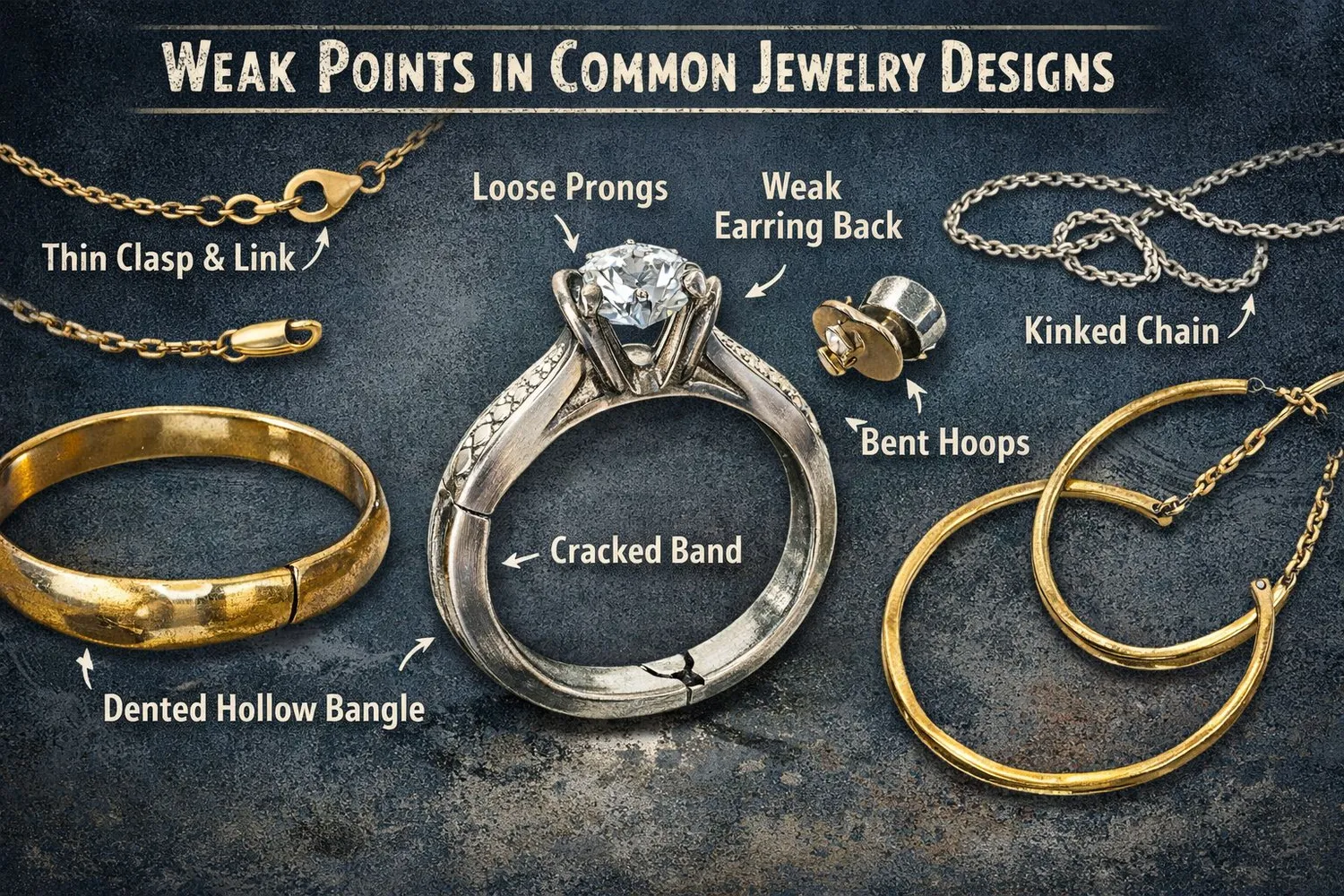
When a necklace or bracelet breaks, the clasp is often the first component to fail. The chain may still look strong. The links may be intact. Yet the entire piece stops functioning because the clasp can no longer close properly or hold tension.
This isn’t surprising when you consider how jewelry is used. Clasps are the only moving mechanical parts in many pieces. They are opened and closed repeatedly, pulled under tension, and exposed to friction and dirt. Over time, those small stresses add up.
A weak clasp doesn’t always break suddenly. It may begin by sticking, closing loosely, or failing to snap shut. Eventually the mechanism stops working entirely or opens unexpectedly.
Understanding why clasps wear out—and how different clasp designs handle stress—can help buyers choose jewelry that lasts longer and avoid one of the most common failure points in everyday pieces.
Why Clasps Fail Before the Rest of the Piece
Most jewelry components remain relatively static. Chain links flex slightly, but they don’t experience the repeated mechanical motion that clasps do.
Clasps act like miniature machines. Every time the jewelry is worn or removed, the clasp opens, rotates, and closes again.
That movement creates two main forms of wear.
The first is mechanical friction. Small metal parts slide against each other inside the clasp, gradually wearing away microscopic layers of metal.
The second is spring fatigue. Many clasps rely on a tiny internal spring to open and close the mechanism. Springs weaken slowly through repeated compression and release.
Environmental factors also contribute. Dust, skin oils, and cosmetic residue can accumulate inside the clasp and interfere with smooth movement.
Because the clasp experiences more mechanical activity than the rest of the jewelry, it naturally becomes the part most likely to wear out first.
Spring Ring vs. Lobster Clasp Durability
Two clasp styles appear frequently in necklaces and bracelets: spring ring clasps and lobster clasps. Each has a distinct mechanical structure.
Spring Ring Clasps
Spring ring clasps are small circular clasps with a tiny lever that opens an internal gate.
Inside the ring sits a coiled spring that pulls the gate closed when the lever is released. The design is compact and widely used in lightweight jewelry.
However, spring ring clasps have several limitations.
Because of their small size, the internal components are extremely thin. The spring itself is tiny, and the opening gate often uses a narrow piece of metal.
Over time, the spring may weaken or break. When that happens, the gate may not close completely.
Another issue is that the opening mechanism relies on a small internal track. Dirt or corrosion can interfere with the gate’s movement.
Once the mechanism begins sticking, the clasp may fail to close securely.
Lobster Clasps
Lobster clasps are shaped somewhat like a lobster claw. A small lever opens a spring-loaded arm that snaps closed when released.
These clasps generally contain larger internal components than spring rings. The gate is thicker and the spring mechanism is more robust.
Because of their larger structure, lobster clasps often tolerate greater tension from heavier chains.
They also tend to be easier to operate, especially on bracelets where small clasps can be difficult to handle.
However, lobster clasps still rely on an internal spring. Over many years of use, that spring can also weaken.
Magnetic Clasp Limitations
Magnetic clasps offer convenience. Instead of operating a mechanical latch, the wearer simply brings the two ends of the jewelry together and the magnets connect automatically.
This design makes them popular for people who have difficulty manipulating small clasps.
However, magnetic clasps introduce different structural limitations.
The holding strength depends entirely on magnetic attraction. If the jewelry experiences a pulling force stronger than the magnetic grip, the clasp can separate.
Magnetic clasps may also weaken over time if the magnet loses strength or becomes coated with debris that prevents full contact.
Another limitation involves alignment. Magnetic clasps often require the magnets to meet directly face-to-face to hold properly. If the bracelet twists or the magnets connect partially, the hold may be weaker.
For lightweight necklaces, magnetic clasps may work well. For heavier chains or bracelets that experience frequent pulling, they may not provide the same level of security as mechanical clasps.
Wear in Internal Spring Mechanisms
Many clasp failures begin inside the mechanism rather than on the exterior.
In both spring ring and lobster clasps, a small metal spring controls the opening and closing action. The spring compresses when the lever is pressed and expands when the lever is released.
Each cycle slightly stresses the metal.
Over thousands of uses, the spring gradually loses elasticity. Instead of snapping closed firmly, the clasp may close slowly or incompletely.
In some cases, the spring can fracture entirely.
When that happens, the clasp may remain permanently open or fail to move at all.
Internal springs are usually hidden inside sealed metal housings. This means they cannot easily be cleaned or lubricated by the wearer.
Once the spring fails, the clasp typically needs to be replaced rather than repaired.
Clasp Size vs. Chain Weight Balance
The relationship between clasp size and chain weight plays an important role in durability.
A heavy chain places more tension on the clasp. If the clasp is small relative to the chain, the mechanical components may experience greater stress than they were designed to handle.
For example, a thin spring ring clasp attached to a thick metal chain may be forced to absorb substantial pulling forces.
Each time the chain shifts or catches slightly on clothing, the clasp mechanism experiences that tension.
Larger clasps generally distribute force across thicker metal parts. The gate and hinge inside the clasp can withstand more stress before deforming.
Balance matters. A strong chain paired with an undersized clasp creates a structural mismatch that can shorten the life of the clasp.
When selecting jewelry intended for daily wear, it’s often wise to ensure the clasp appears proportionate to the weight of the chain.
Safety Chains and Secondary Closures
Some jewelry includes an additional security feature called a safety chain.
A safety chain is a short secondary chain that connects both sides of a bracelet or necklace near the clasp. If the clasp opens unexpectedly, the safety chain prevents the jewelry from falling off completely.
Safety chains are common in bracelets that carry significant weight, such as charm bracelets.
Another type of secondary closure is the safety latch found on certain bracelet clasps. This latch folds over the main clasp and locks it in place.
Secondary closures do not prevent clasp wear, but they reduce the risk of losing the jewelry if the primary clasp fails.
In practice, these features provide an extra layer of protection rather than a substitute for a strong clasp.
Maintenance Tips to Extend Clasp Life
While clasps inevitably wear with use, proper maintenance can slow the process.
One helpful habit is periodic cleaning. Dirt and oils can accumulate inside the clasp opening and interfere with smooth movement. Cleaning the clasp gently with mild soap and water can remove debris.
Another useful step is checking the clasp tension. If the clasp begins closing loosely or failing to snap shut completely, it may be time to have it inspected.
Avoid pulling on the clasp when removing jewelry. Instead, hold both sides of the chain close to the clasp and open it carefully.
This reduces unnecessary tension on the internal spring.
Storing jewelry separately can also help. Clasps that rub against other metal objects may experience additional wear.
Although these steps cannot prevent long-term mechanical fatigue, they can reduce the speed at which the clasp deteriorates.
Selecting Clasps for Long-Term Reliability
Buyers who want jewelry that lasts many years should pay attention to clasp construction rather than focusing only on the chain or pendant.
A few practical guidelines can help identify durable clasp designs.
First, consider clasp size relative to the jewelry. A clasp that appears very small compared with the chain may not provide long-term durability.
Second, examine how the clasp connects to the chain. The jump rings or connector links should be sturdy and fully closed.
Third, test the clasp action. The mechanism should open smoothly and close with a clear snap or firm alignment.
Clasps that feel loose, sticky, or difficult to operate may already have internal issues.
Finally, consider the type of jewelry use. Bracelets often experience more movement and impact than necklaces, so stronger clasp designs may be preferable.
These small details can make a noticeable difference in how long the clasp continues to function properly.
Frequently Asked Questions
Why do jewelry clasps stop closing properly?
Most clasp problems occur when the internal spring weakens or when debris interferes with the moving parts. Over time, repeated opening and closing gradually wears the mechanism.
Can a broken clasp be repaired?
In some cases, a jeweler can replace small connector rings or adjust the clasp alignment. However, if the internal spring fails, replacing the entire clasp is usually the most practical solution.
Are lobster clasps always stronger than spring ring clasps?
Lobster clasps often have larger components and may tolerate more tension. However, durability also depends on the metal thickness and overall construction of the clasp.
Why does my clasp sometimes open unexpectedly?
Unexpected opening can occur if the spring mechanism weakens, if the gate becomes misaligned, or if the jewelry catches on clothing and pulls against the clasp.
Do magnetic clasps wear out?
Magnetic clasps can lose effectiveness if the magnets weaken or if debris prevents the magnets from making full contact. They may also separate under strong pulling forces.
How often should clasps be inspected?
For jewelry worn frequently, checking the clasp every few months is a simple precaution. Look for loose gates, uneven closing, or worn connector rings.
Is it safe to replace a clasp with a different style?
Yes, many jewelers can replace a clasp with a different type if the original one fails. The new clasp should be compatible with the chain’s weight and structure.
Why are bracelet clasps often larger than necklace clasps?
Bracelets experience more movement and tension because they sit on the wrist. Larger clasps provide stronger mechanical support for that environment.
Clasps may appear to be minor components, but they play a critical structural role in jewelry. They are the only parts designed to move repeatedly while holding the entire piece together.
Because of that constant motion, clasps wear down faster than most other jewelry components. Internal springs weaken, friction gradually removes metal, and small mechanical parts lose alignment over time.
Understanding the differences between clasp types, maintaining them properly, and selecting designs that match the weight of the jewelry can help reduce the risk of failure.
Paying attention to this small mechanism often determines whether a necklace or bracelet continues working reliably for years—or fails unexpectedly at the worst moment.