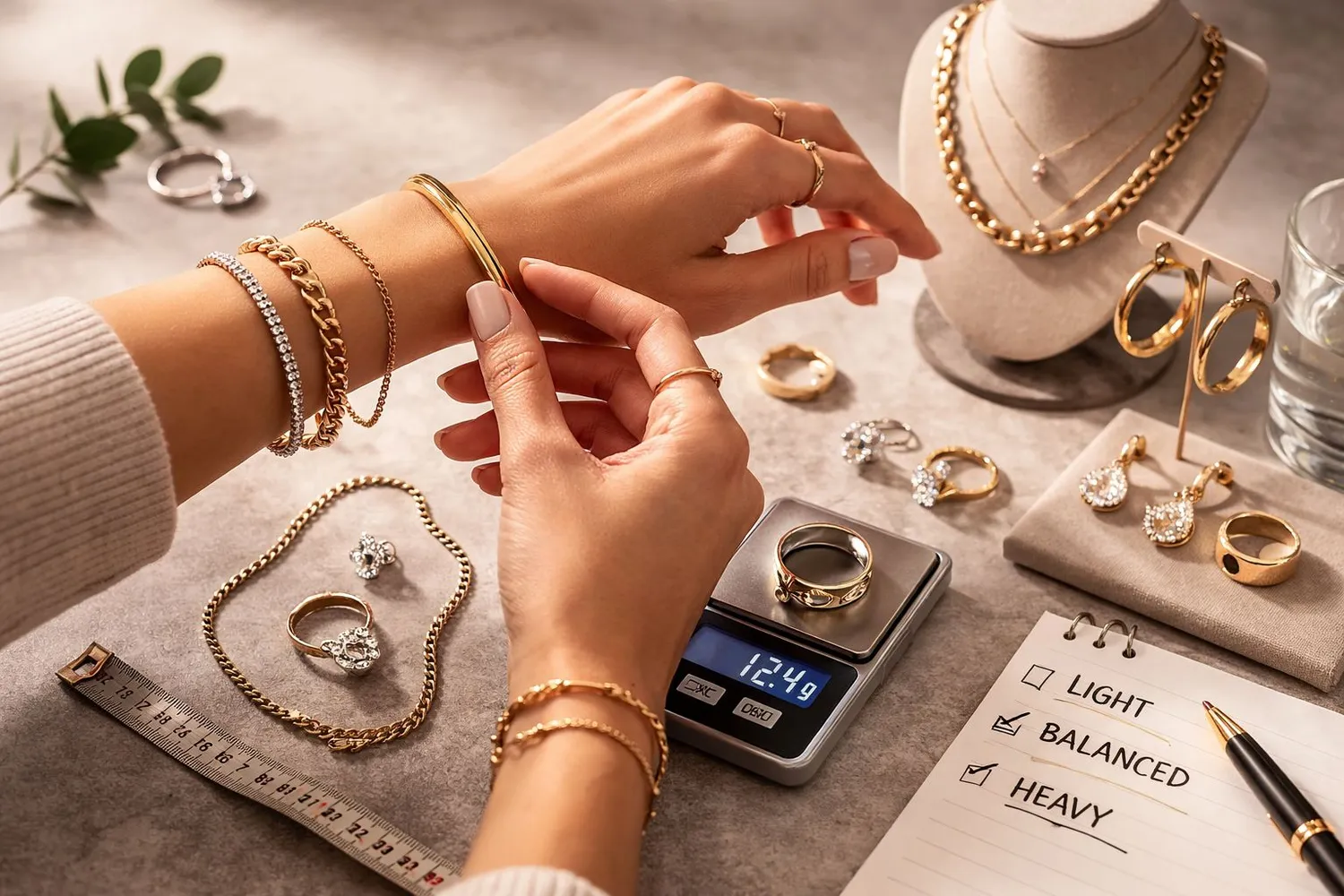
A ring can feel powerful the moment you put it on. It catches the light, changes how you move your hand, makes you glance down a little more often. But there’s a tipping point. What starts as a statement piece can quietly become something you’re constantly adjusting, twisting, or sliding off by mid-afternoon.
Ring weight isn’t just about grams on a scale. It’s about how that weight is distributed, how it interacts with your finger joints, and how your body changes throughout the day and across seasons. If you live in the USA—where climate swings from dry winters to humid summers, and where people often wear rings all day at work—comfort matters more than we admit.
This guide breaks down what “too heavy” really means, what happens to your finger joints under load, and how to balance bold design with everyday wearability.
What Is an Average Comfortable Ring Weight?
There’s no universal number that fits everyone, but there are practical ranges that many jewelers consider comfortable for daily wear.
- Lightweight rings: 2–4 grams
- Moderate weight rings: 4–8 grams
- Heavier statement rings: 8–15+ grams
For most adults, rings under 8 grams are generally comfortable for all-day wear, assuming proper fit and balanced design. Once you move into the 10–15 gram range, comfort depends heavily on band width, stone size, and finger size.
A few key nuances:
- A 10-gram ring on a size 4 finger feels very different than on a size 9.
- A 12-gram ring with a wide, evenly distributed band can feel steadier than a 7-gram ring with a top-heavy stone.
- Hollow construction can reduce weight significantly, but it may compromise durability.
If you’ve ever felt a ring subtly “pull” toward the floor as you walk, that’s weight distribution at work—not just total mass.
How Ring Weight Affects Finger Joints
Your fingers aren’t rigid rods. They have joints, tendons, soft tissue, and small stabilizing muscles. When you wear a heavy ring, especially on the dominant hand, the weight creates downward force and mild torque with movement.
For most healthy adults, a moderately heavy ring won’t cause damage. But here’s what can happen over time:
1. Joint Fatigue
Heavier rings can cause mild fatigue at the base joint (the knuckle closest to your hand). You might notice:
- A slight ache after typing all day
- A feeling of stiffness when making a fist
- The urge to remove the ring in the evening
This isn’t necessarily injury—it’s repetitive strain from carrying weight on a small lever (your finger).
2. Increased Rotation and Friction
When a ring is heavy on top (large stone, cluster setting), it tends to rotate. Constant micro-adjustments mean more friction against skin and knuckle. Over time, this can cause:
- Skin irritation
- Slight indentations
- Callus-like thickening in rare cases
3. Existing Joint Conditions
If someone already has arthritis or joint inflammation, heavier rings can exaggerate discomfort. In these cases, even 6–8 grams may feel like too much.
Safety note: If you experience persistent pain, swelling, numbness, or color changes in the finger, remove the ring and consult a healthcare professional. Jewelry shouldn’t cause ongoing joint pain.
Wide Bands vs. Thin Bands: Weight Feels Different
Two rings can weigh the same but feel completely different depending on band width.
Wide Bands
A wide band spreads pressure across more surface area. That usually means:
- Less “cutting in” feeling
- More stability
- Less spinning (if properly sized)
However, wide bands require slightly larger sizing because they cover more skin and create more friction. In the USA, many jewelers recommend sizing up by about a quarter to half size for bands over 6–8 mm wide.
A heavy wide band (say 9–12 grams) can feel solid but balanced. The weight is distributed around the finger rather than concentrated on top.
Thin Bands
Thin bands concentrate pressure into a narrow strip. That can make even a lighter ring feel sharper against the skin. With heavy stones, thin bands create a lever effect:
- Top-heavy design
- Increased rotation
- Greater pressure at one contact point
This is why a delicate 2 mm band with a large gemstone can feel less stable than a thicker 4 mm band with the same stone.
Common mistake: Choosing a thin band for aesthetic delicacy without considering how it supports the stone’s weight.
Stone-Heavy Designs: Where Weight Becomes Noticeable
The stone often contributes the majority of a ring’s top weight. Larger gemstones or multi-stone cluster designs shift the center of gravity upward.
What that means in practical terms:
- The ring wants to tip forward.
- The underside lifts slightly from the finger.
- You adjust it repeatedly throughout the day.
This is common with cocktail rings and bold engagement-style designs.
Factors that make stone-heavy rings harder to wear:
- Tall settings (high profile above the finger)
- Narrow shanks
- Smooth, rounded undersides that don’t anchor
Ways designers compensate:
- Thicker shanks at the base
- Tapered bands that widen toward the stone
- Hidden counterweights in the lower band
If you’re shopping in-store, don’t just admire the ring in the display case. Wear it for 10–15 minutes. Move your hand naturally. If you’re constantly twisting it back into place, that’s a red flag.
Swelling & Seasonal Factors in the USA
Finger size isn’t static. In the USA, seasonal temperature shifts can noticeably affect ring comfort.
Summer
Warm weather causes mild swelling. In humid regions—like the Southeast—this can be more pronounced. A heavy ring on a slightly swollen finger can feel tight and restrictive.
You may notice:
- Indentations when removing the ring
- Difficulty sliding it off
- Mild throbbing sensation
Winter (Cold & Dry Air)
Cold causes fingers to shrink. A heavy ring that was snug in July may spin in January. Add dry skin, and friction decreases further.
This combination—lighter contact plus heavier top—leads to more rotation.
Daily Fluctuations
Even within one day:
- Sodium-heavy meals
- Exercise
- Dehydration
- Hormonal changes
can alter finger size.
Heavier rings exaggerate these changes. A lightweight band may still feel fine; a 12-gram statement ring might suddenly feel oppressive.
Signs Your Ring Is Too Heavy for Daily Wear
Some discomfort is normal when adjusting to a new piece. But consistent signals matter.
Watch for:
- Regular end-of-day aching
- Redness that lasts more than a few minutes
- Numbness or tingling
- Constant spinning that distracts you
- Removing it as soon as you get home
If you’re only comfortable wearing it for short events, that’s fine. Not every ring has to be all-day jewelry. The issue is mismatching design with your intended use.
Balancing Design and Comfort
You don’t have to give up bold style to stay comfortable. You just need smarter design choices.
1. Focus on Distribution, Not Just Total Weight
A 10-gram ring can feel stable if the weight wraps evenly around the finger. Ask:
- Is the band thick enough to counterbalance the top?
- Does it sit low or high on the finger?
Lower-profile designs generally feel lighter, even when they aren’t.
2. Match Ring Weight to Finger Size
Larger fingers can support heavier rings more comfortably because the surface area and joint structure distribute force more broadly.
Smaller fingers often feel overloaded faster. This isn’t about strength—it’s physics.
3. Consider Hollow vs. Solid Construction
Hollow rings reduce weight significantly. However:
- They may dent more easily.
- Resizing can be limited.
Solid construction feels more substantial and durable but adds weight quickly.
Ask yourself: Is this an everyday ring or occasional wear?
4. Try It During Real Activity
If possible:
- Type on your phone.
- Grip a pen.
- Put your hands in your pockets.
A ring that feels fine while standing still may feel awkward during normal hand use.
5. Account for Climate
If you live in a hot, humid part of the USA, leave slight room for swelling. If you’re in a cold northern state with long winters, ensure it won’t spin excessively when fingers shrink.
Some people keep small ring adjusters for seasonal tweaks.
Wide Statement Rings: Special Considerations
Very wide bands (10 mm and above) create unique challenges:
- Reduced finger flexibility
- Pressure across knuckles
- Difficulty bending fully
These rings often feel comfortable when your hand is relaxed but restrictive when gripping objects.
If choosing a wide statement ring:
- Ensure proper sizing for knuckle clearance.
- Consider slightly rounded interior edges for comfort.
- Avoid overly thick metal if flexibility matters.
When a Statement Ring Is Best as Occasion Wear
Some rings simply aren’t meant for daily wear—and that’s okay.
Cocktail rings, oversized gemstone designs, or heavy sculptural bands may:
- Catch on clothing
- Hit nearby fingers
- Cause fatigue after several hours
If you love the design but it feels tiring by hour four, treat it like formal shoes. Beautiful, intentional, but not everyday.
This reframing helps avoid disappointment. Not every ring needs to be a 24/7 companion.
Practical Buying Checklist
Before purchasing a heavier ring, ask:
- What is the exact weight in grams?
- What is the band width in millimeters?
- Is the construction solid or hollow?
- How high does the stone sit above the finger?
- What is the return or resize policy?
Many jewelers will provide weight if asked. If they don’t know, that’s useful information in itself.
Common Mistakes
- Choosing based on look alone without wearing it for at least 10 minutes.
- Ignoring seasonal swelling.
- Assuming discomfort will “go away” if it persists for weeks.
- Picking an ultra-thin band under a large stone for aesthetic reasons.
- Buying a heavy ring for daily wear without testing during normal hand movement.
Comfort rarely improves if design fundamentals are off.
FAQs
How heavy is too heavy for daily wear?
For many adults, rings above 10–12 grams begin to feel noticeable for all-day use, especially if top-heavy. But individual tolerance varies. Fit and distribution matter more than the raw number.
Can heavy rings damage fingers?
In healthy individuals, occasional wear typically doesn’t cause damage. However, prolonged strain may aggravate existing joint conditions. Persistent pain should not be ignored.
Do men’s rings tend to be heavier?
Often yes, especially wide bands. However, many modern designs use lighter alloys or hollow construction to reduce weight without sacrificing appearance.
Why does my ring feel tighter at night?
Fluid retention, daily activity, and temperature changes can cause mild swelling. Heavier rings can amplify the sensation of tightness.
Is it better to size up for a heavy ring?
Not automatically. Oversizing may increase spinning. Instead, ensure the ring passes over the knuckle comfortably but sits securely at the base of the finger.
Are certain metals heavier?
Yes. Different metals have different densities. For example, platinum is denser than gold, meaning a similarly sized ring can weigh more. If weight is a concern, discuss metal choice with a jeweler.
Final Thoughts
A statement ring should feel intentional—not like something you’re constantly aware of for the wrong reasons.
Weight becomes a burden when it disrupts normal hand movement, causes joint fatigue, or demands continuous adjustment. The solution isn’t always “lighter.” It’s smarter distribution, better sizing, and honest assessment of how you’ll wear it.
Try rings on. Move your hands naturally. Pay attention to subtle discomfort early. A ring can still be bold, sculptural, and eye-catching—without feeling like you’re carrying a small paperweight on your finger all day.
When design and comfort align, you won’t be thinking about the weight. You’ll just enjoy wearing it.