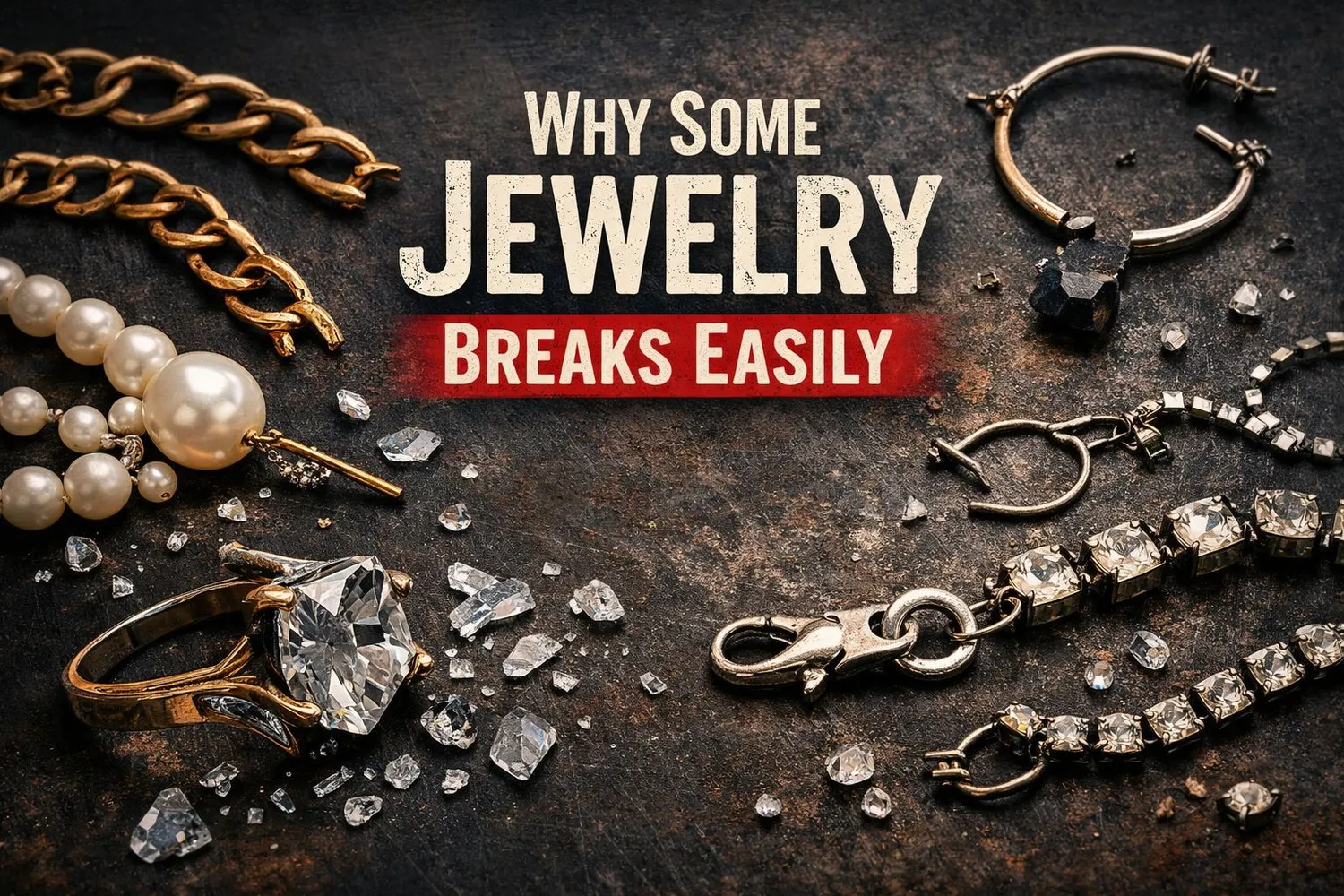
A necklace rarely breaks without warning. The snap might feel sudden, but the failure usually started weeks—or months—earlier. A weak link. A hollow wall too thin to resist bending. A pendant that’s heavier than the chain was built to carry. Add daily friction and a stressed clasp, and something eventually gives.
If you understand how chains are built and how forces move through them, you can predict which styles are durable and which are fragile. This guide walks through the mechanics behind chain breakage, so you can choose—and test—a necklace with fewer surprises.
Types of Chains: How Structure Affects Strength
Different chain styles distribute force in different ways. Some designs share stress evenly across multiple surfaces. Others concentrate it at tiny contact points.
Cable Chain
Cable chains are the simplest design: uniform round or oval links, each interlocked with the next.
Strength profile:
- Depends heavily on wire thickness.
- Stress concentrates at the sides of each individual link.
- If one link fails, the chain separates completely.
Cable chains are reliable when the links are solid and thick enough. Thin versions, especially under 1 mm in diameter, can stretch over time. You’ll often see elongation at the links closest to the clasp or pendant.
Box Chain
Box chains use square-shaped links that interlock in a way that creates a smooth, continuous line.
Strength profile:
- Good resistance to kinking compared to flat chains.
- More surface contact between links than cable chains.
- Can collapse if hollow and thin.
Solid box chains are often stronger than cable chains of the same thickness because of the geometry. However, if they’re hollow, denting becomes the bigger risk.
Rope Chain
Rope chains twist multiple strands into a spiral pattern.
Strength profile:
- Excellent distribution of force across multiple links.
- Redundancy: stress doesn’t rely on one single connection point.
- Harder to repair if severely kinked.
Rope chains tend to be durable when solid. Their twisted structure allows force to spread across many small components instead of one stressed link.
Curb Chain
Curb chains have flattened, interlocking links that lie flat against the skin.
Strength profile:
- Broad contact surfaces reduce localized stress.
- Strong in thicker gauges.
- Thin versions can twist and permanently deform.
Because the links are flattened, curb chains resist rotational movement better than cable chains. But if too thin, they bend instead of flex.
Snake Chain
Snake chains are made from tightly connected plates or bands that form a smooth, flexible tube.
Strength profile:
- Very flexible.
- Vulnerable to kinks.
- Once kinked, often permanently weakened.
Snake chains don’t show visible links, but internally they rely on small, tightly fitted components. A sharp bend can damage internal structure, creating a weak point that later snaps.
Tensile Strength Differences: Metal Matters, But So Does Shape
Tensile strength is the amount of pulling force a material can withstand before breaking. In chains, it’s influenced by:
- Metal type (gold, silver, stainless steel, etc.)
- Alloy composition
- Wire thickness
- Cross-sectional shape
- Whether the chain is solid or hollow
For example, sterling silver is softer than many steel alloys. That doesn’t automatically make a silver chain weak—but it does mean thin silver chains stretch more easily under constant load.
Gold chains vary widely depending on karat. Higher karat gold (like 22K) is softer than 14K because it contains more pure gold and fewer strengthening alloys. Softer metals deform before they snap. Deformation can thin the metal over time, leading to breakage later.
However, shape often matters as much as material. A thicker cable chain in silver may outperform a thin rope chain in gold. The key variable is cross-sectional area. The more metal resisting the pull, the stronger the chain.
If you’re comparing two chains in a store, hold them side by side. The heavier one (assuming similar length and metal type) usually contains more material—and often more strength. Weight isn’t a perfect measure, but it’s a practical clue.
Hollow Chain Risks: Lightweight Isn’t Always Harmless
Hollow chains are manufactured with thin metal walls and empty interiors. They look substantial but weigh much less than solid versions.
The risk isn’t just snapping. It’s deformation.
- Hollow links dent under pressure.
- Dented areas become stress concentrators.
- Once bent, thin walls can crack.
Hollow curb and rope chains are common in fashion jewelry because they provide a bold look at lower cost. But daily wear—especially with pendants—accelerates fatigue.
You can sometimes detect hollow construction by gently tapping the chain on a hard surface. A hollow chain often sounds lighter and less dense than a solid one. This isn’t foolproof, but it’s one informal indicator.
If you want durability for everyday wear, solid construction is generally safer.
Link Design and Stress Distribution
Chains break where stress concentrates. That’s usually:
- At solder joints
- At the thinnest part of a link
- Near the clasp
- Where a pendant slides repeatedly
Each link has a geometry that either spreads force or concentrates it.
Round links distribute stress more evenly than sharply angled links. Square or sharp-cornered designs can create focal points where metal fatigue begins. Over time, microscopic cracks form at these stress points.
Fatigue doesn’t require extreme force. Repeated small movements—walking, turning your head, adjusting clothing—apply micro-load cycles. Metal weakens with repetition, even below its maximum strength.
This is why a necklace can hold fine under a single hard tug but fail during normal daily use months later.
Daily Wear Friction and Metal Fatigue
Chains don’t just experience tension. They experience:
- Abrasion from skin and clothing
- Twisting forces
- Impact when snagged
- Repeated bending near clasps
When a chain rubs against a pendant bail (the loop that holds the pendant), metal gradually wears down. If the pendant bail is narrower or harder than the chain, it can act like a file.
Sweat and environmental exposure can also matter. While not usually enough to cause breakage alone, corrosion in lower-quality alloys can accelerate weakening.
Pay attention to areas that look thinner or slightly discolored. That’s often where wear is happening.
Clasp Weaknesses: The Hidden Failure Point
Many chains don’t break in the middle. They fail at the clasp.
Common clasp issues:
- Spring rings losing tension
- Lobster clasps bending open
- Jump rings not fully soldered
The jump ring—the small circular connector between clasp and chain—is a frequent failure point. If it’s not soldered closed, it can pull apart under tension.
Before buying, check whether the jump ring seam is visibly open. If you can see a gap, that’s a potential weak link.
Clasp size should also match chain weight. A heavy chain with a tiny spring ring is a mismatch. The clasp becomes the bottleneck.
Matching Chain Type to Pendant Weight
A pendant adds constant downward force. If it’s too heavy for the chain:
- Links near the center stretch.
- The chain thins at contact points.
- The necklace breaks at the weakest link.
There’s no universal rule for exact weight ratios because metal type and design vary. But a practical guideline: the chain should look visually proportional to the pendant. If the pendant appears dominant and the chain nearly invisible, the chain is likely undersized.
For heavier pendants, rope or thicker box chains often perform better than ultra-thin cable or snake chains.
Also consider bail size. A tight bail restricts movement and increases friction in one small area.
How to Test Chain Durability Before Purchase
You can’t perform lab tests in a jewelry store, but you can do practical checks:
1. Flex Test
Gently bend the chain between your fingers. It should flex smoothly without stiff spots or sharp kinks.
2. Link Inspection
Use a phone flashlight. Look for:
- Thin solder seams
- Uneven link thickness
- Open jump rings
3. Weight Check
Compare similar-looking chains. A noticeably heavier chain (same metal and length) often has more material.
4. Twist Resistance
Lightly twist and release. It should return naturally without staying deformed.
5. Clasp Pull Test
Gently tug the clasp connection. It shouldn’t separate or widen.
None of these replace professional testing, but they help you avoid obvious weaknesses.
Common Mistakes That Lead to Breakage
- Sleeping in delicate chains
- Wearing thin chains during exercise
- Pairing heavy pendants with fine chains
- Ignoring small bends or kinks
- Assuming “thicker look” means solid construction
Repairing early deformation is cheaper than replacing a snapped chain and potentially losing a pendant.
Edge Cases Worth Considering
Children’s jewelry: Often thinner and more prone to failure under sudden pulling.
Layering multiple chains: Increases friction and tangling stress.
Very short chains (like chokers): Experience more frequent bending due to neck movement.
High-karat gold chains: Softer, more prone to gradual deformation.
Frequently Asked Questions
Why did my chain break even though I never pulled it hard?
Likely fatigue. Repeated small stresses weaken metal over time.
Are thicker chains always stronger?
Usually, but hollow thick chains can be weaker than thinner solid ones.
Is sterling silver too weak for daily wear?
Not inherently. Thickness and construction matter more than metal alone.
Can a jeweler strengthen a weak chain?
They can replace clasps, solder jump rings, or recommend a sturdier chain. They can’t fundamentally change thin link geometry.
How often should I inspect my chain?
Every few months if worn daily. Look closely at clasp areas and pendant contact points.
Is stainless steel stronger than gold?
Many stainless steel alloys have higher tensile strength than gold alloys, but design and thickness still matter.
A necklace snapping feels random, but it’s rarely mysterious. Structure, material, stress distribution, and daily habits all play a role. When you understand how force travels through a chain—and where it concentrates—you can spot weaknesses early and choose designs that match how you actually wear your jewelry.